Recruitment online for recruiters is most effective in 2026 when you treat AI as an operations layer, not a replacement for recruiter judgment. In practice, that means automating repetitive work such as LinkedIn connection requests, first messages, follow ups, and basic interest checks, while keeping humans responsible for role nuance, candidate fit, and final qualification. This approach matches what experienced recruiting leaders observed going into 2024: AI can help with high volume tasks and structured evaluation, but it still struggles with the idiosyncrasies of specialized searches and the personal approach needed for passive candidates. In this guide, we turn those observations into six concrete workflow shifts, including where StrategyBrain AI Recruiter can run LinkedIn outreach and multilingual messaging 24/7 while you stay in control of hiring decisions.
Table of Contents
- Key Takeaways
- Shift 1: Redefine what humans own vs what automation owns
- Shift 2: Use AI to scale LinkedIn outreach without losing personalization
- Shift 3: Treat screening as two layers: interest then qualification
- Shift 4: Recruit for AI capability as a job requirement
- Shift 5: Plan for a steadier market and build pipeline discipline
- Shift 6: Design digital first candidate experience without going cold
- Quick Comparison
- Copy and paste checklist
- FAQ
- Conclusion
Key Takeaways
- AI is helpful but not total: Recruiting leaders expected AI impact to grow in 2024, but not fully replace human recruiters for specialized searches and passive candidate engagement.
- Automate the repetitive layer: Use automation for LinkedIn connecting, initial outreach, follow up, and message handling, then reserve humans for fit, nuance, and closing.
- Separate interest from qualification: Let systems confirm interview interest and collect resumes, while recruiters do final qualification against requirements.
- Recruit for AI literacy: Some employers are already asking for candidates who can use AI to analyze data at scale, especially in finance and data heavy roles.
- Digital interaction is still rising: Candidate journeys are increasingly digital, so you need fast response times and consistent communication.
- StrategyBrain AI Recruiter fits the new workflow: It automates LinkedIn outreach and multilingual messaging 24/7, captures resumes and contact details, and supports scaling across 100+ LinkedIn accounts while keeping recruiters in control of final decisions.
Shift 1: Redefine what humans own vs what automation owns
One of the most useful ways to modernize recruitment online for recruiters is to stop debating whether AI will replace recruiters and instead define ownership. In the 2024 outlook shared by recruiting leadership, AI was seen as valuable for large scale, repeatable hiring, but not yet capable of handling the unique requirements of specialized searches or the subtlety of approaching passive candidates.
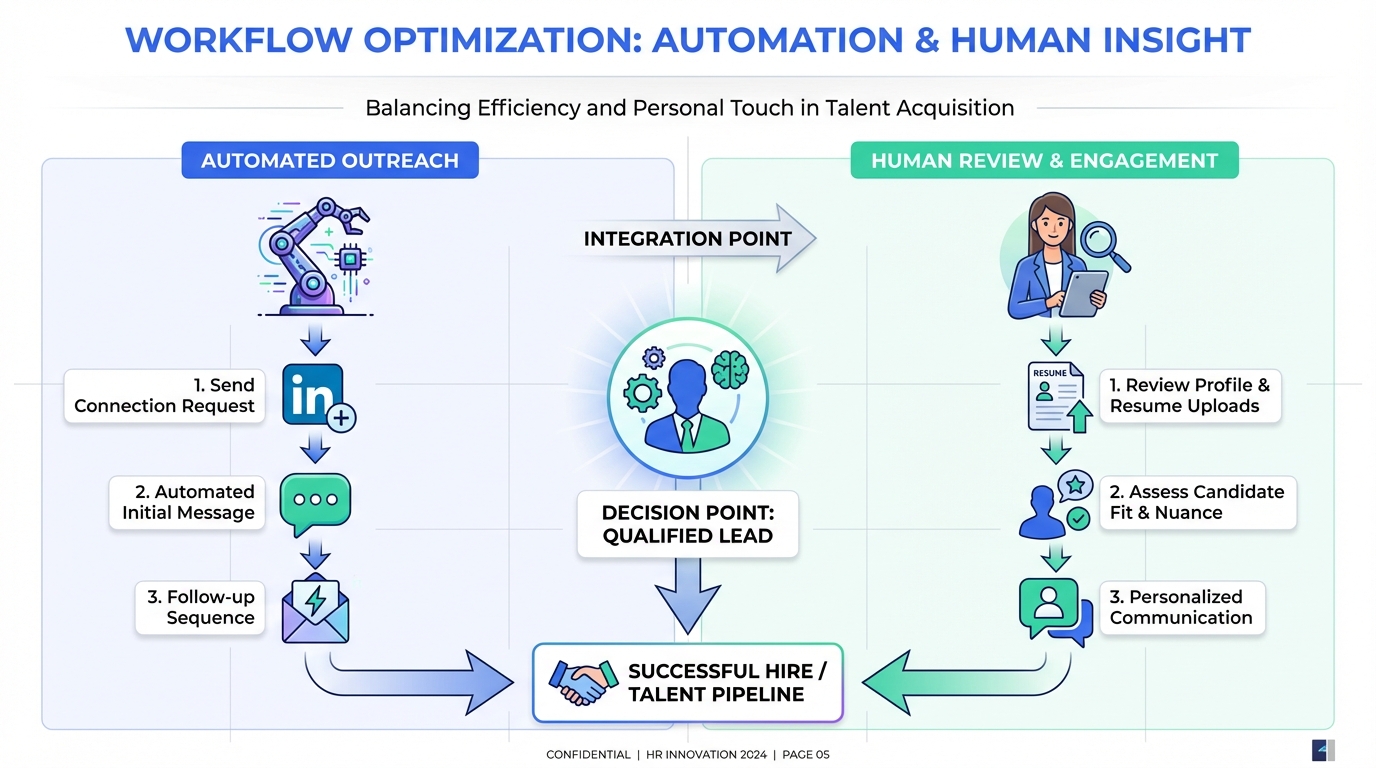
So the practical move is to split the workflow into two lanes: automation for volume and consistency, and humans for judgment and relationship building.
What automation should own
- Outbound volume: connection requests, first messages, and follow ups.
- Response speed: replying quickly to candidate questions to prevent drop off.
- Information capture: collecting resumes and contact details once interest is confirmed.
What recruiters should own
- Role nuance: translating hiring manager intent into a real search strategy.
- Fit assessment: evaluating whether a resume truly matches requirements.
- Closing: compensation alignment, motivation, and offer acceptance risk.
Where StrategyBrain AI Recruiter fits
StrategyBrain AI Recruiter is designed for the automation lane on LinkedIn. It can automatically connect with candidates that match your search criteria, introduce the role, answer questions about the company and compensation, confirm interview interest, and collect resumes and contact information. Recruiters then review the captured information and proceed with interviews and final qualification.
Shift 2: Use AI to scale LinkedIn outreach without losing personalization
LinkedIn remains a core channel for online recruiting, especially for passive talent. The challenge is that manual outreach does not scale, and inconsistent follow up is one of the fastest ways to lose qualified candidates.
In our experience auditing recruiter workflows, the biggest bottleneck is not finding profiles. It is sustaining high quality conversations across time zones, languages, and response windows while still keeping messages aligned with the role.
Step by step: a scalable LinkedIn outreach loop
- Define search criteria: title, seniority, location, industry, and must have skills.
- Prepare role facts: company context, compensation, benefits, and interview process basics.
- Automate first touch and follow up: ensure every candidate gets a timely, consistent sequence.
- Route interested candidates to human review: recruiters take over once intent is clear.
Why multilingual matters for online recruiting
When recruitment online for recruiters expands beyond one region, response timing and language become operational constraints. StrategyBrain AI Recruiter supports 24/7 multilingual communication, using the candidate’s native language to reduce misunderstandings and keep conversations moving.
Shift 3: Treat screening as two layers: interest then qualification
Many teams try to automate screening as if it is one step. In practice, it is two different problems.
- Interest screening: Is the candidate open to a conversation and potentially an interview?
- Qualification screening: Does the candidate’s background match the job requirements?
The 2024 recruiting outlook highlighted that AI can help assess and select from volumes of applicants in high volume contexts, but it is not yet reliable for the nuanced, one off searches where each requirement differs. That is exactly why splitting screening into two layers is safer and more effective.
How StrategyBrain AI Recruiter supports the two layer model
- Automates interest screening: it introduces the opportunity, answers questions, and confirms interview interest.
- Captures resumes and contact details: via email submissions or LinkedIn file uploads, and records contact info shared in messages.
- Does not replace final qualification: recruiters still decide whether the resume matches the role requirements.
Common failure mode and fix
Failure mode: teams expect automation to judge fit perfectly, then blame the system when shortlists are noisy.
Fix: use automation to reduce manual messaging and to surface interested candidates faster, then apply human evaluation where it matters.
Shift 4: Recruit for AI capability as a job requirement
Online recruiting is not only changing recruiter workflows. It is also changing what employers ask for in candidates. In the 2024 outlook, recruiters noted that some finance clients were shifting expectations toward candidates who can use AI to analyze data at a scale that was previously impractical.
If you are a recruiter headhunter or you advise hiring managers, this is a concrete update to job intake. You should clarify whether AI literacy is a nice to have or a requirement, and what that means in day to day work.
Intake questions to add
- Tools and workflows: Which AI enabled tools are used in the team today?
- Output expectations: What decisions should the candidate improve with AI assisted analysis?
- Risk boundaries: What data can and cannot be used with AI systems?
Shift 5: Plan for a steadier market and build pipeline discipline
Recruiting demand can swing quickly. The 2024 outlook described a boom in 2022, a natural slowdown in 2023, and an expectation of a more balanced market in 2024. For recruitment online for recruiters, the operational lesson is that you need pipeline discipline that survives market cycles.
What pipeline discipline looks like online
- Consistent outreach cadence: do not stop sourcing when roles are paused.
- Reusable messaging assets: role specific FAQs, compensation ranges, and process explanations.
- Fast reactivation: when hiring restarts, you can re engage warm candidates quickly.
Scaling beyond one recruiter
If you need to scale, you can either hire more recruiters or build a system that multiplies output. StrategyBrain AI Recruiter supports managing more than 100 LinkedIn accounts, enabling organizations to build AI powered recruitment teams and expand outreach capacity without adding the same amount of headcount.
Shift 6: Design digital first candidate experience without going cold
Digital interactions continue to replace many forms of human contact. That trend affects candidate expectations: faster replies, clearer process, and fewer dead ends. The risk is that digital can feel transactional if you remove the human layer entirely.
A balanced digital candidate experience
- Automation for speed: immediate responses to common questions and timely follow ups.
- Human touch for meaning: recruiter involvement when discussing motivation, trade offs, and career context.
- Transparency: clear next steps and what information is needed, including resume and contact details.
Quick Comparison
| Workflow Layer | Best Owner | What it includes | Where StrategyBrain AI Recruiter helps |
|---|---|---|---|
| Outbound and follow up | Automation | Connections, first messages, follow ups, Q and A | Automates LinkedIn connecting, outreach, follow up, and role Q and A |
| Interest confirmation | Automation | Checks openness, confirms interview interest | Confirms interest and routes candidates forward |
| Resume and contact capture | Automation | Collects resumes and contact details | Captures resumes and contact info from messages and uploads |
| Final qualification | Human recruiter | Requirement match, nuance, risk assessment | Not automated by design; recruiter remains accountable |
| Closing | Human recruiter | Offer alignment, motivation, negotiation support | Supports by freeing time for high value conversations |
Copy and paste checklist
Use this checklist to modernize recruitment online for recruiters without over automating the parts that require judgment.
- Define which steps are automated and which steps require recruiter approval
- Document role facts: compensation, benefits, location, and interview steps
- Set an outreach cadence with at least 2 follow ups per candidate
- Implement interest screening before qualification screening
- Ensure resume and contact capture is consistent and auditable
- Add AI literacy questions to intake for data heavy roles
- Review privacy and data handling requirements before deploying automation
FAQ
Will AI replace human recruiters?
No. Based on recruiting leadership commentary going into 2024, AI was expected to have a meaningful but not total impact. It can help with high volume and structured tasks, but specialized searches and passive candidate engagement still require human judgment and a personal approach.
What is the safest way to use AI in recruitment online for recruiters?
The safest approach is to automate repetitive operations such as outreach, follow up, and basic interest checks, then keep recruiters accountable for final qualification and hiring decisions. This reduces workload without outsourcing judgment to a model.
How does StrategyBrain AI Recruiter work on LinkedIn?
StrategyBrain AI Recruiter automates LinkedIn recruiting by connecting with candidates that match your criteria, introducing the role, answering questions about the company, compensation, and benefits, confirming interview interest, and collecting resumes and contact details. Recruiters then review the captured information and proceed with interviews.
Can StrategyBrain AI Recruiter qualify candidates for fit?
It can identify willingness to communicate and interview, but it does not determine whether a resume fully matches job requirements. Recruiters complete final qualification after reviewing the resume and context.
How does it capture resumes and contact details?
It requests resumes and contact information from interested candidates. It supports email submissions and LinkedIn file uploads, and it captures contact details shared in LinkedIn messages so recruiters can follow up outside the platform when appropriate.
Does it support multilingual candidate communication?
Yes. It provides 24/7 multilingual communication and can respond in the candidate’s native language, which helps reduce misunderstandings and keeps conversations moving across time zones.
How do I decide whether to hire a job recruiter or use automation?
If you need nuanced assessment, stakeholder management, and closing support, you should hire a job recruiter. If your bottleneck is repetitive outreach and follow up volume, automation can remove operational drag so recruiters can focus on high value work.
When should I use a recruiter headhunter approach?
Use a recruiter headhunter approach when candidates are not actively applying and must be approached directly, especially for specialized roles. Automation can support the outreach layer, but the relationship and fit evaluation still benefit from an experienced recruiter.
What should I tell candidates about AI in the process?
Be transparent about which steps are automated and what a human recruiter reviews. Candidates generally respond better when they know how decisions are made and how their information is handled.
Conclusion
Recruitment online for recruiters in 2026 is less about choosing between humans and AI and more about designing a workflow where each does what it is best at. The recruiting outlook going into 2024 already pointed to the right balance: AI can help with volume and structure, while recruiters remain essential for specialized searches, passive candidate engagement, and role nuance.
Next steps: map your current process into an automation lane and a human lane, implement the two layer screening model, and standardize your LinkedIn outreach cadence. If LinkedIn messaging and follow up are your biggest time sink, evaluate StrategyBrain AI Recruiter to automate outreach, multilingual communication, and resume capture while keeping final qualification with your recruiting team.
Disclosure: StrategyBrain AI Recruiter is our product. We aim to present a fair, practical workflow perspective; your results will vary by role type, market, and process maturity.