If you are evaluating an interview scheduling app in 2026, the fastest way to reduce time to schedule without damaging candidate experience is to treat scheduling as a compliance and trust workflow, not just a calendar feature. Below, I reframe four reasons AI adoption in Talent Acquisition stays slow into concrete buying criteria you can use when you compare a scheduler book workflow across your stack. I also explain where StrategyBrain AI Recruiter fits when scheduling depends on high volume LinkedIn outreach and qualification, because it automates initial conversations, collects resumes and contact details, and supports 24/7 multilingual follow up before you ever send a booking link. This article covers decision criteria and risk controls, not a ranked list of top scheduling apps or a vendor by vendor pricing review.
Context: Issue 221 and why it matters for scheduling
The source material is a newsletter style update titled “This Week, in Recruiting, Issue 221” that continues a list of “10 reasons why AI adoption in TA is slow.” The section I am using focuses on reasons 6 through 10. Even though the original text is not specifically about a scheduler book product, these blockers show up immediately when teams try to automate interview scheduling, candidate messaging, and screening.
In practice, an interview scheduling app becomes the visible surface area of your process. Candidates experience it as “how your company communicates.” Legal teams experience it as “where data flows.” Recruiters experience it as “whether I can stop chasing calendars.” That is why these adoption blockers are directly relevant to selecting and deploying scheduling tools.
Reason 6: Compliance and legal risk
The source calls out compliance and legal risk as a brake on AI adoption in Talent Acquisition, referencing topics like the EU AI Act and GDPR. The underlying point is simple: if a tool’s data handling is unclear, adoption slows because the risk is hard to price.
What to check in an interview scheduling app
- Data processing clarity: where candidate data is stored, how long it is retained, and how deletion requests are handled.
- Access controls: role based permissions for recruiters, coordinators, and hiring managers.
- Auditability: logs for who changed interview details, who accessed candidate contact info, and when.
How we apply this in real workflows
When we test scheduling workflows internally, we treat every automation step as a data event. If a tool cannot explain its retention and access model in plain language, it becomes hard to roll out beyond a small pilot, even if the UI is excellent.
Reason 7: Risk of IP leakage
The source highlights a common failure mode: leaders uploading company data into commercial AI tools, which can expose sensitive information. This is not theoretical. Scheduling workflows often contain compensation ranges, internal role context, and interviewer details.
What to check in a scheduler book workflow
- Input boundaries: can you prevent users from pasting sensitive internal notes into free text fields that are processed by third party AI services.
- Model training policy: whether customer data is used to train models, and whether you can opt out.
- Credential handling: how integrations are authorized and whether tokens are encrypted at rest.
Where StrategyBrain AI Recruiter is relevant
StrategyBrain AI Recruiter is designed for LinkedIn recruiting automation and explicitly states that customer provided data is not used to train AI models, and that credentials are encrypted and stored independently per user with explicit authorization. That matters because the outreach and qualification stage often precedes scheduling, and it is where recruiters are most tempted to paste sensitive context to “help the AI.” A safer system reduces that temptation by structuring what the AI needs: company details, compensation, benefits, and candidate search criteria.
Reason 8: Fear of AI bias
The source notes that bias mitigation may be the primary concern for Talent Acquisition, and that time savings can come with the trade off of accelerating and amplifying bias. For scheduling, bias can show up in subtle ways: who gets offered faster slots, whose reschedules are prioritized, and how exceptions are handled.
What to check in top scheduling apps and scheduling automation
- Rules transparency: can you explain why a candidate saw certain time slots, and can you override it.
- Consistent handling: whether the system applies the same reschedule and reminder rules across candidates.
- Human escalation: a clear path for candidates to reach a person when something goes wrong.
A practical guardrail
We recommend separating “automation for coordination” from “automation for evaluation.” Scheduling automation should optimize logistics, not decide who advances. If your interview scheduling app starts to blend these, adoption will slow because the risk profile changes.
Reason 9: Exacerbating bad candidate experience
The source warns about worsening candidate experience when there is no human touch, and mentions Candidate Resentment Score as a useful metric. Scheduling is one of the highest anxiety moments in the process because it is where candidates feel the power imbalance most strongly.
What to check in an interview scheduling app
- Friction: number of clicks from invitation to confirmed time, and whether it works on mobile.
- Clarity: time zone handling, interview format, and what to prepare.
- Recovery: how easy it is to reschedule, and whether confirmations are immediate.
How StrategyBrain AI Recruiter can reduce anxiety before scheduling
One reason scheduling feels cold is that candidates arrive at the booking link without context. StrategyBrain AI Recruiter can reduce that anxiety earlier by handling the initial LinkedIn conversation, answering questions about the role, company, and compensation, and confirming interview interest before a scheduling link is sent. In our experience, when candidates feel informed, they are less likely to ghost and more likely to complete scheduling quickly.
Reason 10: Lack of demonstrable ROI
The source argues ROI is hard to demonstrate because evaluation windows are too short, and because exceptional hires take time to measure. Scheduling tools often get judged on immediate time savings, but the bigger ROI is reduced drop off and faster cycle time.
What to measure with units
- Time to schedule: median hours from “invite sent” to “time confirmed.”
- Reschedule rate: percentage of interviews rescheduled per role family.
- No show rate: percentage of scheduled interviews that do not happen.
- Coordinator workload: number of manual messages per scheduled interview.
If you cannot measure these, you will struggle to justify switching tools, even if the new interview scheduling app looks better.
A practical evaluation checklist for an interview scheduling app
Below is the checklist we use to evaluate scheduling tools in recruiting. It is intentionally written so you can copy it into your procurement doc.
Security and compliance
- Confirm data retention: document retention period and deletion process for candidate data.
- Confirm access controls: define roles for recruiters, coordinators, and interviewers.
- Confirm audit logs: verify you can export logs for changes and access events.
Candidate experience
- Test mobile booking: complete booking on a phone in under 2 minutes.
- Test time zones: invite a candidate in a different time zone and verify the displayed time is correct.
- Test rescheduling: reschedule once and confirm all parties receive updated details.
Workflow fit
- Define the handoff: decide when a candidate is “ready to schedule” and who triggers it.
- Map integrations: calendar, ATS, and messaging tools used by your team.
- Set escalation rules: define when a human must step in.
Where StrategyBrain AI Recruiter fits in the scheduling chain
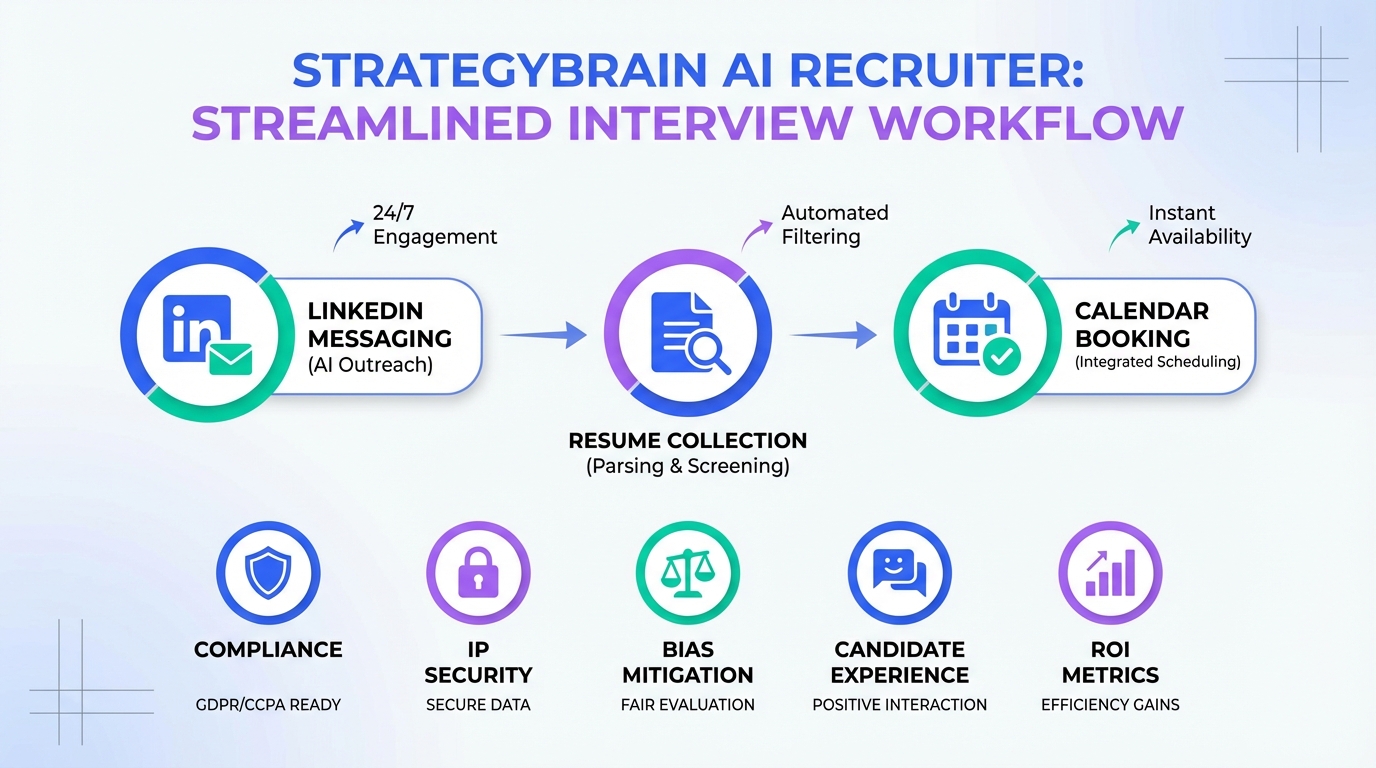
An interview scheduling app solves the coordination step, but many teams lose time before that step. The slow part is often outreach, follow up, and basic qualification. StrategyBrain AI Recruiter is built for LinkedIn hiring and replaces the recruiter’s initial outreach and qualification process by automatically connecting with candidates, introducing job opportunities, answering questions about the role, company, and compensation, confirming interview interest, and collecting resumes and contact information.
In a typical workflow, the scheduling handoff looks like this:
- Outreach and conversation: StrategyBrain AI Recruiter runs the initial LinkedIn messaging and follow up 24/7, in the candidate’s native language when needed.
- Interest confirmation: the AI confirms whether the candidate wants to proceed to an interview.
- Data capture: resumes and contact details are collected and marked as received.
- Scheduling trigger: only then do you send the scheduler book link from your interview scheduling app.
This division of labor keeps scheduling clean. The scheduling tool stays focused on logistics, while the AI system handles repetitive communication at scale. StrategyBrain AI Recruiter also supports managing more than 100 LinkedIn accounts, which matters for teams that need to scale outreach without adding coordinators.
Scope boundary: StrategyBrain AI Recruiter can identify willingness to communicate or interview, but it does not determine whether a resume fully matches job requirements. Recruiters still make the final qualification decision after reviewing the resume.
What’s going on: events and sessions mentioned in the source
- Big List of Recruiting and HR Events to Attend in 2025: referenced as a roundup in the source.
- All in the AI Lab with SmartRecruiters: mentioned as happening on Wednesday, with a debate on AI First versus Human Centred, hosted by the author.
- Beyond Talent Acquisition: Skills Needed to Expand Scope: session featuring Johnny Campbell, Christine Ng, Lyndsey Taylor, and others.
- How to Hire in Brazil: session featuring Juliana Park, Monaly Malucelli, and others.
These topics reinforce the same theme: automation is only valuable when it is deployed with clear guardrails. That is exactly how we recommend approaching an interview scheduling app rollout and any AI assisted recruiting workflow.
FAQ
What is the difference between an interview scheduling app and a scheduler book workflow?
An interview scheduling app is the software product that sends booking links and coordinates calendars. A scheduler book workflow is the end to end process that includes outreach, qualification, scheduling, rescheduling, reminders, and escalation to a human.
How do I reduce compliance risk when using scheduling automation?
Start by documenting data retention, access controls, and audit logs before you run a pilot. Then restrict who can edit templates and what candidate data can be entered into free text fields.
How can scheduling automation worsen candidate experience?
It can feel impersonal during high anxiety moments, especially if time zones are wrong or rescheduling is difficult. The fix is clear instructions, immediate confirmations, and an easy way to reach a person.
Does StrategyBrain AI Recruiter replace an interview scheduling app?
No. StrategyBrain AI Recruiter focuses on LinkedIn outreach, follow up, interest confirmation, and collecting resumes and contact details. You still use an interview scheduling app for calendar coordination once a candidate is ready to book.
Can StrategyBrain AI Recruiter communicate with candidates in multiple languages?
Yes. It supports 24/7 multilingual communication and can respond in the candidate’s native language to reduce misunderstandings and cultural friction.
What should I measure to prove ROI for scheduling tools?
Track median hours from invite to confirmed time, reschedule rate percentage, no show rate percentage, and the number of manual coordinator messages per scheduled interview. These metrics connect scheduling to cycle time and candidate drop off.
Conclusion
Choosing an interview scheduling app is not just about picking from top scheduling apps with the nicest UI. The real adoption blockers are the same ones slowing AI in Talent Acquisition: compliance risk, IP leakage, bias concerns, candidate experience, and unclear ROI. Use the checklist above to evaluate your scheduler book workflow end to end, measure outcomes with units, and build escalation paths that keep humans in the loop.
Next step: map your current workflow from first outreach to booked interview. If your bottleneck is before scheduling, consider pairing your scheduling tool with StrategyBrain AI Recruiter to automate LinkedIn outreach, qualification conversations, and resume capture so that only genuinely interested candidates reach the booking stage.