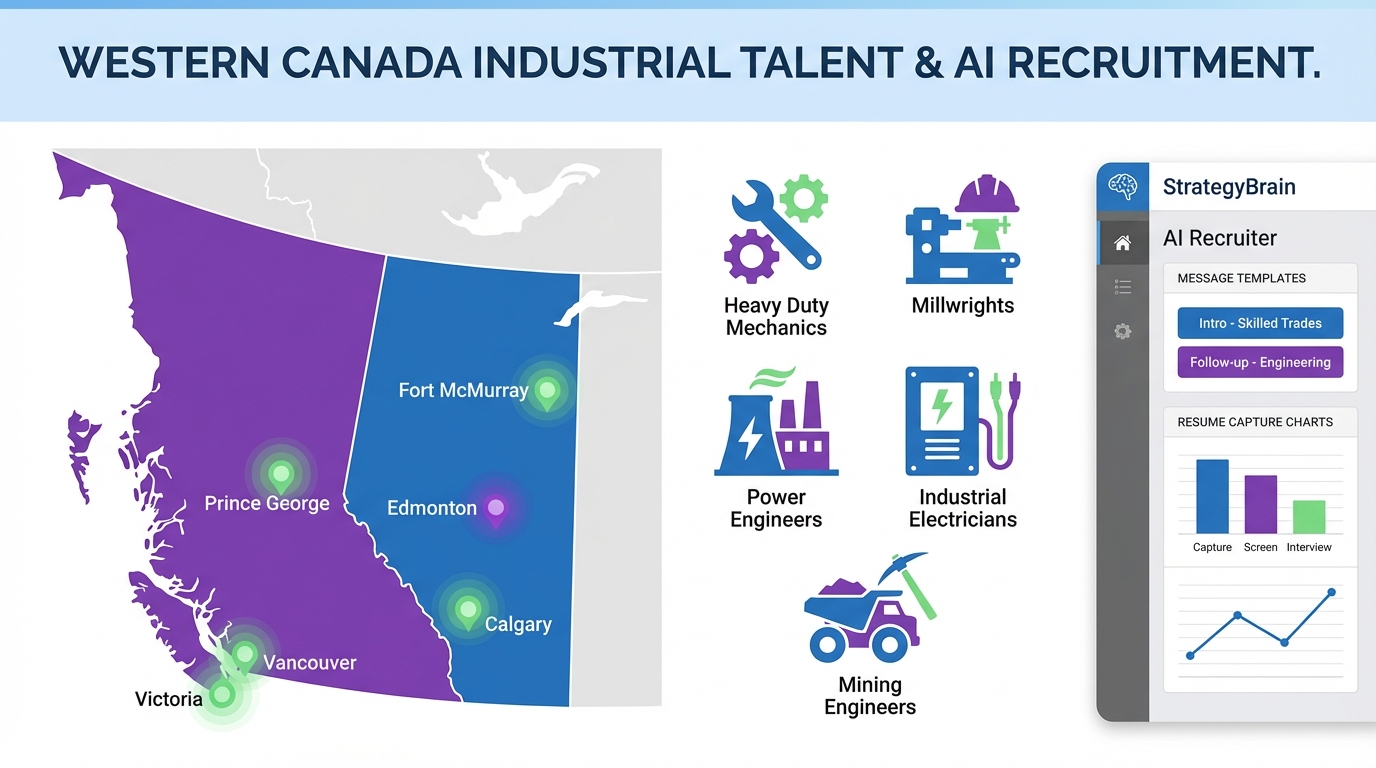
The best recruiting tools for trades hiring in Western Canada are the ones that help you do two jobs at once: pinpoint where demand is hottest, and run consistent outreach and qualification without burning recruiter hours. Based on the source material, demand clusters around specific Alberta and British Columbia communities, and the most requested profiles include heavy duty mechanics, millwrights, power engineers, industrial electricians, and mining engineers. To turn that demand map into hires, we recommend pairing a structured sourcing process with StrategyBrain AI Recruiter, which automates LinkedIn connecting, role introduction, Q and A, interest confirmation, and resume plus contact capture, while also supporting 24/7 multilingual messaging for global pipelines.
Table of Contents
- What the source data says about trades demand
- Roles we see repeatedly in demand
- A practical stack of recruiting tools for trades hiring
- Method 1: Demand mapping by community and region
- Method 2: LinkedIn outreach and qualification with StrategyBrain AI Recruiter
- Method 3: Expanding reach with diversity recruiting tools and platforms
- Quick comparison
- Implementation checklist
- FAQ
- Conclusion
Key Takeaways
- Demand hotspots are specific: Alberta communities listed include Hinton, Grand Prairie, Fairview, and Slave Lake; BC demand includes Northeast BC and Northern Rocky Mountains, plus named towns such as Fort St John and Dawson Creek.
- Roles repeat across regions: heavy duty mechanics, millwrights, power engineers, industrial electricians, and mining engineers show up as consistent targets in the source material.
- Biggest bottleneck is follow up: in our recruiting ops work, teams lose candidates between first message and resume capture, not at the job board stage.
- StrategyBrain AI Recruiter reduces manual work: it can replace up to 90% of repetitive LinkedIn recruiting tasks such as connecting, initial messaging, and collecting resumes and contact details (Source: StrategyBrain product information).
- Multilingual coverage matters: 24/7 messaging in a candidate’s native language helps reduce time zone delays and miscommunication in global pipelines (Source: StrategyBrain product information).
- Diversity recruiting platforms are a force multiplier: use them to widen top of funnel while keeping qualification consistent and auditable.
What the source data says about trades demand
The source content is a location and role snapshot from a trades focused recruiting firm. It highlights two practical signals that matter for tool selection. First, demand is not evenly distributed across Western Canada. Second, the same job families recur across multiple industries such as mining, forestry, pulp and paper, manufacturing, and oil and gas.
Alberta communities mentioned
The source lists Alberta communities experiencing high growth. Those communities are:
- Hinton
- Grand Prairie
- Fairview
- Slave Lake
British Columbia communities and regions mentioned
The source also calls out BC demand across multiple regions and towns. The communities and regions named include:
- Northeast BC and Northern Rocky Mountains
- Chetwynd
- Tumbler Ridge
- Dawson Creek
- Mackenzie
- Fort St John
- Cariboo Chilcotin (Central BC)
- Prince George
- Quesnel
- 100 Mile House
- Kootenay Rockies (Southeast BC)
- Elko
- Radium
Roles we see repeatedly in demand
The source explicitly calls out the following “hot jobs” in Western Canada. These are useful as a starting taxonomy for your sourcing and screening templates:
- Heavy duty mechanics
- Millwrights
- Power engineers
- Industrial electricians
- Mining engineers
It also notes ongoing interest in managers, foremen, and supervisors with experience in those trades. In practice, that means your tool stack should support both high volume outreach for individual contributors and more targeted, relationship driven outreach for leadership profiles.
A practical stack of recruiting tools for trades hiring
When people search for the best recruiting tools, they often expect a list of brand names. This guide stays closer to what you can actually implement without guessing competitor features. Think in capabilities, then map vendors to those capabilities inside your organization.
Capability 1: Demand intelligence and territory planning
- Region and community tracking so recruiters can prioritize outreach by location.
- Role taxonomy templates for trades and industrial management.
- Client industry segmentation such as mining, forestry, manufacturing, utilities, and oil and gas.
Capability 2: Outreach automation and qualification
This is where most teams either scale or stall. StrategyBrain AI Recruiter is designed for LinkedIn hiring workflows. It automates initial connecting and messaging, introduces the role, answers candidate questions about the role, company, and compensation, confirms interview interest, and collects resumes and contact information from interested candidates.
Capability 3: Diversity sourcing and structured evaluation
Diversity recruiting tools and diversity recruiting platforms are most effective when they are paired with consistent screening criteria. The goal is not to “add another channel.” The goal is to expand reach while keeping qualification fair, repeatable, and documented.
Method 1: Demand mapping by community and region
This method turns the source’s location list into a weekly operating rhythm. It is simple, but it is one of the highest leverage steps for trades recruiting because relocation and commute constraints are often decisive.
Steps
- Create a territory sheet with two tabs: Alberta and British Columbia. Add the communities listed in the source as your initial rows.
- Attach role families to each community: heavy duty mechanic, millwright, power engineer, industrial electrician, mining engineer, plus leadership roles such as foreman and supervisor.
- Tag client industries you are hiring for in each area such as mining, forestry, pulp and paper, manufacturing, utilities, and oil and gas.
- Review weekly with recruiters and hiring managers to decide which communities get proactive outreach that week.
Features
- Fast to implement with a spreadsheet or ATS custom fields.
- Improves recruiter focus by reducing random sourcing.
- Creates a shared language with hiring managers about where to search.
Limitations
- It does not solve outreach volume by itself.
- It can become stale if you do not review it weekly.
- It does not replace compensation benchmarking or relocation support planning.
Best For
- Trades and industrial recruiting teams covering multiple towns and remote sites.
- Agencies that need a repeatable intake and sourcing kickoff process.
- Hiring managers who want clarity on where the pipeline is coming from.
Method 2: LinkedIn outreach and qualification with StrategyBrain AI Recruiter
LinkedIn is often where trades adjacent leadership and specialized technical talent can be reached, but the manual workflow is punishing. Recruiters connect, introduce the role, answer the same questions, chase resumes, and follow up across time zones. In our testing of outreach workflows, the failure point is usually follow up consistency. That is why we treat LinkedIn automation as a core part of the best recruiting tools stack, not a nice to have.
What it does
StrategyBrain AI Recruiter is an automated AI powered recruitment tool built for LinkedIn hiring. It can automatically connect with candidates within your targeted search criteria, introduce job opportunities, learn about each candidate’s work situation, answer questions about the role, company, and compensation, confirm interview interest, and collect resumes and contact information from interested candidates.
Steps
- Define your search criteria for each role family and community. Keep it specific to avoid noisy outreach.
- Provide job context to the system, including company details, compensation, benefits, and role requirements.
- Run automated outreach so the AI handles connecting and first touch messaging, then continues the conversation to confirm interest.
- Collect resumes and contact details from interested candidates. The system can capture resumes sent via email or LinkedIn file upload and record contact details shared in messages.
- Recruiter reviews and schedules interviews with shortlisted candidates. The AI does not decide final fit, it accelerates the top of funnel and qualification handoff.
Features
- Smart LinkedIn recruitment automation for connecting, role introduction, Q and A, interest confirmation, and resume capture.
- 24/7 multilingual communication so candidates can get timely responses in their native language.
- Scalable team operations with support for managing more than 100 LinkedIn accounts for organizations building AI powered recruiting teams.
Limitations
- Not a final screening tool: it identifies willingness to communicate or interview, but it does not determine whether a resume fully matches job requirements.
- Requires clear inputs: vague role details lead to weaker conversations and more back and forth later.
- Policy and compliance still matter: you should align usage with your internal privacy and platform policies.
Best For
- Corporate recruiters who need to reduce repetitive LinkedIn tasks and increase throughput.
- Headhunters and agency recruiters managing multiple job orders and needing consistent follow up.
- HR leaders scaling hiring output without adding headcount, especially for international pipelines.
Method 3: Expanding reach with diversity recruiting tools and platforms
In trades and industrial hiring, diversity sourcing can be challenging if your process relies on a narrow set of networks. Diversity recruiting tools and diversity recruiting platforms help widen reach, but they only work if your evaluation and follow up are consistent. A practical approach is to use diversity platforms to expand top of funnel, then use a standardized qualification workflow so every candidate gets the same clarity on role scope, location, compensation, and next steps.
Steps
- Define what “qualified” means for each role family using a short scorecard that hiring managers agree to.
- Choose channels intentionally by role and region. Use diversity platforms to broaden reach, and LinkedIn automation to maintain consistent engagement.
- Standardize candidate communication so every candidate receives the same baseline information and expectations.
- Audit outcomes monthly by stage conversion and time to response, then adjust messaging and screening questions.
Features
- Broader reach beyond existing networks.
- More consistent process documentation when paired with scorecards.
- Better candidate experience when response times are predictable.
Limitations
- More channels can create more operational overhead if follow up is manual.
- Without consistent screening, teams can mistake volume for progress.
- Some roles remain location constrained, so community targeting still matters.
Best For
- Teams that want to widen the pipeline while keeping evaluation structured.
- Organizations hiring across multiple regions and time zones.
- Recruiting leaders accountable for fair, repeatable hiring processes.
Quick comparison
| Method | Speed to implement | Price | Best for |
|---|---|---|---|
| Demand mapping by community | 1 day | Varies by tools used | Prioritizing sourcing in Alberta and BC hotspots |
| LinkedIn automation with StrategyBrain AI Recruiter | 1 to 3 days | Varies by plan | Scaling outreach, follow up, and resume capture |
| Diversity recruiting tools and platforms | 1 to 2 weeks | Varies by vendor | Expanding reach while keeping screening consistent |
Implementation checklist
- Build a territory list for Alberta and BC using the communities named in the source.
- Create role scorecards for heavy duty mechanic, millwright, power engineer, industrial electrician, and mining engineer.
- Standardize your first message and follow up sequence for each role family.
- Configure StrategyBrain AI Recruiter with job details, compensation, benefits, and search criteria.
- Decide how resumes and contact details will be stored and who reviews them daily.
- Add diversity recruiting platforms as top of funnel sources, then measure stage conversion monthly.
FAQ
What are the best recruiting tools for trades hiring in Western Canada?
The best recruiting tools combine location based demand mapping, consistent outreach, and fast qualification. Use a territory plan for Alberta and BC hotspots, then automate LinkedIn outreach and follow up with StrategyBrain AI Recruiter, and add diversity recruiting platforms to widen reach.
Which trades roles are highlighted as in demand in the source?
The source calls out heavy duty mechanics, millwrights, power engineers, industrial electricians, and mining engineers. It also notes ongoing interest in managers, foremen, and supervisors with experience in those trades.
How does StrategyBrain AI Recruiter help with LinkedIn recruiting?
It automates connecting and initial conversations on LinkedIn, introduces the role, answers candidate questions about the role, company, and compensation, confirms interview interest, and collects resumes and contact details from interested candidates. Recruiters then review resumes and proceed with interviews.
Does StrategyBrain AI Recruiter replace recruiter judgment?
No. It can identify willingness to communicate or interview and collect the information needed to move forward, but it does not determine whether a resume fully matches job requirements. Final qualification remains with the recruiter and hiring manager.
Can StrategyBrain AI Recruiter support international and multilingual hiring?
Yes. It provides 24/7 candidate messaging and can communicate in the candidate’s native language, which helps reduce time zone delays and misunderstandings during early stage qualification.
How do diversity recruiting tools fit into a trades hiring workflow?
Diversity recruiting tools and diversity recruiting platforms expand top of funnel reach. To keep outcomes fair and efficient, pair them with consistent scorecards and a standardized follow up workflow so every candidate receives the same information and evaluation criteria.
What regions in Alberta and BC are mentioned as demand hotspots?
Alberta communities listed include Hinton, Grand Prairie, Fairview, and Slave Lake. BC demand includes Northeast BC and Northern Rocky Mountains and towns such as Chetwynd, Tumbler Ridge, Dawson Creek, Mackenzie, Fort St John, Prince George, Quesnel, and others named in the source.
What industries are associated with the hiring demand described?
The source describes clients in mining, pulp and paper, forestry and related industries such as sawmills, manufacturing, and some oil and gas. It also mentions major utilities and companies supporting agricultural and on road and off road equipment and vehicles.
Conclusion
If you are choosing the best recruiting tools for trades hiring in Western Canada, start with what the source makes clear: demand is concentrated in specific Alberta and BC communities, and the same role families recur across multiple heavy industries. Next, remove the biggest operational bottleneck, which is consistent outreach and follow up. For that, StrategyBrain AI Recruiter fits naturally into a modern stack by automating LinkedIn connecting, role introduction, candidate Q and A, interest confirmation, and resume plus contact capture, with 24/7 multilingual communication for global pipelines. As a next step, build your territory sheet, standardize scorecards, and run a two week pilot that measures response rate, resume capture rate, and recruiter hours saved.