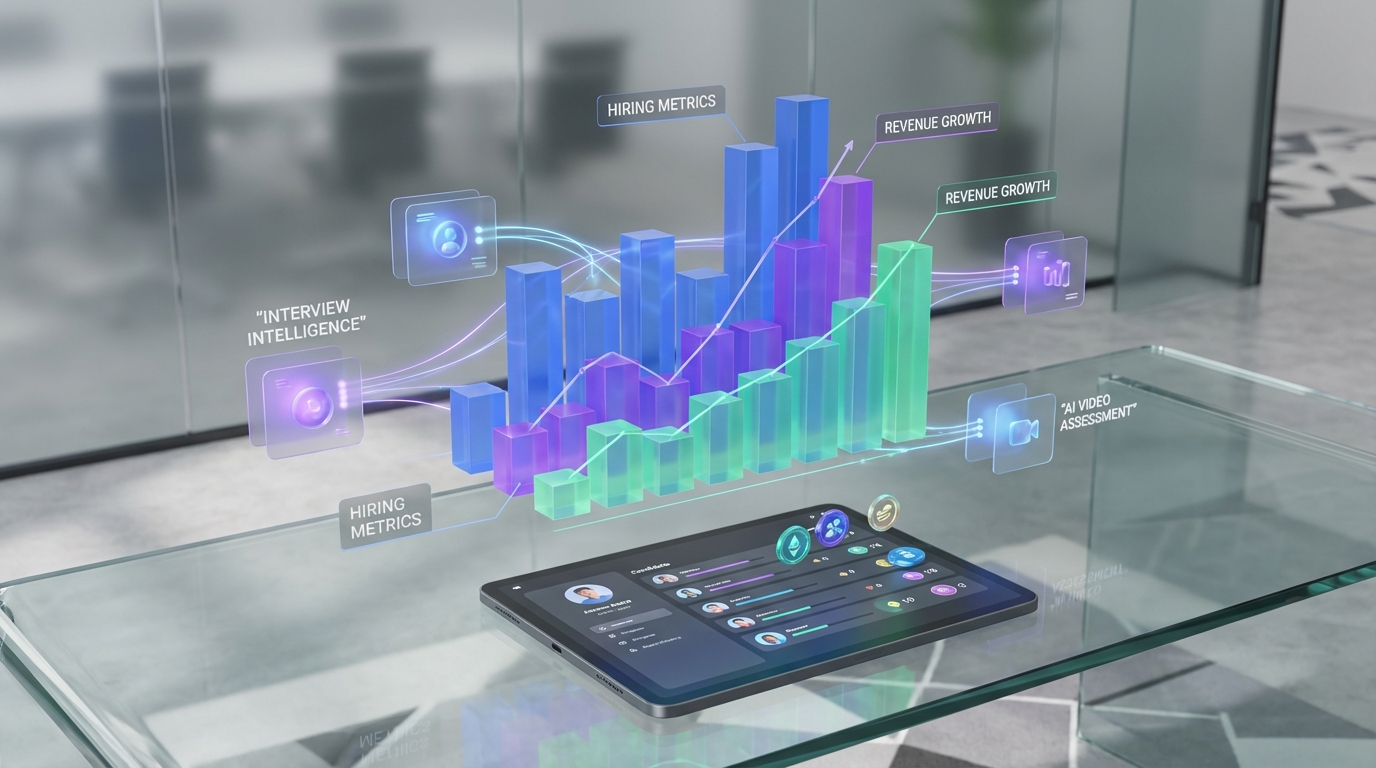
Is your Talent Acquisition team truly influencing business strategy, or just reporting operational metrics? Many TA functions are stuck measuring activity rather than impact. The practical shift is to use an ai hiring platform to connect hiring data to revenue, team performance, and other business outcomes, then explain the “why” behind the numbers with interview intelligence and, where appropriate, ai video assessment signals. In our own recruiting ops work, the teams that earn a seat at the strategy table are the ones that can show how hiring changes business results, not just how many messages were sent.
Why TA metrics get stuck at “activity”
Most TA dashboards over-index on what is easiest to count: outreach volume, interviews scheduled, time-to-fill, and pipeline stage counts. Those are useful operational controls, but they rarely answer executive questions like “Are we hiring the people who move the business forward?” or “Is hiring improving team performance?”
The core issue is attribution. Activity metrics describe effort, but they do not show outcomes. To earn strategic influence, TA needs a measurement system that links hiring to business results and can stand up to scrutiny from finance, operations, and functional leaders.
The three maturity stages of TA metrics
On Episode 717 of Recruiting Future, Leandro Cartelli describes a strategy for evolving TA metrics to drive strategic influence and real business impact. The framing is simple and useful: metrics mature in stages.
Stage 1: Activity reporting
- What it looks like: counts of sourcing actions, interviews, offers, and time-to-fill.
- What it’s good for: managing recruiter workload and identifying bottlenecks.
- What it misses: whether hiring improved business outcomes.
Stage 2: Efficiency and quality signals
- What it looks like: funnel conversion rates, offer acceptance rate, hiring manager satisfaction, and early quality indicators.
- Where interview intelligence helps: structured interview notes and consistent evaluation criteria make “quality” less subjective.
- Where AI video assessment can help: when used responsibly, it can standardize parts of screening, but it must be governed to avoid bias and overreach.
Stage 3: Business impact measurement
- What it looks like: hiring outcomes tied to revenue, retention, productivity, and team performance.
- What changes: TA becomes a business partner because it can quantify impact and explain tradeoffs.
- What it requires: cross-functional alignment on definitions, data access, and governance.
How to connect recruiting metrics to business goals
Connecting recruiting metrics to strategic goals is less about building a massive dashboard and more about choosing a small set of outcome metrics that leadership already trusts. Then you work backward to the recruiting levers that influence them.
Step-by-step mapping (reproducible approach)
- Pick 1 business goal per quarter. Examples include revenue growth, faster product delivery, improved customer retention, or reduced operational risk.
- Choose 1–2 outcome metrics owned by the business. For example, sales quota attainment, customer churn rate, or cycle time for delivery.
- Define the hiring contribution. This is your hypothesis, such as “reducing time-to-productivity for new hires improves delivery cycle time.”
- Attach recruiting leading indicators. Use a limited set, such as time-to-accept, pass-through rates, and candidate experience signals.
- Instrument the workflow with an AI hiring platform. Capture structured data from sourcing, screening, interviews, and offers so you can explain changes, not just report them.
In practice, interview intelligence is the bridge between “numbers” and “narrative.” It helps you show which competencies were assessed, what themes appeared across interviews, and where candidates dropped out. That context is what makes metrics persuasive in leadership conversations.
How data builds genuine organizational influence
Influence comes from being able to answer strategic questions with evidence and clear tradeoffs. When TA can show, for example, that a change in outreach strategy improved qualified responses and reduced time-to-accept, leaders start asking TA for recommendations rather than status updates.
What we found works in executive reviews
- Use business language first. Lead with outcomes, then show recruiting drivers.
- Show decisions, not just charts. “We changed X because Y, and Z improved.”
- Standardize definitions. If “qualified” means different things across teams, your metrics will be challenged.
- Keep the metric set small. A short scorecard is more credible than a sprawling dashboard.
This is where an ai hiring platform becomes more than automation. It becomes the system that enforces consistent data capture across recruiters and hiring managers, which is a prerequisite for trustworthy reporting.
Why candidate experience still gets overlooked
Candidate experience is often discussed but under-measured. The common failure mode is treating it as a brand metric only, instead of an operational and conversion metric that affects acceptance rates and time-to-hire.
Candidate experience signals worth tracking
- Response time: how quickly candidates receive answers to questions and next steps.
- Process clarity: whether candidates understand stages, timelines, and expectations.
- Drop-off reasons: why candidates disengage at each stage.
One practical advantage of using StrategyBrain AI Recruiter inside your workflow is that it can maintain timely, consistent communication during early outreach and qualification on LinkedIn. That reduces “silent periods” that candidates interpret as disinterest, while also capturing structured conversation outcomes that can be rolled into your reporting.
Where an AI hiring platform fits, including StrategyBrain AI Recruiter
An ai hiring platform should do two jobs at once: reduce manual work and improve measurement quality. If it only automates tasks but does not produce reliable data, it will not help TA become more strategic.
What StrategyBrain AI Recruiter automates on LinkedIn
- Candidate outreach and follow-up: automatically connects with candidates that match your search criteria and continues the conversation.
- Role introduction and Q&A: introduces the opportunity and answers questions about the role, company, compensation, and benefits based on the information you provide.
- Interest confirmation and data capture: confirms interview interest and collects resumes and contact details from interested candidates.
- 24/7 multilingual communication: responds in the candidate’s native language across time zones to reduce delays and misunderstandings.
- Team scaling: supports managing more than 100 LinkedIn accounts so organizations can scale outreach capacity.
How this supports better metrics maturity
When early-stage outreach and qualification are consistent, your funnel data becomes cleaner. That makes it easier to move from Stage 1 activity reporting to Stage 2 efficiency signals, and eventually to Stage 3 business impact measurement. For example, if your outreach conversations reliably capture interest level and resume receipt, you can measure qualified response rates and time-to-first-qualified-candidate with less manual reconciliation.
Limitations and governance notes (important)
- AI Recruiter does not make final fit decisions. It identifies willingness to communicate or interview, while recruiters still evaluate resume fit and final qualification.
- AI video assessment requires caution. If you use AI video assessment, define what it is allowed to evaluate, document the rationale, and monitor for adverse impact.
- Privacy and security must be explicit. StrategyBrain states that customer-provided data is not used to train AI models and that data is encrypted and isolated per customer instance.
A practical scorecard you can copy
Below is a compact scorecard format we have used to keep leadership conversations focused. It is designed to be readable in 3 minutes and defensible in 30 minutes.
Quarterly TA impact scorecard (template)
- Business goal: [Example: reduce delivery cycle time]
- Business outcome metric: [Example: cycle time in days]
- Hiring contribution hypothesis: [Example: faster ramp for key roles reduces cycle time]
- Recruiting leading indicators:
- Time-to-accept in days
- Offer acceptance rate in percent
- Qualified response rate in percent
- Candidate response time in hours
- Evidence pack: structured interview themes from interview intelligence, top drop-off reasons, and changes made this quarter
- Decision requests: what you need from leadership, such as headcount approval, compensation band changes, or interview process changes
If you are using StrategyBrain AI Recruiter for LinkedIn outreach, add one line that shows how automated outreach affected qualified responses and candidate response time. Keep it factual and avoid over-claiming.
Episode reference: Recruiting Future, Episode 717
The source content for this article references Episode 717 of Recruiting Future, where Leandro Cartelli discusses evolving TA metrics to drive strategic influence and business impact. The key themes include the three maturity stages of TA metrics, connecting recruiting metrics to strategic business goals, building organizational influence through data, and the ongoing gap in candidate experience measurement.
If you want to listen, search for “Recruiting Future” in your podcast app and look for Episode 717.
FAQ
What is an AI hiring platform?
An AI hiring platform is software that uses automation and AI to support recruiting workflows such as sourcing, screening, interview coordination, and analytics. In this article, we focus on how it improves measurement quality by capturing consistent data across the funnel.
What does interview intelligence mean in recruiting?
Interview intelligence is the structured capture and analysis of interview information, such as consistent notes, competency signals, and themes across interviewers. It helps teams explain why funnel outcomes change, not just that they changed.
How can TA prove business impact without over-claiming?
Start with a clear hypothesis, use business-owned outcome metrics, and show the recruiting leading indicators that plausibly influence them. Be explicit about what you can and cannot attribute directly to hiring.
Does StrategyBrain AI Recruiter replace recruiters?
No. StrategyBrain AI Recruiter automates early LinkedIn outreach, role introduction, Q&A, interest confirmation, and collection of resumes and contact details. Recruiters still review resumes and make final qualification and hiring decisions.
Can StrategyBrain AI Recruiter communicate with candidates in different languages?
Yes. StrategyBrain AI Recruiter is designed for 24/7 multilingual candidate communication, using the candidate’s native language to reduce delays and misunderstandings.
How should we use AI video assessment responsibly?
Define the purpose, document evaluation criteria, monitor for bias, and ensure candidates understand the process. Avoid using AI video assessment as a single gate for hiring decisions without human review and governance.
What is the fastest metric upgrade a TA team can make?
Pick one business goal for the quarter and map a small set of recruiting leading indicators to it. Then standardize data capture in your workflow so the numbers are consistent across recruiters and hiring managers.
Why do candidate experience metrics matter for hiring outcomes?
Candidate experience affects conversion and acceptance. Faster response times and clearer process communication typically reduce drop-off, which can shorten time-to-hire and improve offer acceptance rates.
Conclusion
If TA is only reporting activity, it will be treated as an operational function. The path to strategic influence is to mature metrics from activity to efficiency and quality signals, and then to business impact measurement that leaders already recognize. An ai hiring platform supports that shift by standardizing data capture, while interview intelligence and carefully governed ai video assessment can add the context needed to make metrics credible.
Next step: choose one business goal for the next quarter, build a one-page scorecard, and instrument your LinkedIn outreach so you can measure qualified responses and candidate response time consistently. If LinkedIn outreach is a bottleneck, StrategyBrain AI Recruiter is designed to automate early conversations and resume collection so your team can spend more time on final qualification and hiring decisions.