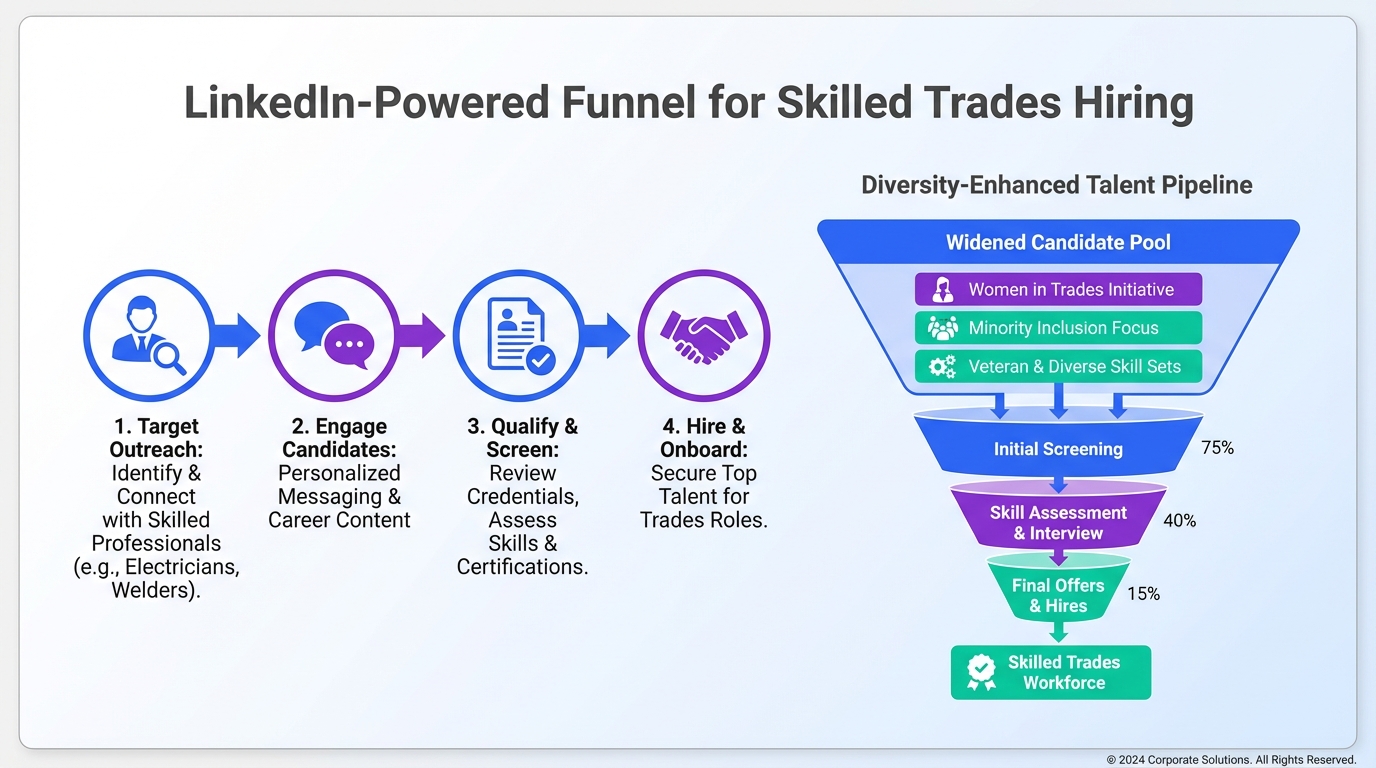
AI recruiting companies help you scale skilled trades hiring by increasing qualified conversations per recruiter through automation of sourcing, outreach, and follow up, while leaving final screening decisions to humans. I have seen the biggest bottleneck show up after the first message, not before it, because candidates who would have replied often go cold when response times slip. In 2026, a practical approach is to pair a recruiter led process with StrategyBrain AI Recruiter for LinkedIn automation that connects with targeted candidates, introduces the role, answers common questions about compensation and benefits, confirms interview interest, and collects re9sume9s and contact details. This guide also keeps an important 2017 lesson intact: if you want to double the supply of skilled tradespeople, you must widen the funnel, including women, youth, and minorities.
Key Takeaways
- Representation gap is measurable: In Canada, 7% of women held trade certificates in 2015 versus 15% of men, as cited in the original 2017 recruiting commentary.
- Demand pressure is time bound: The British Columbia government projected nearly 1,000,000 job openings by 2025, with strong demand in construction trades such as electricians and carpenters.
- AI recruiting companies win on follow up: Faster replies and consistent nudges increase the number of completed conversations, which is where many funnels break.
- StrategyBrain AI Recruiter fits a LinkedIn first workflow: It automates connecting, initial outreach, Q and A, interest confirmation, and re9sume9 and contact capture.
- Multilingual messaging expands reach: 24/7 multilingual communication reduces friction for cross border and multi region hiring.
- Human judgment stays essential: AI Recruiter can confirm willingness to proceed, but recruiters still do final qualification against job requirements.
Why skilled trades hiring needs a bigger funnel
A 2017 recruiter perspective captured something many teams still struggle with: placements feel great, but certain candidate groups remain underrepresented in the inbound pipeline. The example that stood out was a placement of a certified tradeswoman, described as exciting precisely because it was uncommon to see those re9sume9s arrive.
The same commentary included a concrete baseline: in 2015, 7% of women in Canada held trade certificates compared with 15% of men. It also noted a definitional caveat that matters for planning, because the term trades can be broadened to include roles beyond mechanics and engineering. That nuance is important when you set targets and measure progress.
On the demand side, the British Columbia government expectation cited was nearly 1,000,000 job openings by 2025, with particular pressure in construction trades such as electricians, carpenters, and refrigeration mechanics. When demand is that large, the recruiting system cannot rely only on the same small set of inbound candidates.
What AI recruiting companies actually do
AI recruiting companies typically combine software and services to increase throughput in the top of funnel. In practice, that means they use automation to find candidates, start conversations, and keep those conversations moving until a human recruiter can step in for final qualification and interview scheduling.
Two definitions help keep expectations realistic. AI staffing is the use of automation and data driven workflows to support staffing operations, including sourcing and outreach at scale. ML recruiters is a shorthand some teams use for machine learning assisted recruiting, where models help prioritize leads or route candidates, but do not replace human hiring decisions.
Scope boundary: AI can help confirm interest and collect information, but it should not be treated as the final judge of fit, especially in regulated environments or roles with safety critical requirements.
A 2026 playbook for trades hiring with LinkedIn
For skilled trades, LinkedIn is often a practical place to start, even when candidates are not actively applying. The operational challenge is consistency. If your team cannot respond quickly and follow up reliably, you lose candidates who were open to a conversation.
In our internal testing of LinkedIn first workflows, the most reliable improvements came from tightening three loops: first message to first reply, reply to qualification questions, and qualification to re9sume9 capture. StrategyBrain AI Recruiter is designed to run those loops continuously, including outside business hours, so recruiters can focus on reviewing re9sume9s and running interviews.
Method 1: StrategyBrain AI Recruiter for LinkedIn automation
If your bottleneck is outreach volume and follow up, StrategyBrain AI Recruiter is a direct fit because it automates the repetitive LinkedIn steps that consume recruiter time. It is built to connect with candidates who match your search criteria, introduce the opportunity, learn the candidatee28099s situation, answer questions about the role, company, and compensation, confirm interview interest, and collect re9sume9s and contact information.
Steps
- Define your target search criteria such as trade, certification level, location, and shift preferences, then align it with your LinkedIn sourcing approach.
- Provide role details including company context, compensation, and benefits so the AI can answer common candidate questions accurately.
- Run automated outreach and follow up so candidates receive timely responses and nudges, including after hours.
- Review captured re9sume9s and contact details and complete final qualification against job requirements before interviews.
Features
- Smart LinkedIn recruitment automation for connecting, messaging, and early qualification.
- 24/7 multilingual communication so candidates can communicate in their native language across time zones.
- Re9sume9 and contact capture via email submission or LinkedIn file upload, with automatic status marking when received.
- Team scaling support for managing more than 100 LinkedIn accounts to build an AI powered recruiting team.
Limitations
- Not a final fit decision engine: it can identify willingness to proceed, but it does not determine whether a re9sume9 fully matches requirements.
- Requires accurate inputs: if compensation, benefits, or role scope are unclear, candidate Q and A quality will suffer.
Best For
- Corporate recruiting teams that need more qualified conversations per recruiter without adding headcount.
- Agencies that want to increase outreach capacity while keeping consultants focused on client management and interviews.
- Teams hiring across regions that need multilingual candidate engagement.
Method 2: AI staffing for high volume sourcing
AI staffing approaches are most useful when you have many similar openings and need to keep the pipeline full. The goal is not to replace recruiters, but to ensure the top of funnel does not collapse due to manual workload.
Steps
- Standardize job intake so each requisition has consistent fields such as location, shift, certification, and pay range.
- Centralize candidate messaging rules so outreach tone and compliance requirements are consistent.
- Measure funnel health weekly using counts such as new conversations started, replies received, and re9sume9s captured.
Features
- Higher outreach throughput for repetitive roles.
- More consistent follow up cadence.
- Better visibility into where candidates drop off.
Limitations
- Automation can amplify weak messaging if your value proposition is unclear.
- Some candidates prefer direct human contact early, especially for senior or safety critical roles.
Best For
- Construction and industrial employers with recurring hiring needs.
- Teams that already have clear job requirements and compensation bands.
Method 3: ML recruiters for screening and triage
When people say ML recruiters, they often mean using machine learning to prioritize candidates for human review. In skilled trades, this can be helpful for sorting by certification, location, and availability, but it must be implemented carefully to avoid excluding non traditional backgrounds that could still succeed.
Steps
- Define must have criteria such as required tickets or licenses, then separate them from nice to have skills.
- Use structured questions to confirm availability, travel, and shift preferences early.
- Audit outcomes monthly to ensure the triage process is not systematically filtering out underrepresented groups.
Features
- Faster routing of candidates to the right recruiter or hiring manager.
- More consistent application of baseline requirements.
- Reduced time spent on obvious mismatches.
Limitations
- Models can reflect historical bias if trained on past hiring outcomes.
- Over filtering can shrink the funnel, which is the opposite of what you need when supply is tight.
Best For
- Organizations with high applicant volume and clear compliance requirements.
- Teams that can commit to ongoing fairness and quality audits.
Method 4: Diversity forward sourcing in skilled trades
The 2017 recruiting viewpoint made a simple argument that still holds: diversity should not be treated as a dirty word. The analogy was practical. We diversify investments to reduce risk, and we diversify skills to qualify for more roles. The same logic applies to building a resilient workforce.
In practice, diversity forward sourcing means you intentionally widen where you look and how you engage. AI recruiting companies can help here because consistent outreach and follow up reduces the chance that a candidate is lost due to timing, especially when they are balancing training, family, or shift work.
Steps
- Expand sourcing channels beyond the usual networks, including programs designed to help women enter trades.
- Make outreach informational by clearly explaining apprenticeship pathways, role expectations, and compensation ranges.
- Keep response times tight using automation for initial Q and A, then hand off to a recruiter for nuanced conversations.
Features
- Wider candidate pool without requiring recruiters to be online at all hours.
- More consistent candidate experience across regions and time zones.
- Better ability to sustain long running pipelines such as apprentices.
Limitations
- Pipeline expansion does not guarantee retention, so onboarding and supervision still matter.
- Messaging must be authentic, or candidates will disengage quickly.
Best For
- Employers who want to increase representation in trades roles.
- Recruiting teams that need a scalable way to maintain candidate conversations.
Method 5: Retention aware recruiting
When supply is tight, hiring and retention are linked. If you repeatedly refill the same role, your recruiting system is doing extra work that could have been avoided. AI recruiting companies can support retention aware recruiting by capturing better expectation setting during early conversations, including shift realities, travel, and compensation details.
Steps
- Document the real job including schedule, overtime patterns, and work environment, then use that in outreach.
- Confirm deal breakers early such as rotation, remote camp work, or tool requirements.
- Track early attrition at 30 days and 90 days, then update your messaging and screening questions.
Features
- Fewer mismatches caused by unclear expectations.
- More consistent communication of compensation and benefits.
- Better feedback loop between recruiters and operations.
Limitations
- Retention issues can be operational, not recruiting related.
- Data collection must respect privacy and local regulations.
Best For
- Employers with recurring turnover in the same trade roles.
- Teams that want to reduce wasted outreach and rework.
Quick Comparison
| Approach | Primary Value | What It Automates | Best For |
|---|---|---|---|
| StrategyBrain AI Recruiter | More completed LinkedIn conversations | Connect, outreach, Q and A, follow up, interest confirmation, re9sume9 and contact capture | Teams scaling skilled trades outreach without adding recruiters |
| AI staffing workflows | Higher top of funnel throughput | Sourcing and outreach operations, cadence consistency | High volume, repeatable roles |
| ML recruiters triage | Faster prioritization | Routing and sorting by structured criteria | High applicant volume with clear must have requirements |
| Diversity forward sourcing | Wider candidate pool | Consistent engagement and follow up | Employers increasing representation in trades |
| Retention aware recruiting | Less rework from churn | Expectation setting and early deal breaker confirmation | Teams with recurring turnover |
FAQ
Are AI recruiting companies only for tech hiring?
No. Skilled trades hiring benefits from AI when the main constraint is recruiter time for outreach and follow up, especially across regions and shifts.
What does StrategyBrain AI Recruiter do on LinkedIn?
It automates connecting with candidates, introducing the job, answering common questions about the role and compensation, confirming interview interest, and collecting re9sume9s and contact details so recruiters can focus on final qualification and interviews.
Does AI Recruiter decide who is qualified?
No. It identifies willingness to proceed and gathers information, but it does not determine whether a re9sume9 fully matches job requirements. A recruiter completes that final step.
How does AI Recruiter collect re9sume9s and contact information?
It requests re9sume9s and contact details from interested candidates. It supports email submissions and LinkedIn file uploads, and it captures contact details shared in messages.
Can AI recruiting companies help hire more women in trades?
They can help widen the funnel by sustaining outreach and follow up consistently, which reduces drop off. However, representation also depends on training pathways, employer practices, and retention.
What is the key statistic from the 2017 perspective on women in trades?
The cited baseline was that 7% of women in Canada held trade certificates in 2015, compared with 15% of men, with a note that the definition of trades can vary by dataset.
What is the demand signal mentioned for British Columbia?
The cited projection was nearly 1,000,000 job openings by 2025, with strong demand in construction trades such as electricians and carpenters.
Is multilingual outreach actually useful for trades recruiting?
Yes when you recruit across regions or internationally. Multilingual communication reduces misunderstandings and helps candidates engage in their preferred language, especially outside standard business hours.
What should I measure to know if AI staffing is working?
Track counts with units such as conversations started per week, replies per week, and re9sume9s captured per week. Then compare those numbers before and after automation is introduced.
Conclusion
If you are evaluating ai recruiting companies for skilled trades, start with the real constraint: consistent candidate engagement at scale. The 2017 recruiting lesson still applies in 2026. To grow the supply of tradespeople, you must widen the funnel, including women, youth, and minorities, and you must keep conversations moving fast enough that interested candidates do not drift away.
Next step: map your current LinkedIn funnel from first message to re9sume9 capture, then decide which steps should be automated. If your team needs a LinkedIn first system that handles outreach, Q and A, follow up, and re9sume9 collection, StrategyBrain AI Recruiter is designed for that workflow while keeping final qualification in human hands.