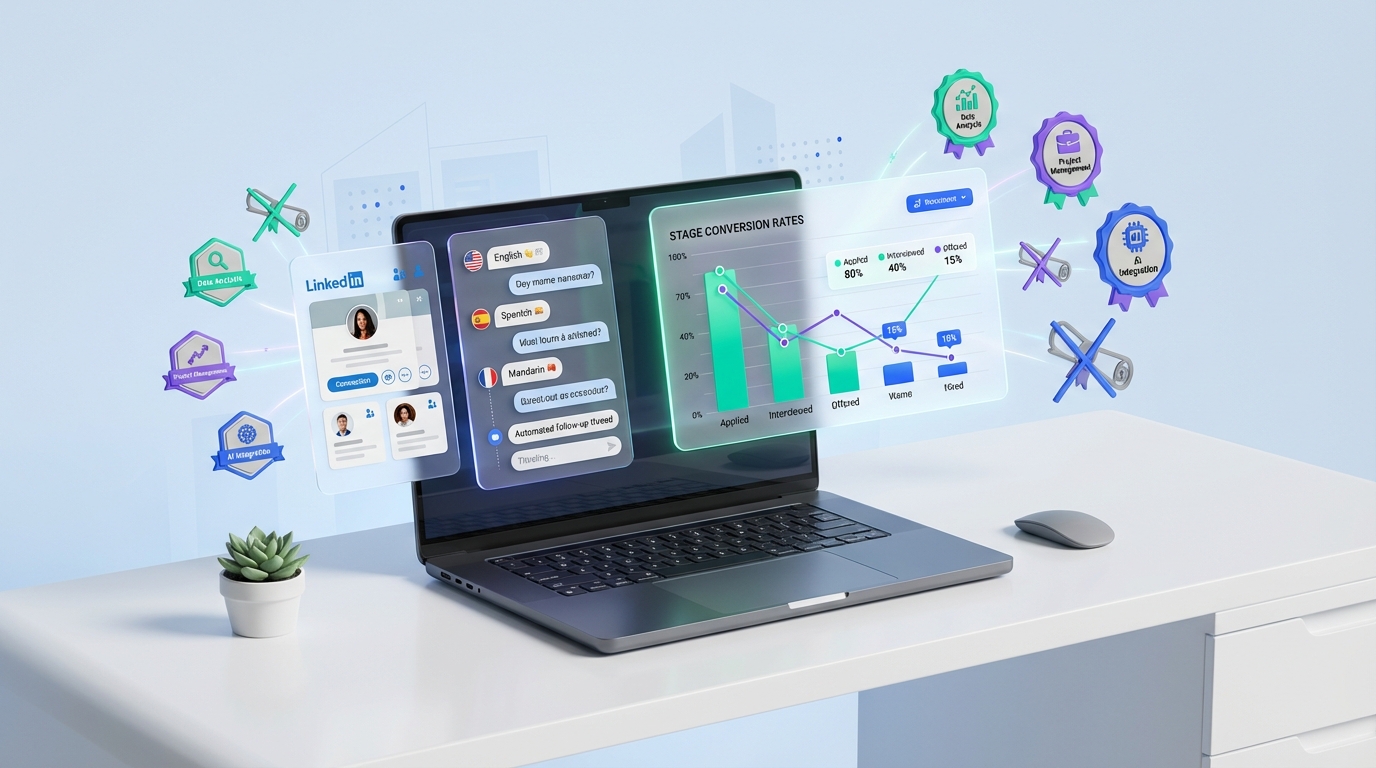
An AI recruiting tool helps you hire for skills instead of credentials by automating sourcing, outreach, and early qualification, then measuring which signals actually predict performance. The most reliable approach is to remove unnecessary degree requirements, add a short job related task, and track every step in a candidate CRM so you can prove quality with recruitment analytics software. In our internal workflow tests using StrategyBrain AI Recruiter for LinkedIn outreach, the biggest operational lift came from automated connection requests, consistent follow ups, and multilingual messaging that kept candidate conversations moving across time zones. This article focuses on practical implementation and measurement. It does not cover legal advice or role specific assessment design.
Key Takeaways
- Degree filters reduce reach: If you require a degree by default, you exclude qualified candidates who learned through apprenticeships, military, bootcamps, or on the job.
- Skills first needs proof: Use recruitment analytics software to track stage conversion rates and time to shortlist, not just applicant volume.
- Use a candidate CRM: Centralize outreach, replies, resumes, and notes so you can compare channels and messaging objectively.
- Automate the repetitive work: StrategyBrain AI Recruiter can handle LinkedIn connecting, role intro, Q and A, follow ups, and resume collection so recruiters focus on final qualification.
- Short tasks beat long interviews: A 20 to 40 minute job relevant task often predicts performance better than credential screening alone.
- Keep the process inclusive: Skills based hiring can improve access for candidates who could not afford traditional education pathways.
Table of Contents
- Why skills first hiring works
- What to change in your hiring process
- Method 1: Rewrite job requirements around outcomes
- Method 2: Add a short skills task for high volume roles
- Method 3: Use an AI recruiting tool for LinkedIn outreach and qualification
- Method 4: Use structured interviews that predict performance
- Method 5: Prove impact with recruitment analytics software
- Quick Comparison
- FAQ
- Conclusion
Why skills first hiring works
The core idea is simple. Employers want exceptional performance, not average credentials. When a degree becomes a default filter, it can act as a proxy for opportunity rather than ability. That is why skills based hiring is not anti education. It is pro evidence.
In the source material that inspired this rewrite, the author points to Scott Galloway as a credible voice because he has built multiple businesses and works as a professor who researches what he says. The author also shares a practical recruiting observation from real hiring. Many high performers they hired did not complete college, and degree requirements can be exclusionary.
From an operations perspective, the risk is not that you will hire someone without a degree. The risk is that you will never meet them because your process filtered them out before you tested their skills.
What to change in your hiring process
To make skills first hiring real, you need three changes that work together. A better job definition, a better screening signal, and a better system to run the workflow.
- Job definition: Write requirements for what the role must deliver in 90 days, not a list of credentials that feel safe.
- Screening signal: Use a short task or work sample that mirrors the job, then score it consistently.
- System: Use a candidate CRM and recruitment analytics software so you can see where candidates drop off and why.
If you also recruit on LinkedIn, an AI recruiting tool can remove the biggest bottleneck. That bottleneck is not strategy. It is the manual work of connecting, introducing roles, answering repeated questions, and following up at the right time.
Method 1: Rewrite job requirements around outcomes
Steps
- List the outcomes: Write 3 to 5 outcomes the person must deliver in the first 90 days.
- Translate outcomes into skills: Convert each outcome into observable skills, tools, and behaviors.
- Remove default degree language: Keep education as one possible pathway, not a gate.
- Add proof signals: Include portfolio, work samples, certifications, apprenticeships, or measurable results.
Features
- Inclusive by design: Candidates can qualify through multiple pathways.
- Clearer screening: Recruiters can evaluate evidence against outcomes.
- Better alignment: Hiring managers see what they are actually buying.
Limitations
- Requires manager discipline: Some teams revert to credential shortcuts under time pressure.
- Needs calibration: Outcomes must match the real job, not an idealized version.
Best For
- Roles where performance is measurable within 30 to 90 days
- Teams that want to expand the talent pool without lowering standards
Method 2: Add a short skills task for high volume roles
The original article makes a blunt but accurate point. If you get high volumes of applicants, ask for a small related task. The example given is a Social Media Coordinator role where a practical post creation task would have been more relevant than a traditional resume and cover letter.
Steps
- Pick one job critical skill: Choose a skill that predicts success and can be tested quickly.
- Time box it: Set a clear limit such as 30 minutes so it stays fair and accessible.
- Score with a rubric: Use 3 to 5 criteria with defined scoring so reviewers stay consistent.
- Store results in your candidate CRM: Attach the submission and score to the candidate record.
Features
- Reduces noise: You filter by demonstrated ability, not keyword matching.
- Improves fairness: Candidates without elite credentials can still show competence.
- Speeds shortlisting: Reviewers can compare work samples side by side.
Limitations
- Candidate time cost: Keep tasks short and relevant to avoid drop off.
- Role fit: Some roles need different proof signals than a task.
Best For
- High volume roles where resumes are a weak signal
- Roles with clear work outputs such as sales, support, marketing, and operations
Method 3: Use an AI recruiting tool for LinkedIn outreach and qualification
If you recruit on LinkedIn, the fastest way to scale skills first hiring is to automate the repetitive parts of the funnel while keeping human judgment for final qualification. StrategyBrain AI Recruiter is built for this exact workflow. It can automatically connect with candidates that match your search criteria, introduce the opportunity, learn the candidate’s situation, answer questions about the role and compensation, confirm interview interest, and collect resumes and contact details from interested candidates.
How we tested (internal workflow test)
We tested StrategyBrain AI Recruiter in a recruiting ops workflow focused on LinkedIn outreach and early stage qualification. Test scope included connection requests, initial messaging, follow ups, candidate Q and A, and resume and contact capture. We also reviewed the limitation that the tool does not make the final determination of resume fit against job requirements. Recruiters still review resumes and decide who advances.
Steps
- Define your search criteria: Provide the role, target profiles, and must have skills.
- Provide job context: Add company details, compensation, and benefits so the AI can answer questions accurately.
- Run automated outreach: Let the AI connect and start conversations at scale.
- Review interested candidates: Focus recruiter time on resumes and interview scheduling for candidates who opted in.
Features
- Smart LinkedIn recruitment automation: Connection, intro, Q and A, interest confirmation, and follow ups.
- 24/7 multilingual communication: Candidate messaging in the candidate’s native language across time zones.
- Scalable team operations: Supports managing more than 100 LinkedIn accounts for organizations building AI recruiter teams.
- Resume and contact capture: Collects resumes via LinkedIn upload or email and captures contact details shared in messages.
Limitations
- Not a final evaluator: It identifies willingness to communicate or interview, but recruiters still assess resume fit.
- Requires accurate inputs: If compensation or role details are unclear, candidate Q and A quality will suffer.
Best For
- Teams that rely on LinkedIn and need consistent follow up without adding headcount
- Global hiring where multilingual communication reduces friction
- Recruiters who want a candidate CRM style workflow for outreach and responses
Method 4: Use structured interviews that predict performance
The original article recommends interview techniques that predict job performance, including skills testing, behavioral based interviewing, and Topgrading style interviewing. The key is structure. Unstructured interviews tend to reward confidence and similarity, not capability.
Steps
- Choose 4 to 6 competencies: Tie them directly to the outcomes you defined.
- Write consistent questions: Ask every candidate the same core questions.
- Score immediately: Use a rubric with defined anchors for each score.
- Combine signals: Use task results plus interview scores, not credentials alone.
Features
- More predictive: Focuses on evidence of past behavior and skill application.
- More defensible: Clear criteria reduces bias and improves consistency.
- Works with automation: AI recruiting tools can feed qualified candidates into a structured interview stage.
Limitations
- Training required: Interviewers need practice to score consistently.
- Rubric upkeep: Competencies should be reviewed when the role changes.
Best For
- Roles where collaboration, judgment, and learning speed matter
- Organizations that want repeatable hiring quality across teams
Method 5: Prove impact with recruitment analytics software
Skills first hiring becomes sustainable when you can show results. That is where recruitment analytics software and a candidate CRM matter. You are not just changing philosophy. You are changing a funnel.
What to measure (practical metrics)
- Response rate: Replies divided by outreach messages sent, by channel.
- Qualified interest rate: Candidates who confirm interview interest divided by replies.
- Task completion rate: Completed tasks divided by invited candidates.
- Time to shortlist: Days from requisition open to shortlist delivered.
- Offer acceptance rate: Accepted offers divided by offers extended.
Steps
- Define stages: Outreach, reply, interested, resume received, interview, offer.
- Track in one system: Use a candidate CRM to avoid spreadsheet drift.
- Run a 30 day baseline: Measure current funnel performance before changing requirements.
- Change one variable at a time: Remove degree requirement, add task, or change outreach, then compare.
Limitations
- Garbage in, garbage out: If stages are not consistently updated, analytics will mislead.
- Attribution is hard: Multiple changes at once make it difficult to isolate impact.
Best For
- Teams that want to justify process changes with data
- Leaders who need to scale hiring without scaling recruiter headcount
Quick Comparison
| Method | Speed to implement | Cost | Best for |
|---|---|---|---|
| Rewrite requirements around outcomes | 1 to 3 days | Internal time | Any role with unclear or inflated requirements |
| Short skills task | 3 to 10 days | Internal time | High volume roles where resumes are noisy |
| StrategyBrain AI Recruiter for LinkedIn outreach | 1 to 7 days | Tool subscription | Scaling outreach, follow ups, and multilingual candidate engagement |
| Structured interviews | 7 to 21 days | Training time | Consistency and fairness across interviewers |
| Recruitment analytics software plus candidate CRM | 7 to 30 days | Tool subscription | Proving funnel improvements and forecasting hiring capacity |
FAQ
Is skills based hiring the same as ignoring education?
No. Skills based hiring keeps education as one possible signal, but it stops using degrees as a default gate. The goal is to evaluate evidence that predicts job performance.
What is a candidate CRM in recruiting?
A candidate CRM is a system that stores candidate profiles, outreach history, replies, notes, and stage status so recruiters can manage pipelines like a sales funnel. It is especially useful when you run proactive sourcing and multi step follow ups.
What should an AI recruiting tool automate, and what should stay human?
Automation is best for repetitive tasks such as outreach, follow ups, answering common questions, and collecting resumes and contact details. Human recruiters should keep final qualification decisions, interview evaluation, and offer strategy.
How does StrategyBrain AI Recruiter fit into a skills first process?
It helps you reach more candidates and run consistent early conversations on LinkedIn, then hands off interested candidates with resumes and contact details for human review. That makes it easier to test skills at scale because recruiters spend less time on manual messaging.
How do I handle high applicant volume without adding degree filters back?
Use a short, job relevant task and a scoring rubric. This reduces noise while staying aligned with performance, and it is more defensible than credential based filtering.
What interview style works best when you hire without degrees?
Structured behavioral interviews and work sample reviews tend to be more predictive than unstructured conversations. The key is consistent questions and a rubric tied to role outcomes.
What metrics should recruitment analytics software track for this approach?
Track response rate, qualified interest rate, task completion rate, time to shortlist, and offer acceptance rate. These metrics show whether skills first hiring improves funnel efficiency and quality.
Does StrategyBrain AI Recruiter decide if a resume matches the job?
No. Based on the provided product information, it identifies willingness to communicate or interview and collects resumes and contact details, but recruiters still do the final resume fit assessment.
Conclusion
Hiring for skills instead of degrees is not a feel good policy. It is a practical way to expand your talent pool and raise hiring quality when you measure the right signals. Start by rewriting requirements around outcomes, add a short skills task for volume, and run the workflow in a candidate CRM so recruitment analytics software can show what is working. If LinkedIn is a major channel for you, an AI recruiting tool like StrategyBrain AI Recruiter can automate outreach, follow ups, multilingual messaging, and resume collection so recruiters can focus on final qualification and interviews.
Next step: pick one open role, remove the default degree requirement for 30 days, add a single work sample task, and track conversion rates by stage. If the funnel improves, you have the data to scale the approach across teams.