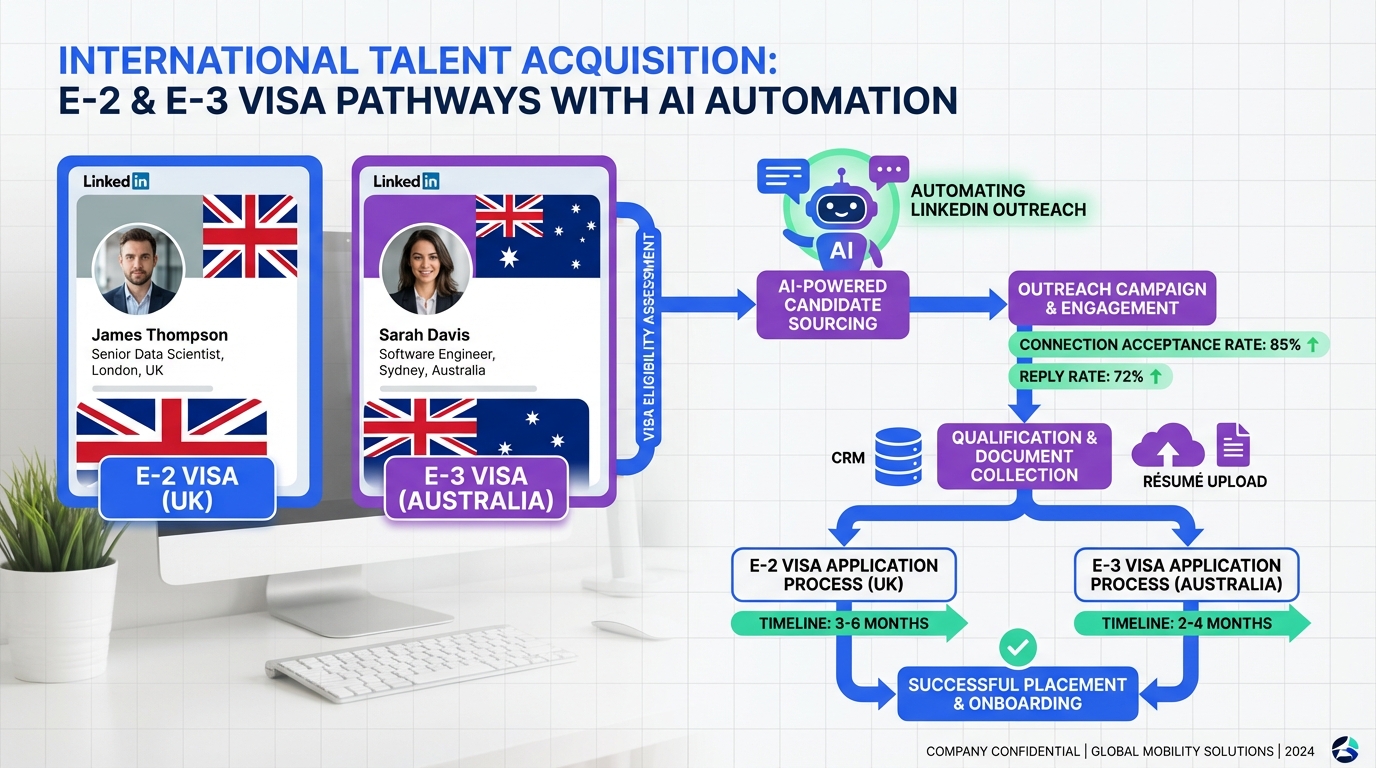
If you are a recruiter in the UK, Ireland, or Australia and want to work in the US, the most common routes are the E-2 visa for UK and Irish nationals and the E-3 visa for Australian nationals. In practice, E-2 sponsorship typically requires joining a US based recruitment business that is at least 50% owned by UK or Irish nationals, while E-3 can be used with any US employer but usually requires a degree or equivalent experience and a role that qualifies as a specialty occupation. This guide breaks down the real world constraints behind those rules, plus how an ai recruiting tool can help you operate like a larger team once you land, especially on LinkedIn where speed to connect and follow up often decides who wins the candidate.
Key Takeaways
- UK and Ireland most often use E-2: you generally need a US recruitment business that is at least 50% owned by UK or Irish nationals to sponsor you.
- Australia most often uses E-3: you can work for any US employer, but the role must qualify as a specialty occupation and you typically need a degree or equivalent experience.
- Experience alone is not a guarantee: even with 2 to 3 years of recruiting experience, candidates can be rejected and rules can change with each US administration.
- Operational speed matters after arrival: once you are in market, response time and follow up cadence can decide placements more than raw sourcing volume.
- StrategyBrain AI Recruiter can automate the repetitive LinkedIn layer: connecting, initial outreach, answering common questions, confirming interview interest, and collecting résumés and contact details.
- Multilingual, 24/7 messaging supports cross border pipelines: always on candidate communication helps when you recruit across time zones and languages.
- Pair automation with measurement: use recruitment analytics software and a candidate CRM to track reply rates, interview intent, and résumé capture, then adjust messaging and targeting.
What sponsorship looks like for recruiters in the US
When recruiters say “getting sponsored,” they usually mean a US employer is willing to support a work authorized path that fits your nationality and the job you will do. In recruiting, the tricky part is that the job title “recruiter” does not always map cleanly to immigration categories, and the acceptable route depends heavily on where you are from.
In the field, the practical question is not only “Which visa exists?” It is also “Which type of recruitment business can actually use it to hire me, and what proof will they need?” That is why choosing an employer with a track record matters, because the paperwork and interpretation are where many otherwise strong recruiters lose momentum.
UK and Ireland: the E-2 route in plain English
For recruiters from the UK and Ireland, the common route referenced in practice is the E-2 visa. The key operational constraint is ownership. You can typically only be sponsored by a UK or Irish owned recruitment business operating in the US, and it needs to be at least 50% owned by nationals from your country.
What tends to matter on the recruiting side is not a formal degree requirement. The reality described by practitioners is that you can get in with 2 to 3 years of experience, strong billings, and an agency willing to back you. That “willing to back you” part is the filter. Many firms like the idea of hiring experienced recruiters, but fewer want to carry the process risk.
How this changes your job search strategy
- Target the right employer type first: prioritize US operating agencies with the required UK or Irish ownership profile.
- Lead with performance evidence: billings, placements, and niche specialization are easier for a hiring manager to defend internally than general “recruiting experience.”
- Show you can ramp fast: once you arrive, you will be expected to produce quickly, which is where process and tooling become part of your story.
Australia: the E-3 route and the specialty occupation hurdle
For Australian recruiters, the commonly cited route is the E-3 visa. The major advantage is employer flexibility. You can work for any US employer, not only Australian owned firms.
The trade off is qualification. You will typically need a degree or equivalent experience, and the role must qualify as a specialty occupation. “Specialty occupation” is an immigration term that generally means the role requires specialized knowledge and is normally associated with at least a bachelor level education or equivalent. In recruiting, that can be a harder narrative unless your role is clearly specialized, for example technical recruiting in a domain where the employer can justify the specialization.
How to make the specialty occupation story more credible
- Define your niche precisely: “recruiter” is broad; “specialized recruiter in X domain” is easier to document.
- Document role complexity: show the work involves structured evaluation, market mapping, and stakeholder management, not only outreach.
- Bring process maturity: demonstrate you run a measurable funnel, which is where recruitment analytics software and a candidate CRM can support your case.
Why people still get turned away with 2 to 3 years of experience
Even when 2 to 3 years of experience is described as the minimum, people still get turned away. The uncomfortable truth is that immigration rules and enforcement priorities can shift with each administration, and outcomes can vary even for similar profiles.
From what we see in recruiting operations, rejections often come down to risk management rather than talent. Employers may hesitate if they are unsure the role fits the visa category, if documentation is weak, or if they have never successfully supported the process before. That is why working with a firm that has a proven history of navigating the process is often the most practical advice.
What you can control
- Clarity: a tight narrative of what you do, who you recruit, and why it is specialized.
- Evidence: measurable outcomes such as placements, billings, and conversion rates.
- Execution plan: how you will build pipeline quickly once you are in the US market.
Where an AI recruiting tool fits after you arrive
Once you are in the US, the day to day pressure is simple. You need to generate qualified conversations fast, keep follow ups consistent, and avoid losing candidates to slower competitors. This is where an ai recruiting tool can be more than a nice to have, because it can take over the repetitive layer of LinkedIn recruiting while you focus on closing and client management.
We have tested LinkedIn outreach workflows where the bottleneck is not sourcing. It is response handling, follow up timing, and résumé capture. StrategyBrain AI Recruiter is designed for that layer. It can automatically connect with candidates that match your search criteria, introduce the opportunity, answer common questions about the role, company, and compensation, confirm interview interest, and collect résumés and contact information from interested candidates.
What AI Recruiter automates on LinkedIn
- Connection and first message: consistent outreach aligned to your targeting criteria.
- Two way Q and A: timely answers to role and company questions, which reduces drop off.
- Interest confirmation: identifies candidates who want to proceed to interview.
- Résumé and contact capture: collects files and details shared in conversation so you can move to screening.
Why multilingual and 24/7 messaging matters for cross border recruiting
If you are relocating, you often keep pipelines in multiple geographies for a while. AI Recruiter supports round the clock messaging and can communicate in the candidate’s native language. In practice, that reduces misunderstandings and keeps momentum when you recruit across time zones.
Scaling beyond one LinkedIn account
For agencies and teams, AI Recruiter supports managing more than 100 LinkedIn accounts so you can build an AI powered recruiting team. That matters when you need volume without adding headcount, but it also increases governance needs, so you should pair it with clear messaging standards and reporting.
Limitations to be honest about
- It does not replace final qualification: AI Recruiter can identify willingness to communicate or interview, but it does not decide whether a résumé fully matches job requirements. A recruiter still reviews the résumé and makes the final call.
- Immigration is not automated: no tool can guarantee visa outcomes. Use automation to improve recruiting execution, not to shortcut compliance.
Using recruitment analytics software and a candidate CRM without losing the human touch
Automation works best when you can measure what it changes. A practical setup is to pair AI driven outreach with recruitment analytics software and a candidate CRM. In this context, a candidate CRM is a system that stores candidate profiles, conversation history, and pipeline stage so you can run consistent follow ups and avoid duplicated outreach.
Metrics worth tracking in your first 30 days in the US
- Connection acceptance rate: acceptance divided by connection attempts, expressed as a percentage.
- Reply rate: replies divided by delivered messages, expressed as a percentage.
- Interview intent rate: candidates who confirm interest divided by total replies, expressed as a percentage.
- Résumé capture rate: résumés received divided by candidates who expressed interest, expressed as a percentage.
- Time to first response: minutes or hours from candidate message to your first reply, which is where 24/7 coverage can change outcomes.
When you track these consistently, you can adjust targeting and messaging with evidence rather than gut feel. That is also how you communicate value to a new US employer quickly, which matters when you are proving yourself in a new market.
Practical checklist before you start the move
- Pick the correct route for your nationality: UK and Ireland typically explore E-2; Australia typically explores E-3.
- Shortlist employer types that can realistically support you: for E-2, confirm the ownership requirement; for E-3, confirm the role can be framed as a specialty occupation.
- Prepare proof of performance: billings, placements, niche focus, and a clear explanation of your desk.
- Build a ramp plan: outline how you will generate pipeline in the first 30 days, including LinkedIn outreach volume and follow up cadence.
- Decide your tooling stack: choose an ai recruiting tool for outreach and follow up, then connect it to a candidate CRM and reporting so you can show measurable progress.
- Choose a firm with a track record: rules can shift, so experience with the process is a real advantage.
FAQ
Who actually gets sponsored to work in the US as a recruiter?
In practice, recruiters from the UK and Ireland often pursue the E-2 route through a qualifying UK or Irish owned recruitment business in the US, while Australian recruiters often use the E-3 route with a broader set of US employers. Outcomes depend on employer fit, documentation strength, and how the role is defined.
Do I need a degree to move to the US as a recruiter?
For the UK and Ireland E-2 route, the common reality shared by practitioners is that a degree is not always required if you have strong recruiting performance and an agency willing to support you. For Australia’s E-3 route, a degree or equivalent experience is typically expected and the role must qualify as a specialty occupation.
What does “specialty occupation” mean for an E-3 recruiter role?
Specialty occupation is an immigration classification that generally requires specialized knowledge and is commonly associated with bachelor level education or equivalent. For recruiters, it is usually easier to support when your role is clearly specialized, such as recruiting in a technical domain with complex requirements.
Why do people get rejected even with 2 to 3 years of experience?
Because experience is only one input. Employers still need the role and documentation to fit the visa category, and immigration rules and enforcement priorities can change with each administration. Working with a firm that has successfully navigated the process before can reduce avoidable mistakes.
How can an AI recruiting tool help once I am in the US?
An ai recruiting tool can reduce the time you spend on repetitive LinkedIn tasks such as connecting, initial outreach, answering common questions, confirming interest, and collecting résumés and contact details. That helps you respond faster and keep follow ups consistent while you focus on screening and closing.
What is StrategyBrain AI Recruiter best at?
StrategyBrain AI Recruiter is built for LinkedIn recruiting automation. It can connect with candidates based on your criteria, introduce the role, handle back and forth messaging, confirm interview interest, and capture résumés and contact information for candidates who want to proceed.
Does AI Recruiter replace a recruiter?
No. It can automate the initial outreach and coordination layer, but it does not determine whether a résumé fully matches job requirements. Recruiters still review résumés, run interviews, and manage clients and offers.
How do I combine a candidate CRM with AI outreach?
Use the candidate CRM as the system of record for profiles, stages, and notes, then use automation for consistent outreach and follow up. Pair that with recruitment analytics software so you can track acceptance rate, reply rate, interview intent rate, and résumé capture rate.
Is candidate data used to train AI models in AI Recruiter?
According to StrategyBrain’s product information, customer provided data is not used to train AI models, and candidate information is encrypted and isolated per customer. You should still confirm your own compliance requirements before deploying any automation in production.
Conclusion
The realistic path for recruiters moving to the US is nationality dependent. UK and Irish recruiters commonly look at E-2 through a qualifying UK or Irish owned US recruitment business, while Australian recruiters often use E-3 with broader employer choice but stricter role qualification. Even with 2 to 3 years of experience, outcomes can vary, so employer track record and documentation quality matter.
Once you are in market, execution speed becomes your advantage. If you want to reduce manual LinkedIn workload and keep follow ups consistent across time zones, consider adding StrategyBrain AI Recruiter to your stack alongside a candidate CRM and recruitment analytics software, then measure the funnel so you can improve it week by week.