An ai recruiting tool is most valuable when it reduces manual outreach, improves candidate response handling, and turns conversations into structured data your team can act on. To make that concrete, we used the Career Happiness Index (2012) highlights from City & Guilds as a lens and mapped the findings to modern recruiting operations. The short version is that “recognition and appreciation” ranked as the most important factor for 62% of surveyed workers, and that should directly influence how you message candidates and how you measure engagement. In this article, we show how to operationalize those insights with StrategyBrain AI Recruiter on LinkedIn, and where recruitment analytics software and the best CRM software for recruitment agency teams fit into the workflow.
Key Takeaways
- Message quality matters: “Feeling recognized and appreciated” was rated very important by 62% of workers in the Career Happiness Index (2012) highlights (Source: City & Guilds).
- Segment by motivation: Pride in work differed by training path, with 68% vocationally trained vs 62% academically trained reporting pride (Source: City & Guilds).
- Automate the repetitive layer: StrategyBrain AI Recruiter can automate LinkedIn connecting, initial role introduction, Q&A, and follow up so recruiters spend time on final qualification.
- Global hiring needs always on comms: StrategyBrain AI Recruiter supports 24/7 multilingual candidate messaging to reduce time zone delays and language friction.
- Scale with governance: StrategyBrain AI Recruiter supports managing more than 100 LinkedIn accounts for team based outreach at higher volume.
- Analytics and CRM still matter: Use recruitment analytics software to track funnel conversion and use the best CRM software for recruitment agency workflows to manage submissions, clients, and placements.
What the 2012 happiness highlights say
The source material summarizes a UK based Career Happiness Index (2012) released by City & Guilds. The highlights are not a recruiting study, but they are useful because they describe what workers say they value at work, which can influence how candidates interpret your outreach and your employer value proposition.
Key highlights (as reported)
- Sample size: 2,200 workers surveyed.
- Happiest roles: Gardeners and florists ranked highest, followed by hairdressers and plumbers.
- Least happy roles: Bankers, IT professionals, and HR workers were listed as least happy.
- Self employment: 85% of self employed people were reported as happier at work.
- Pride in work: 68% vocationally trained vs 62% academically trained said they were proud of their work.
- Recognition: Feeling recognized and appreciated was most important, with 62% saying it was very important.
For recruiting leaders, the most actionable line is the recognition point. It is a direct hint that your first message and follow up should feel human, specific, and respectful of the candidate’s work, even when you use automation.
How to translate happiness data into recruiting
Happiness data does not tell you who is qualified. It does tell you what many people respond to emotionally and socially. That matters because candidate engagement is a prerequisite for assessment, interviews, and offers.
Three recruiting implications you can apply immediately
- Recognition first: Start outreach with a specific observation about the candidate’s work, then connect it to the role’s impact. This aligns with the “recognized and appreciated” finding.
- Fit language by audience: Candidates in skills based roles may respond better to craft, autonomy, and pride language, while office based roles may respond to growth, scope, and influence. This mirrors the pride in work split.
- Reduce friction: If self employed workers report higher happiness, they may be sensitive to bureaucracy. Keep early steps lightweight and fast, then deepen later.
This is where an ai recruiting tool becomes more than a time saver. It becomes a consistency engine that ensures every candidate gets a respectful, structured, and timely experience.
Where StrategyBrain AI Recruiter fits in a modern stack
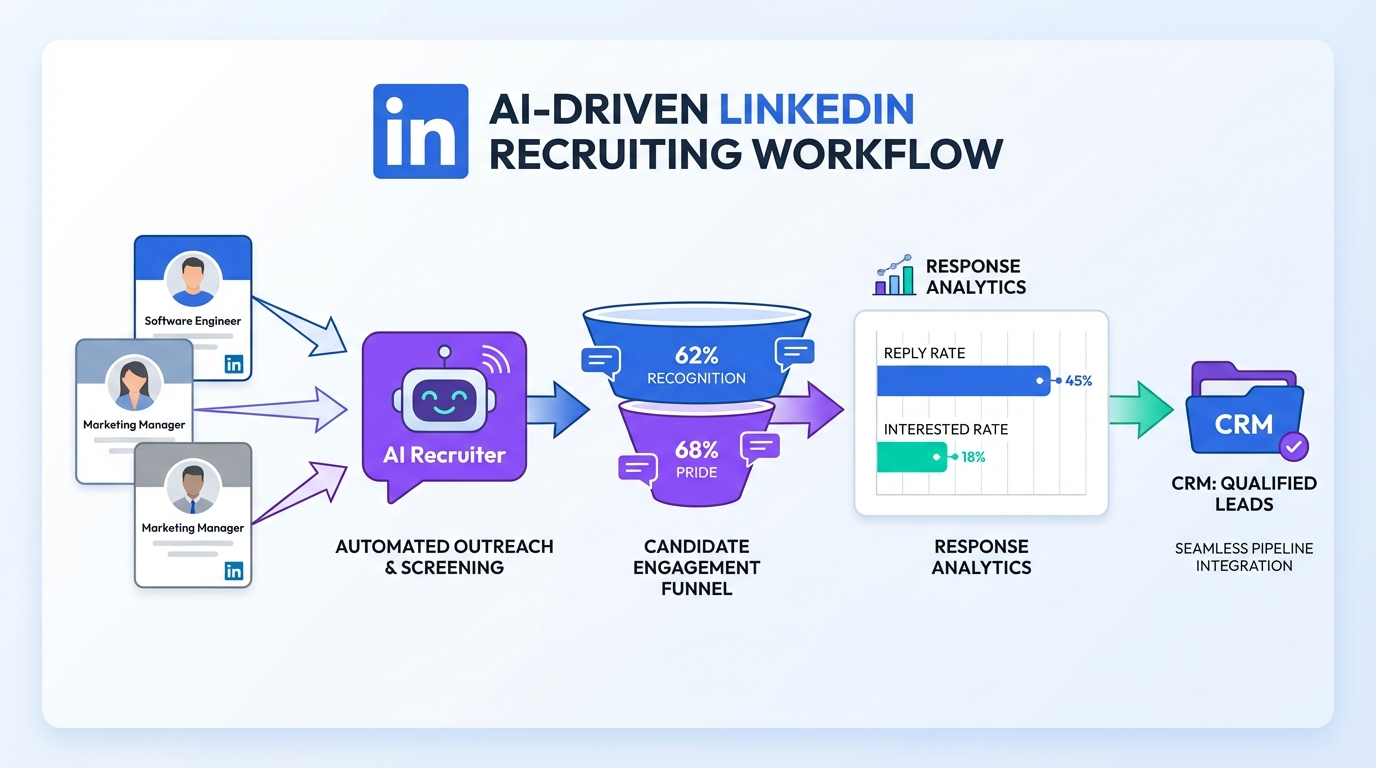
StrategyBrain AI Recruiter is designed for LinkedIn hiring workflows. In practice, it sits between your sourcing strategy and your human led evaluation. It automates the repetitive front end of outreach and early conversation, then hands off to recruiters for final qualification and interviews.
What it automates on LinkedIn
- Connecting with candidates who match your targeted search criteria.
- Introducing job opportunities and answering common questions about the role, company, and compensation.
- Following up with candidates in a timely way, including outside business hours.
- Collecting resumes and contact information from interested candidates.
What it adds for global and high volume teams
- 24/7 multilingual communication in the candidate’s native language.
- Team scaling by supporting management of more than 100 LinkedIn accounts.
In our experience reviewing recruiting operations, the biggest operational win is not just speed. It is reducing “context switching” for recruiters. When the AI handles the first layer of messaging and captures structured outcomes, recruiters can spend their time on the parts that require judgment.
Workflow: LinkedIn outreach to shortlist with AI support
The workflow below is a practical template you can copy. It is intentionally written so it can be implemented with StrategyBrain AI Recruiter plus your existing ATS, recruitment analytics software, and CRM.
Step by step implementation
-
Define the search criteria
Document the role requirements, must have skills, location constraints, and seniority. This is the input that determines who the AI will connect with on LinkedIn.
-
Prepare a recognition based opening
Write 2 to 3 opening message variants that include a specific recognition cue. For example, reference a project type, domain, or measurable outcome. This aligns with the 62% recognition importance highlight.
-
Configure StrategyBrain AI Recruiter with job context
Provide company details, compensation, benefits, and role specifics so the AI can answer candidate questions consistently and accurately during the first conversation.
-
Run outreach and let the AI manage follow up
StrategyBrain AI Recruiter connects, introduces the opportunity, and follows up. It also learns the candidate’s situation and confirms interview interest where appropriate.
-
Capture resumes and contact details
When candidates express interest, StrategyBrain AI Recruiter requests resumes and contact information. It supports email submissions and LinkedIn file uploads, and marks resumes as received when provided.
-
Human final qualification
Recruiters review the resume and decide fit. StrategyBrain AI Recruiter can identify willingness to communicate or interview, but it does not determine full qualification against requirements.
Quick checklist for rollout
- Confirm what the AI is allowed to say about compensation and benefits, and keep it consistent with your approved ranges.
- Decide what counts as “interested” and what data must be captured before handoff.
- Define a response time standard for human follow up after the AI collects a resume.
- Set a multilingual policy for global roles so candidates can choose their preferred language.
Measurement: what to track with recruitment analytics software
If you already use recruitment analytics software, the goal is to measure whether AI assisted outreach improves the funnel, not just activity volume. If you do not have analytics yet, start with a small set of metrics that are easy to define and hard to game.
Metrics that connect to outcomes
- Connection acceptance rate: accepted connections divided by connection requests sent.
- Reply rate: candidates who reply at least once divided by accepted connections.
- Interested rate: candidates who confirm interest divided by candidates who replied.
- Resume capture rate: resumes received divided by interested candidates.
- Interview scheduled rate: interviews scheduled divided by resumes received.
To tie this back to the happiness highlights, you can also tag message variants that include recognition language and compare their reply and interested rates. That is a simple way to test whether the “recognized and appreciated” insight shows up in your own pipeline.
CRM handoff for agencies
Agency teams often ask whether an AI recruiting tool replaces the best CRM software for recruitment agency operations. In practice, it does not. The CRM remains the system of record for clients, submissions, interviews, offers, and placements. The AI layer improves the top of funnel and the speed of candidate engagement.
A clean division of responsibilities
- StrategyBrain AI Recruiter: LinkedIn outreach, early conversation, Q&A, follow up, resume and contact capture.
- Recruitment CRM: client requirements, candidate ownership, submission history, pipeline stages, and revenue reporting.
- Recruitment analytics software: funnel conversion, cohort analysis, and channel performance reporting.
If you want the simplest implementation, start by ensuring every AI captured resume and contact detail is logged into your CRM with a consistent source tag such as “LinkedIn AI assisted outreach.”
Limitations and guardrails
AI can improve speed and consistency, but it should not be treated as a substitute for professional judgment or compliance review.
Limitations we recommend stating internally
- Qualification is still human work: StrategyBrain AI Recruiter can confirm interest and collect resumes, but recruiters must assess fit against requirements.
- Happiness data is directional: the Career Happiness Index (2012) highlights are not a guarantee of individual motivation.
- Message governance matters: define what the AI can say about compensation, benefits, and role scope to avoid inconsistency.
Privacy and security notes (from product information)
- StrategyBrain AI Recruiter states it complies with privacy regulations in the EU, United States, and Canada.
- Customer provided data is stated as not used to train AI models.
- LinkedIn account credentials are stated as encrypted and stored independently per user with explicit authorization.
FAQ
What is an ai recruiting tool in practical terms?
An ai recruiting tool is software that automates parts of recruiting such as sourcing, outreach, messaging, screening, and data capture. In this article, we focus on AI that supports LinkedIn outreach and early candidate conversations, then hands off to recruiters for final qualification.
How does StrategyBrain AI Recruiter help with LinkedIn recruiting?
StrategyBrain AI Recruiter automates connecting with candidates, introducing the role, answering questions about the job and company, following up, and collecting resumes and contact details from interested candidates. Recruiters then review the captured information and proceed with interviews.
Can StrategyBrain AI Recruiter communicate in multiple languages?
Yes. StrategyBrain AI Recruiter is designed for 24/7 multilingual candidate communication, using the candidate’s native language to reduce misunderstandings and time zone delays.
Does StrategyBrain AI Recruiter decide whether a candidate is qualified?
No. It can identify willingness to communicate or interview and can collect resumes and contact details, but it does not determine whether a resume fully matches job requirements. Recruiters complete final qualification.
Do I still need recruitment analytics software if I use an AI tool?
Yes. Recruitment analytics software helps you measure funnel conversion and channel performance. AI can increase activity, but analytics tells you whether that activity improves outcomes such as interviews and hires.
Is the best CRM software for recruitment agency teams replaced by AI outreach?
No. A recruitment CRM remains the system of record for clients, submissions, interviews, offers, and placements. AI outreach improves the top of funnel and candidate engagement, then the CRM manages the downstream workflow.
How should I use “happiness at work” data without overinterpreting it?
Use it to improve messaging and candidate experience, not to predict individual behavior. For example, the recognition finding can inform how you write outreach, but it should not be used as a screening criterion.
What is the fastest way to test whether recognition based messaging works?
Run two outreach variants for the same role and track reply rate and interested rate for each variant. Keep the audience and timing consistent, and use recruitment analytics software to compare results.
Conclusion
The Career Happiness Index (2012) highlights point to a candidate truth that still shows up in modern pipelines: people respond to recognition, clarity, and respectful communication. A well implemented ai recruiting tool helps you deliver that experience consistently at scale. If your team recruits on LinkedIn, StrategyBrain AI Recruiter can automate connecting, initial conversations, follow up, and resume capture, while your recruiters focus on final qualification and interviews. Next, choose 1 role, define 2 message variants, track funnel metrics in your recruitment analytics software, and ensure every captured lead is logged into the best CRM software for recruitment agency workflows you already rely on.