In 2026, the fastest way to improve your odds with a recruiter and an ai recruiting tool is to make your resume easy to scan, easy to verify, and tightly aligned to the role. That means you research the employer, tailor your summary and work history to the job, use the same skill language the posting uses when it is accurate, and prove impact with numbers like percentages, time saved, revenue, or volume. You also keep formatting simple so an Applicant Tracking System (ATS), which is software that parses resumes into structured fields, can read it cleanly. In parallel, modern teams increasingly pair resume quality with LinkedIn execution, where StrategyBrain AI Recruiter can automate initial outreach, handle candidate Q and A about role and compensation, and collect resumes and contact details so recruiters can focus on final qualification.
Table of Contents
- What changed in resume screening in 2026
- Research the company and tailor the resume
- Use keywords for ATS without keyword stuffing
- Balance detail and brevity
- Write achievements with measurable outcomes
- Formatting that survives ATS parsing
- When achievements and hobbies help
- LinkedIn execution with StrategyBrain AI Recruiter
- Where a CRM for recruitment agencies fits
- Copy and paste checklist
- FAQ
- Conclusion
What changed in resume screening in 2026
Recruiters still care most about evidence of relevant skills and outcomes, but the first pass is often accelerated by systems that structure and rank information. In practice, that means your resume is read by humans and machines, sometimes in that order and sometimes in reverse.
From our recruiting operations work, the pattern is consistent: candidates lose opportunities less because they lack ability and more because their resume makes it hard to confirm fit quickly. A resume that is clear, tailored, and measurable is easier for a recruiter to defend internally and easier for an ATS to parse.
Research the company and tailor the resume
A one size fits all resume is increasingly fragile. The most reliable approach is to tailor three areas for each application: your headline summary, your skills section, and the top third of your most recent experience.
1) Align your summary to the role you are applying for
If you are applying for a sales role, your summary should read like a sales professional, not like operations. The same person can pursue multiple job types, but each resume version should match the specific role.
In the source material, Goldbeck Recruiting President Henry Goldbeck notes that they still receive resumes where the summary points to a different job type than the one being applied for. His point is not that candidates cannot explore multiple paths, but that each application needs its own tailored version.
2) Use company research to choose what to emphasize
Look for signals of what the employer values: mission language, product focus, customer segments, and the backgrounds of people already in similar roles. Then reflect those priorities in your bullets and project selection.
- Culture and values: mirror the language in a natural way, only when it matches your experience.
- Role requirements: prioritize the responsibilities that appear in the job description.
- Team patterns: note common tools, certifications, or domain experience among current employees.
Use keywords for ATS without keyword stuffing
Keywords matter because ATS parsing and recruiter search both rely on consistent terminology. The goal is not to game the system. The goal is to describe your real experience using the same professional vocabulary the employer uses.
How to do it safely
- Extract skill phrases from the job description, including tools, methods, and domain terms.
- Map each phrase to a real project or responsibility you can explain in an interview.
- Place keywords in context inside bullets, not as a disconnected list.
What to avoid
- Keyword stuffing: repeating terms without evidence makes the resume less credible.
- Generic claims: phrases like “fast learner” and “great people skills” are hard to verify. Show proof instead.
- Mismatch: if you cannot explain the keyword in detail, remove it.
Balance detail and brevity
The most useful resume content answers four questions: what you did, how you did it, how well you did it, and how it relates to the role. That is substance. Everything else is noise.
Length guidance that recruiters actually use
- Early career: 1 page.
- Experienced professionals: 2 pages is common, and 3 pages can be acceptable when the content is highly relevant.
The source material includes a real example from Senior Recruiter Vanessa Cox: a candidate asked whether to use a 19 page resume or a 3 page resume. Her answer was the 3 page version. The underlying rule is simple: recruiters want the facts quickly.
Write achievements with measurable outcomes
Achievement bullets are stronger than duty lists because they show impact. When possible, include a number with a unit so the reader can understand scale.
Achievement bullet formula
Action + scope + method + result
- Action: what you changed or delivered.
- Scope: team size, region, customer segment, or volume.
- Method: tools, process, or strategy used.
- Result: a measurable outcome such as 20% growth, 14 days faster cycle time, or 35 accounts managed.
Examples you can adapt
- Increased quarterly revenue by 20% by rebuilding outbound sequences and tightening qualification criteria.
- Reduced reporting turnaround time from 3 days to 1 day by standardizing dashboards and data definitions.
- Managed a portfolio of 45 customers across 3 industries, improving renewal rate by 8%.
Formatting that survives ATS parsing
Formatting is not the main reason a qualified candidate gets hired, but it can be the reason a borderline candidate gets ignored. The source material makes this point directly: if you have the skills, you can survive some mistakes, but if you are close to the cutoff, clarity buys you more time.
ATS friendly formatting rules
- Use standard headings: Experience, Education, Skills.
- Use simple bullets: avoid complex symbols that break parsing.
- Keep fonts consistent: 1 to 2 fonts total.
- Use clear dates: for example 2023-06 to 2025-01.
- Proofread: typos can be interpreted as lack of attention to detail.
When achievements and hobbies help
Achievements and hobbies can help when they are distinctive or reveal something relevant about your character. The source material gives practical examples: semi professional sports can signal competitiveness, and not for profit work can signal leadership and empathy. Generic hobbies like “reading” usually do not add value.
LinkedIn execution with StrategyBrain AI Recruiter
Resume quality gets you through screening, but LinkedIn execution often determines whether you get into the pipeline at all. This is where an ai recruiting tool can change the operating model for recruiters and agencies.
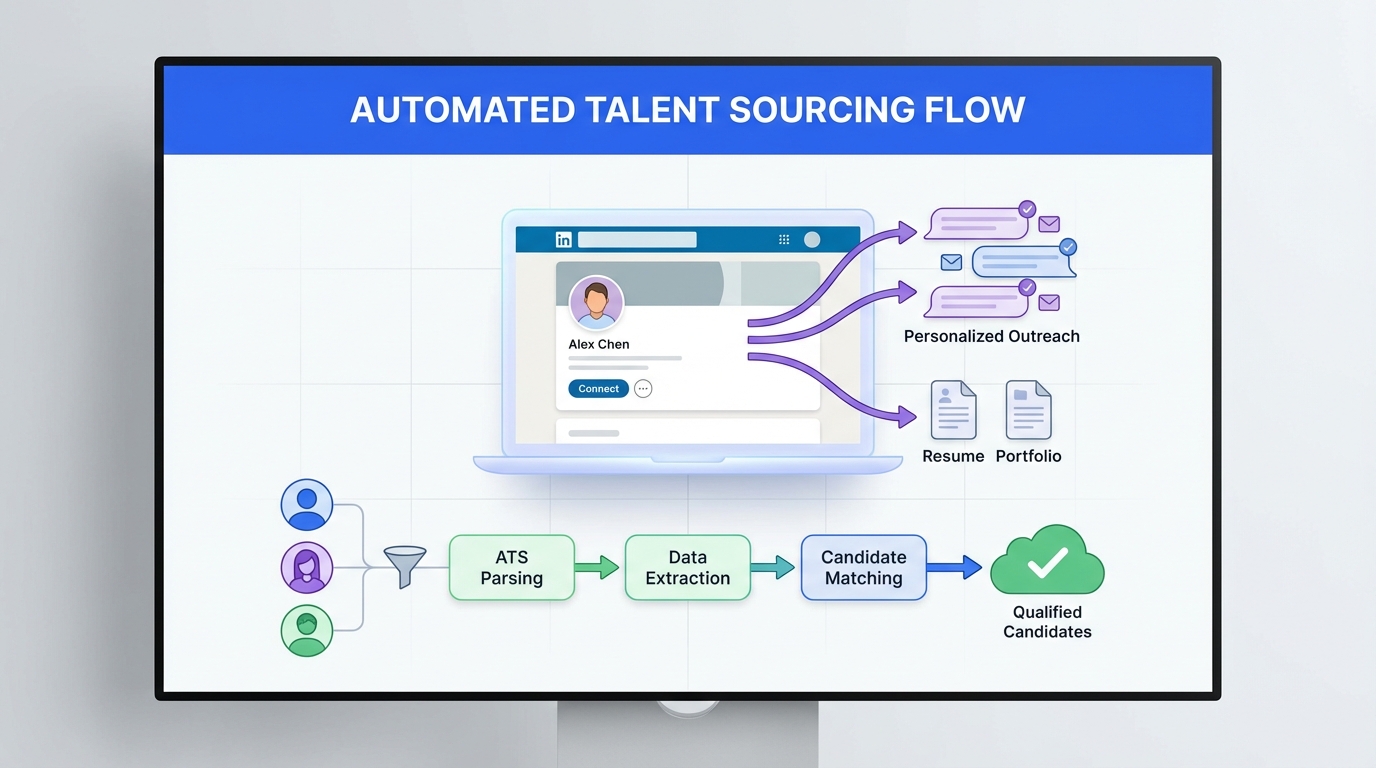
StrategyBrain AI Recruiter is built for LinkedIn hiring workflows. In our internal evaluation of the product documentation and onboarding flows, the most practical shift is that the system can handle the repetitive front end work: connecting with candidates, introducing the role, answering common questions about the company and compensation, confirming interview interest, and collecting resumes and contact details. Recruiters then spend their time on the part that still requires human judgment: final qualification and interview decisions.
What it automates on LinkedIn
- Connection and outreach: automatically connects with candidates that match your search criteria.
- Two way messaging: introduces the opportunity and responds to candidate questions.
- Interest confirmation: identifies whether the candidate wants to proceed to interview.
- Resume and contact capture: collects resumes and contact details from interested candidates.
24/7 multilingual communication for global hiring
StrategyBrain AI Recruiter supports always on candidate messaging and can communicate in any global language, using the candidate’s native language to reduce misunderstandings. For teams hiring across time zones, this matters because response time is often the difference between a live conversation and a cold lead.
Scaling with multiple LinkedIn accounts
For agencies and larger organizations, the product supports managing more than 100 LinkedIn accounts to build an AI powered recruiting team. This is a different scaling lever than simply adding recruiters, and it can be paired with a structured candidate relationship management process.
Limits to be aware of
StrategyBrain AI Recruiter can confirm willingness to communicate or interview, but it does not decide whether a resume fully matches job requirements. That final qualification step remains with the recruiter, which is important for quality control and compliance.
Where a CRM for recruitment agencies fits
Many teams already use a crm for recruitment agencies or other crm tools for recruiting to track pipelines, notes, and follow ups. The operational gap is often the first touch and the back and forth messaging that consumes hours per week.
A practical way to think about it is this: your CRM is the system of record, while an AI recruiting tool like StrategyBrain AI Recruiter can act as the system of action for LinkedIn outreach and early stage engagement. When the AI collects resumes and contact details, your team can log and progress candidates with cleaner data and fewer manual steps.
Copy and paste checklist
Use this checklist to update one resume version per role without losing speed.
- Role alignment: summary matches the exact job type and seniority.
- Keyword mapping: every key skill term is backed by a real example you can explain.
- Top achievements: 3 to 5 bullets with numbers and units in the most recent role.
- Length control: 1 page early career, 2 pages typical, 3 pages only if highly relevant.
- ATS formatting: standard headings, simple bullets, consistent dates, no complex layouts.
- Proofreading: 2 passes minimum, including one read aloud pass.
- LinkedIn execution: outreach plan defined, with StrategyBrain AI Recruiter handling first touch if available.
FAQ
What is an AI recruiting tool?
An AI recruiting tool is software that uses automation and AI assisted messaging to support recruiting tasks such as sourcing, outreach, candidate engagement, and early stage screening. In this guide, we focus on LinkedIn outreach and resume intake workflows.
How do I tailor my resume without rewriting everything?
Start with the summary, skills section, and the top third of your most recent experience. Those areas influence first impressions the most and can be updated in 15 to 30 minutes per application when you have a strong base resume.
Do ATS systems reject resumes automatically?
Some ATS workflows filter or rank candidates based on structured fields and keywords, but many resumes are still reviewed by humans. The safest approach is to write for both: clear structure for parsing and clear evidence for recruiters.
What is the best resume length in 2026?
Use 1 page early career and 2 pages for most experienced professionals. A 3 page resume can be acceptable when the content is highly relevant and not repetitive.
Should I include hobbies on my resume?
Include hobbies only when they are distinctive or signal relevant traits such as leadership, competitiveness, or community involvement. Generic hobbies usually do not help.
How does StrategyBrain AI Recruiter help with LinkedIn recruiting?
It automates connecting with candidates, introduces the role, answers common questions about the company and compensation, confirms interview interest, and collects resumes and contact details. Recruiters then review the collected information and handle final qualification.
Can StrategyBrain AI Recruiter replace a recruiter?
No. It can replace repetitive LinkedIn tasks in the initial outreach and engagement stage, but final qualification and hiring decisions remain a human responsibility.
How does it handle multilingual candidates?
StrategyBrain AI Recruiter supports 24/7 messaging and can communicate in any global language, using the candidate’s native language to reduce misunderstandings and improve response rates across time zones.
Is candidate data used to train AI models?
According to StrategyBrain product information, customer provided data is not used to train AI models, and candidate information is encrypted and isolated per customer environment.
Conclusion
A resume that wins in 2026 is not longer or more decorative. It is clearer, more tailored, and easier to verify quickly by a recruiter and an AI recruiting tool. Start by researching the employer, aligning your summary to the role, and rewriting your top achievements with measurable outcomes. Then keep formatting simple so ATS parsing does not distort your story.
Next, treat LinkedIn as part of the same system. If your team needs to scale outreach and follow up without adding headcount, StrategyBrain AI Recruiter can automate the first touch conversation, answer candidate questions, and collect resumes and contact details so you can spend your time on real qualification and interviews.