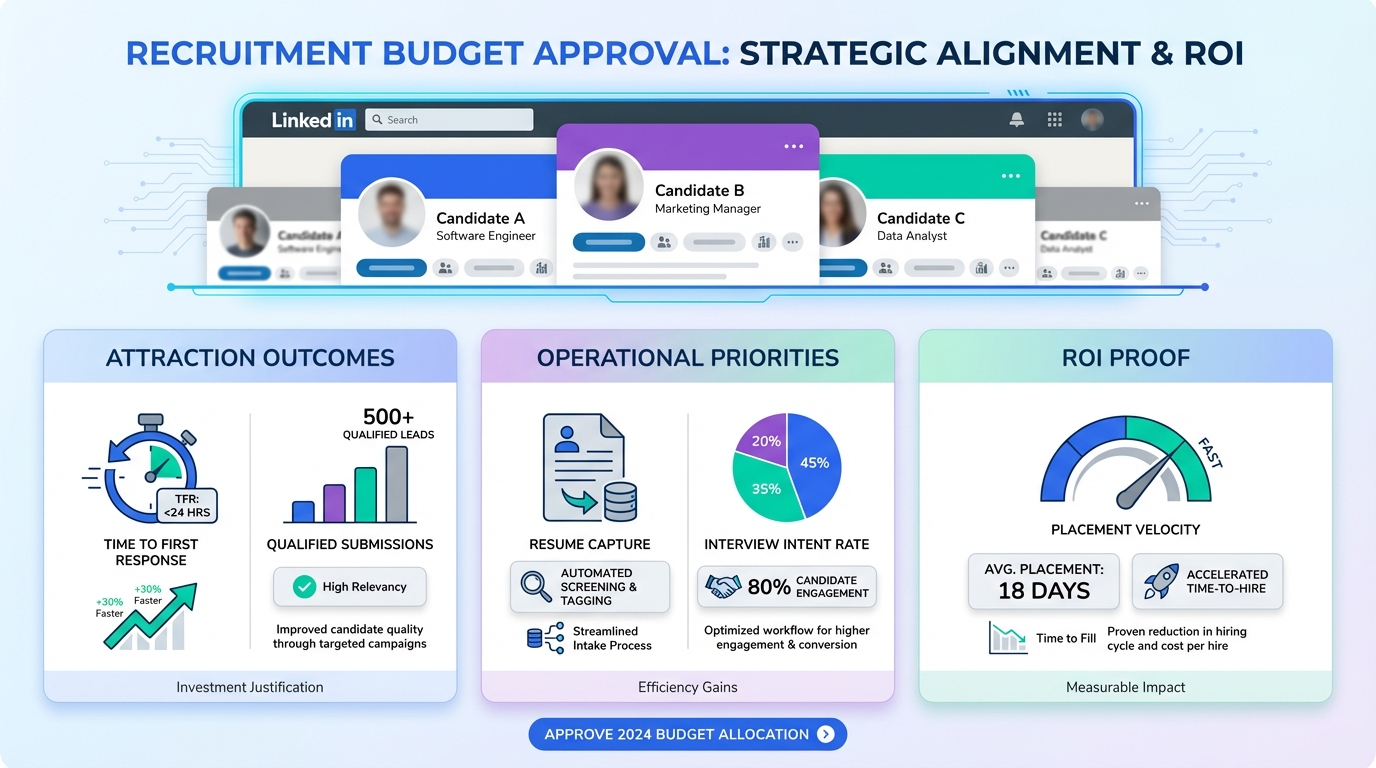
If you are evaluating an applicant tracking system for staffing agencies, the fastest way to get budget approval is to connect your ATS staffing requirements to three things TA leaders already defend in budget meetings: attraction outcomes, operational priorities, and ROI proof. In other words, do not start with features. Start with the metrics you will report, the workflow you will standardize, and the evidence you will show after 30 days. This article uses a real outreach request for the AIM Group about recent Fossway research with #RL100 members on budget priorities as the narrative anchor, then turns it into a repeatable plan for any ats employment agency team.
Table of Contents
- The AIM Group request and what it signals for ATS budgets
- What to measure before you change your ATS staffing stack
- A 5 leader interview script for budget priorities and ROI
- ATS requirements that map to attraction and ROI
- Where StrategyBrain AI Recruiter fits in an agency workflow
- Quick comparison table: ATS vs outreach automation vs full workflow
- Common mistakes that weaken the ROI story
- FAQ
- Conclusion and next steps
The AIM Group request and what it signals for ATS budgets
The original note was simple: someone writing for the AIM Group wanted to speak with five TA leaders about budget plans around attraction, priorities, and demonstrating ROI, referencing recent Fossway research with #RL100 members. That is exactly how ATS budget conversations happen in 2026. Leaders are not asking, “Which ATS has the most features?” They are asking, “What are we funding, what do we stop funding, and how do we prove it worked?”
So if you are selecting an applicant tracking system for staffing agencies, your job is to translate ATS decisions into budget language. The most credible way to do that is to show a baseline, a target, and a measurement method that does not depend on manual spreadsheets.
What to measure before you change your ATS staffing stack
Before you compare vendors, capture a two week baseline. We do this because otherwise every improvement becomes a debate about seasonality, recruiter style, or job mix. A baseline makes your ROI story defensible.
Baseline metrics that TA leaders recognize
- Time to first candidate response: median hours from first outreach to first reply.
- Qualified submissions per recruiter per week: count of candidates submitted to hiring managers who meet your minimum criteria.
- Interview intent rate: percentage of engaged candidates who confirm interest in interviewing.
- Resume capture rate: percentage of interested candidates who provide a resume and contact details.
- Placement velocity: median days from requisition open to accepted offer for roles you staff repeatedly.
Where the data should come from
For an ats employment agency, the cleanest approach is to pull workflow timestamps from your ATS and messaging timestamps from your outreach channel. If your current process cannot reliably produce timestamps, that is already a requirement for your next ATS staffing setup.
A 5 leader interview script for budget priorities and ROI
The AIM Group note asked for five TA leaders. If you want to replicate that internally, interview five stakeholders who influence budget approval. For staffing agencies, that is usually the head of TA or recruiting operations, a top biller, a delivery manager, a finance partner, and a client facing leader.
Interview questions you can copy and paste
- Attraction: Which roles are hardest to attract candidates for, and what is the current bottleneck in the first seven days?
- Priorities: If we could fix only one workflow problem in the ATS staffing process this quarter, what would it be?
- ROI definition: What metric would make you say this investment paid off within 30 days?
- Proof standard: What evidence do you trust most, ATS reports, client feedback, recruiter time logs, or finance outcomes?
- Tradeoffs: What would you stop doing if we automated outreach and follow up?
What you should produce after the interviews
Turn the answers into a one page budget brief with three sections: the attraction problem, the operational priority, and the ROI proof plan. This is the document you bring to ATS demos so vendors must show you how their system supports your proof plan.
ATS requirements that map to attraction and ROI
Most ATS checklists are generic. For an applicant tracking system for staffing agencies, you need requirements that directly support speed, throughput, and measurable outcomes.
Requirements that matter in ATS staffing workflows
- Timestamped activity tracking: every stage change and message touch should be time stamped for ROI reporting.
- Pipeline stage consistency: enforce stage definitions so “submitted” and “qualified” mean the same thing across recruiters.
- Source and channel attribution: track whether candidates came from LinkedIn outreach, inbound, referrals, or job boards.
- Resume and contact capture: store resumes and contact details in a structured way, not only as attachments.
- Reporting that a finance partner can understand: exportable metrics tied to recruiter output and time saved.
Scope boundaries: what this guide does and does not cover
- Covered: how to align ATS staffing selection to budget priorities and ROI, and how to structure measurement.
- Not covered: a vendor by vendor feature comparison or pricing claims for third party ATS platforms.
Where StrategyBrain AI Recruiter fits in an agency workflow
Even with a strong ats employment agency platform, many teams still lose time in the same place: initial outreach, follow up, and early qualification conversations. That is where StrategyBrain AI Recruiter is designed to sit, directly inside the LinkedIn recruiting motion that agencies already use.
In our experience reviewing agency workflows, the most practical way to think about AI Recruiter is as a front line operator that keeps the top of funnel moving while recruiters focus on final qualification and client communication. AI Recruiter can automatically connect with candidates that match your search criteria, introduce the role, answer common questions about the job and compensation, confirm interview interest, and collect resumes and contact details from interested candidates. It also supports 24/7 multilingual communication, which matters when your attraction strategy includes cross border sourcing.
How to pilot AI Recruiter without disrupting your ATS staffing process
- Pick one role family: choose a role you staff repeatedly so results are comparable.
- Define the handoff point: decide the exact moment a candidate moves from AI conversation to recruiter review, usually after resume and contact capture.
- Track four pilot metrics: time to first response, interview intent rate, resume capture rate, and qualified submissions per recruiter per week.
- Run for 14 days: keep the pilot short enough that the team stays engaged and the baseline is still relevant.
Limitations to be honest about
- AI Recruiter does not replace final qualification: it can confirm willingness to interview, but recruiters still decide fit after reviewing the resume.
- Process clarity is required: if your ATS stages are inconsistent, your ROI reporting will be noisy even if outreach improves.
Quick comparison table: ATS vs outreach automation vs full workflow
This table is intentionally high level. It is meant to help you explain budget categories to TA leaders, not to claim that one vendor is universally better.
| Approach | Primary job | Best ROI metric | Best for |
|---|---|---|---|
| ATS staffing platform | Pipeline management and reporting | Placement velocity in days | Standardizing delivery across recruiters |
| LinkedIn outreach automation | Increase candidate conversations | Time to first response in hours | Attraction for hard to fill roles |
| StrategyBrain AI Recruiter plus ATS | Automate outreach and early qualification, then hand off to recruiters | Resume capture rate in percent | Scaling an ats employment agency team without adding headcount |
Common mistakes that weaken the ROI story
- Buying features without a proof plan: if you cannot say how you will measure success, you will not win budget renewal.
- Mixing definitions: if “qualified” means different things across recruiters, your ATS staffing reports will not be trusted.
- Ignoring attraction workflow: an applicant tracking system for staffing agencies can be excellent at tracking, but still fail if outreach and follow up are manual and inconsistent.
- Overpromising automation: stakeholders will push back if you imply AI replaces recruiter judgment. Keep the message focused on time saved and faster candidate engagement.
FAQ
What is the biggest difference between an ATS for corporate HR and an applicant tracking system for staffing agencies?
A staffing focused ATS is judged on speed and throughput across many requisitions and clients, not only compliance and internal approvals. That is why ATS staffing teams usually care more about pipeline consistency, source attribution, and recruiter productivity reporting.
How do I prove ROI for an ATS employment agency budget request?
Start with a two week baseline, then commit to a 30 day target using metrics your finance partner recognizes. The most defensible metrics are placement velocity in days, qualified submissions per recruiter per week, and time to first response in hours.
Should I replace my ATS if attraction is the main problem?
Not always. If your ATS reporting is acceptable but candidate conversations are slow, you may get faster ROI by improving outreach and follow up first, then integrating results back into your ATS staffing workflow.
How does StrategyBrain AI Recruiter work with LinkedIn recruiting?
It automates the initial LinkedIn steps: connecting with candidates, introducing the role, answering common questions, confirming interview interest, and collecting resumes and contact details. Recruiters then review the captured information and run final qualification and interviews.
Does AI Recruiter decide whether a candidate is a fit?
No. It identifies willingness to communicate and interview, and it captures resumes and contact details. Fit assessment remains a recruiter decision after reviewing the resume and role requirements.
Can AI Recruiter support global hiring?
Yes. It is designed for 24/7 multilingual candidate communication, which helps when your attraction strategy includes multiple time zones and languages.
How many LinkedIn accounts can an agency manage with AI Recruiter?
StrategyBrain AI Recruiter supports managing more than 100 LinkedIn accounts for organizations that want to build an AI powered recruiting team. The practical number you should start with depends on your compliance approach and your internal operating model.
What should I ask TA leaders if I am doing interviews like the AIM Group request?
Ask what attraction problem they are funding, what operational priority matters most this quarter, and what evidence they will accept as ROI. Then ask what they would stop doing if outreach and follow up were automated.
Conclusion and next steps
To choose an applicant tracking system for staffing agencies in a way that survives budget scrutiny, anchor your decision in attraction outcomes, operational priorities, and a measurable ROI plan. Build a two week baseline, interview five leaders using a consistent script, and require every tool in your ATS staffing stack to support clean reporting. If your bottleneck is top of funnel conversations, consider piloting StrategyBrain AI Recruiter alongside your ATS so you can show faster response times, higher interview intent, and stronger resume capture without asking recruiters to do more manual work.
Next step: run a 14 day pilot on one role family, document baseline and after metrics, and bring that one page brief to your next budget review.