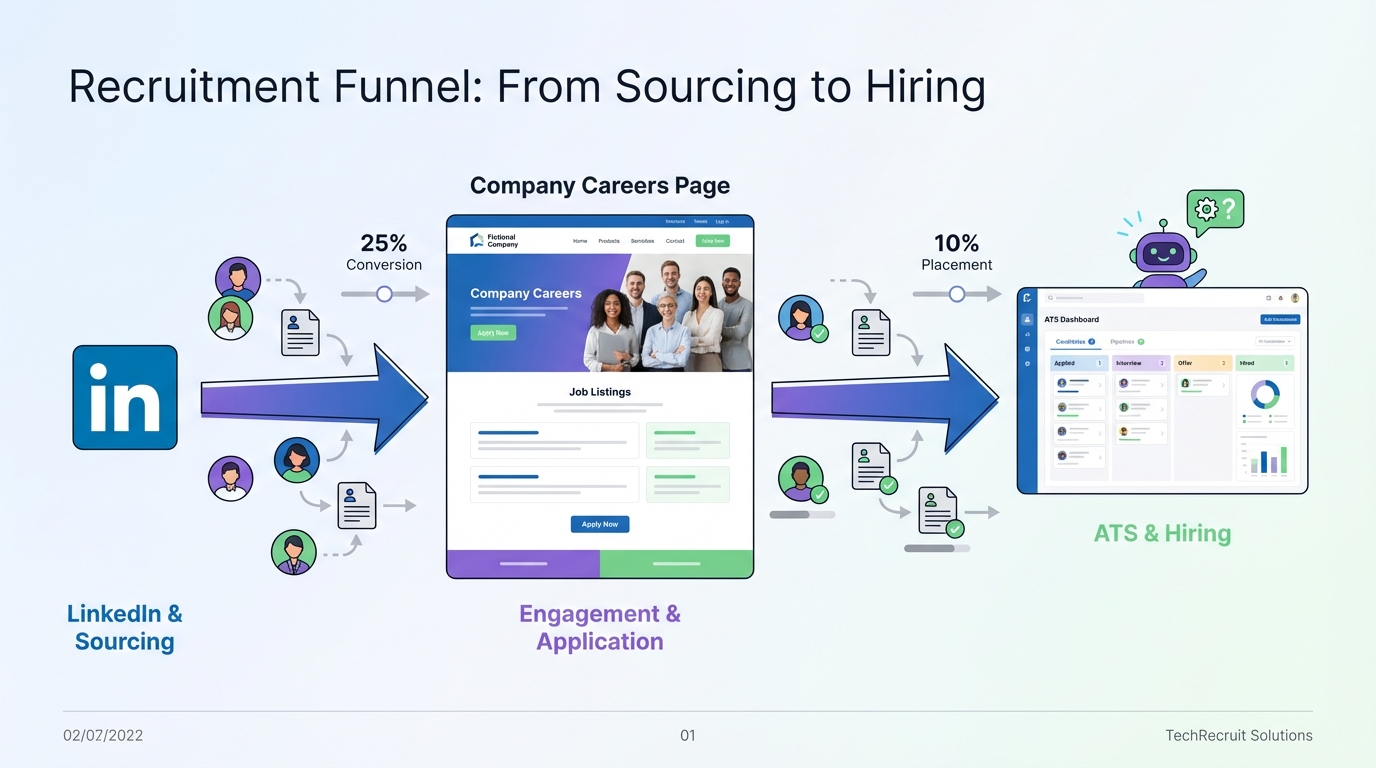
If you want cleaner hiring data and fewer drop offs, route applicants to a careers page on your own website and connect it to candidate tracking software. You can still share roles on third party job boards and social platforms, but your primary funnel should bring candidates back to your site so you control the message, reduce distractions, and keep every application inside one application tracking system. In this guide, I explain what changes when you own the careers page, how to set it up with employment application software, and where StrategyBrain AI Recruiter fits in when LinkedIn is a major sourcing channel.
Table of Contents
- Why a careers page changes your hiring outcomes
- What candidate tracking software should capture on your site
- Method 1: Build a company job board on your website
- Method 2: Connect your careers page to an application tracking system
- Method 3: Add StrategyBrain AI Recruiter for LinkedIn sourcing and follow up
- Method 4: Reduce candidate leakage from third party platforms
- Method 5: Measure the funnel and improve conversion
- Quick Comparison
- FAQ
- Conclusion
Key Takeaways
- Own the funnel: A careers page keeps candidates on your domain so you control messaging and reduce distractions.
- Centralize data: Candidate tracking software works best when every application, resume, and message lands in one system of record.
- Use third party boards for reach, not the final step: Promote externally, but drive applicants back to your careers page.
- Pair site applications with LinkedIn automation: StrategyBrain AI Recruiter can handle initial LinkedIn outreach and follow up while your application tracking system stores applicant data.
- 24/7 multilingual communication: StrategyBrain AI Recruiter supports always on candidate messaging in the candidate’s native language.
- Scale with multiple accounts: StrategyBrain AI Recruiter supports managing more than 100 LinkedIn accounts for team based sourcing operations.
Why a careers page changes your hiring outcomes
When you send candidates to a third party job site, you are also sending them into a marketplace designed to keep them browsing. That is great for the platform, but it is not great for your conversion rate or your ability to track what happened next.
In the source article that inspired this rewrite, the author describes a very real pattern: candidates upload resumes to large job boards, then recruiters and headhunters can immediately start contacting them. Even when those messages do not lead to a move, the candidate is now in multiple databases and may be re contacted later, which can increase turnover risk after you hire them.
A careers page on your own site is the simplest way to keep the candidate journey coherent. It also gives your candidate tracking software a clean place to capture structured data, such as role applied for, location, trade or specialty, and availability.
What candidate tracking software should capture on your site
Candidate tracking software is the layer that records and organizes applicant information and hiring activity. Many teams use the term interchangeably with an application tracking system, which is the system that manages applications, stages, and hiring workflows.
On a careers page, your tracking setup should reliably capture the following items so you can make decisions with evidence rather than guesswork.
Minimum data to capture
- Source: Where the candidate came from, such as your website, LinkedIn, or a job board campaign.
- Role and location: The exact job posting and region tied to the application.
- Resume and contact details: A resume file plus email and phone, stored consistently.
- Consent and privacy: A clear notice that explains how you use candidate data.
- Status history: Every stage change with timestamps so you can audit the process.
Scope note: This article focuses on the website funnel and LinkedIn outreach. It does not cover background checks, offer letter tooling, or payroll onboarding systems.
Method 1: Build a company job board on your website
The original author’s recommendation is straightforward: build a careers page and host your job listings on your own site. They mention using a WordPress job board plugin such as WordPress Job Manager or an equivalent tool. The specific plugin matters less than the outcome: candidates can browse roles without leaving your domain.
Steps
- Create a dedicated careers page with a clear value proposition, benefits, and role categories.
- Publish job listings in a consistent format with responsibilities, requirements, location, and pay range if you share it publicly.
- Add an application form that collects resume and contact details in a structured way.
- Confirm the next step on submission, such as expected response time and how interviews work.
Features to include
- Search and filters by trade, discipline, location, and seniority.
- Mobile friendly layout so candidates can apply from a phone.
- Clear employer story so candidates understand why the role exists and what success looks like.
Limitations
- You still need distribution: A careers page does not replace promotion. You will still post and share roles elsewhere.
- It requires upkeep: Outdated postings reduce trust and can create compliance issues.
Best For
- Teams that want to control the candidate journey end to end.
- Employers who want a consistent brand experience for applicants.
- Organizations that need better attribution for recruiting spend.
Method 2: Connect your careers page to an application tracking system
A careers page is the front door. Your application tracking system is the back office that keeps the process consistent. If you only collect resumes by email or scattered forms, you will lose context, duplicate work, and create reporting gaps.
Steps
- Define your stages such as new applicant, phone screen, interview, offer, hired, and rejected.
- Map form fields so your employment application software writes clean data into the right ATS fields.
- Set up notifications so hiring managers see qualified submissions quickly.
- Standardize rejection and follow up messages to improve candidate experience.
What I look for in the integration
- Reliable resume capture with file upload support and clear file type rules.
- Duplicate detection so repeat applicants do not fragment into multiple records.
- Audit trail for compliance and internal accountability.
Limitations
- Bad forms create bad data: If your form is confusing, your candidate tracking software will store incomplete records.
- Over automation can backfire: Auto rejections without context can harm your employer brand.
Method 3: Add StrategyBrain AI Recruiter for LinkedIn sourcing and follow up
Many teams treat LinkedIn as a separate world from their website funnel. That split is where leads get lost. The practical approach is to run two coordinated tracks: your careers page captures inbound applicants, and LinkedIn outreach drives targeted candidates into the same process.
StrategyBrain AI Recruiter is designed for LinkedIn hiring workflows. It automates the initial outreach and qualification conversation by connecting with candidates that match your search criteria, introducing the opportunity, answering questions about the role, company, and compensation, and confirming interview interest. When a candidate wants to proceed, it collects resumes and contact details so your team can move them into your candidate tracking software and interview flow.
Steps
- Provide job context including company details, compensation, benefits, and candidate search criteria.
- Let the AI run outreach to connect and start conversations with relevant candidates.
- Review interested candidates after resumes and contact details are collected.
- Move qualified candidates into your application tracking system stages for interviews and decisions.
Where it fits with candidate tracking software
- Top of funnel automation: AI Recruiter handles repetitive LinkedIn tasks so recruiters focus on evaluation and closing.
- Always on follow up: It responds 24/7 and supports multilingual communication in the candidate’s native language.
- Scale operations: It supports managing more than 100 LinkedIn accounts for organizations that run team based sourcing.
Limitations
- It does not replace final qualification: AI Recruiter identifies willingness to proceed, but recruiters still assess resume fit against requirements.
- Process alignment matters: If your ATS stages and interview criteria are unclear, automation will not fix the downstream bottleneck.
Method 4: Reduce candidate leakage from third party platforms
The original author calls out a common drawback of sending candidates to third party job sites: candidates get distracted by endless alternatives. That is not a moral failing, it is how marketplaces are built.
To reduce leakage, treat third party platforms as awareness channels and your careers page as the conversion destination. Your candidate tracking software then becomes the single source of truth for what happened after the click.
Practical checklist
- Use consistent job titles across platforms so candidates recognize the same role.
- Repeat the same core message so the candidate experience feels continuous.
- Keep the apply flow short and remove unnecessary fields from the first step.
- Confirm submission with a clear next step and expected timeline.
Method 5: Measure the funnel and improve conversion
Once your careers page is the hub, you can measure the recruiting funnel like a marketing funnel. The original author explicitly compares recruiting to marketing, and that framing is useful because it pushes you to track conversion points rather than rely on anecdotes.
What to measure inside your application tracking system
- View to apply rate: Job page views divided by completed applications.
- Apply to screen rate: Completed applications divided by candidates screened.
- Screen to interview rate: Screened candidates divided by interviews scheduled.
- Interview to offer rate: Interviews divided by offers extended.
- Offer acceptance rate: Accepted offers divided by offers extended.
What I change first when results are weak
- Rewrite the job post to clarify outcomes, schedule, and compensation expectations.
- Simplify the application so candidates can complete it quickly on mobile.
- Speed up first response using templates and automation where appropriate.
Quick Comparison
| Approach | Primary Goal | What You Control | Best For |
|---|---|---|---|
| Third party job boards only | Reach | Limited messaging and limited data consistency | Fast distribution when you need volume |
| Careers page plus candidate tracking software | Conversion and data quality | Brand, funnel, and applicant records in one place | Teams that want a repeatable hiring process |
| Careers page plus ATS plus StrategyBrain AI Recruiter | Conversion plus outbound automation | Website funnel plus automated LinkedIn outreach and follow up | Teams sourcing heavily on LinkedIn and hiring across time zones |
FAQ
What is candidate tracking software in plain terms?
Candidate tracking software is the system that stores applicant information and tracks where each person is in your hiring process. Many companies implement it as part of an application tracking system so stages, notes, and decisions stay consistent.
Do I need to stop using job boards if I build a careers page?
No. The practical model is to use job boards for visibility and then route serious candidates back to your careers page so your employment application software captures clean data and reduces distractions.
Why does sending candidates to third party sites hurt conversion?
Third party job sites are designed to keep candidates browsing many opportunities. When candidates click away, you lose control of the message and your candidate tracking software loses a clean, attributable path.
How does StrategyBrain AI Recruiter help if I already have an ATS?
An ATS organizes applicants after they enter your process. StrategyBrain AI Recruiter focuses on the LinkedIn top of funnel by automating outreach, answering candidate questions, confirming interest, and collecting resumes and contact details for your team to review.
Can StrategyBrain AI Recruiter communicate with candidates in different languages?
Yes. StrategyBrain AI Recruiter supports 24/7 multilingual communication and can respond in the candidate’s native language to reduce misunderstandings during early conversations.
Does StrategyBrain AI Recruiter decide if a candidate is qualified?
No. It identifies willingness to proceed and gathers resumes and contact details, but final qualification against job requirements is completed by the recruiter after reviewing the resume.
How does AI Recruiter collect resumes and contact details?
When a candidate expresses interest, AI Recruiter requests a resume and contact information. It supports email submissions and LinkedIn file uploads, and it captures contact details shared in messages so recruiters can follow up.
What should I put on a careers page besides job listings?
Include a clear description of your company, benefits, what success looks like, and how the hiring process works. This reduces back and forth and improves the quality of applications your candidate tracking software receives.
How do I keep candidate data secure and compliant?
Use a documented privacy notice, restrict access by role, and ensure data is encrypted in transit and at rest. StrategyBrain AI Recruiter states that customer provided data is not used to train AI models and that credentials and candidate data are encrypted and isolated per customer.
Conclusion
The fastest way to improve hiring clarity is to make your careers page the center of your recruiting funnel and connect it to candidate tracking software so every applicant record is consistent and measurable. Keep using external platforms for reach, but bring candidates back to your site for conversion and data quality. If LinkedIn is a major channel for you, pair that website funnel with StrategyBrain AI Recruiter so outreach, follow up, and resume collection happen continuously while your team focuses on evaluation and interviews.
Next steps: audit where your job links send candidates today, publish a careers page with a simple application flow, and confirm that every submission lands cleanly in your application tracking system.