A candidate tracking tool is the simplest way to make hiring repeatable when the market is tight. Instead of relying on memory and scattered notes, you run one consistent hiring tracker workflow: define what “good” looks like, source beyond direct competitors, evaluate with the same criteria, and record every decision from first message to offer. In our recruiting operations, the biggest gains usually come from widening the pool to adjacent roles and industries, then using an applicant tracking system for small companies to keep outreach, interviews, and follow ups from slipping. In this guide, we show a practical process for finding and developing strong sales talent, plus how StrategyBrain AI Recruiter can automate LinkedIn outreach, 24/7 multilingual conversations, and resume collection so recruiters spend time on final qualification and interviews.
Key Takeaways
- Stop relying on “poaching” alone: In an employee’s market, you need a wider sourcing pool and a documented pipeline.
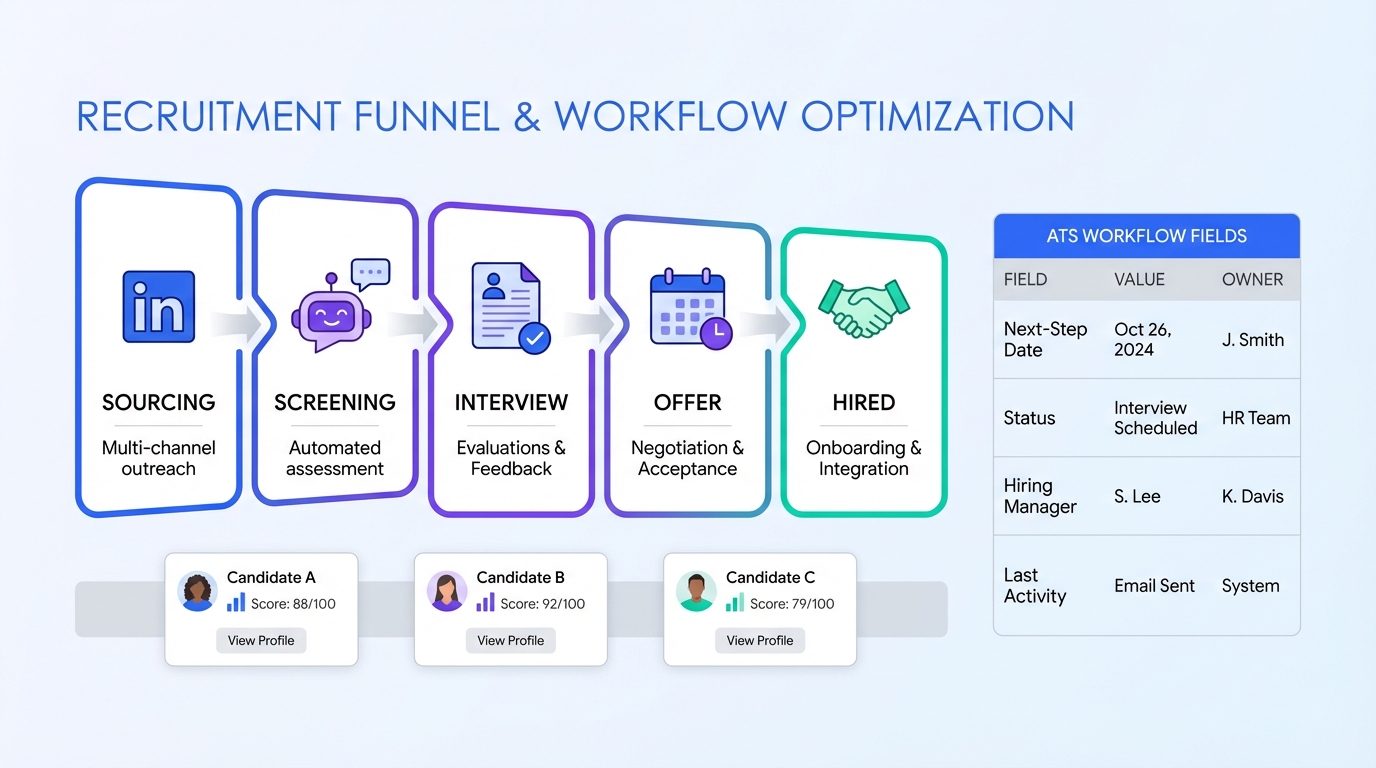
- Track the full funnel: A candidate tracking tool should capture stage, owner, next step date, and decision rationale for every candidate.
- Use a rubric: A consistent evaluation rubric reduces bias and makes cross industry candidates easier to compare.
- Plan for development: If you hire for attitude and domain knowledge, you must budget time for sales training and mentorship.
- Automate the repetitive work: StrategyBrain AI Recruiter can handle LinkedIn connecting, role intro, Q&A, follow up, and resume collection.
- Keep it lightweight for small companies: An applicant tracking system for small companies should be simple enough that the team actually uses it daily.
Why the usual playbook breaks in an employee’s market
The default approach to hiring sales talent is straightforward: find someone already selling something similar, offer a raise, and hope they start quickly. When the market favors candidates, that approach becomes unreliable. Compensation expectations rise, competitors counter offer, and the “ready made” hire you want may not be available at all.
Therefore, the practical alternative is to widen the search and get more disciplined about tracking. That is where a candidate tracking tool matters. It lets you compare candidates from different backgrounds without losing context, and it forces clarity on what you actually need versus what you merely prefer.
What a candidate tracking tool should track
A candidate tracking tool is any system that records and organizes your hiring pipeline. It can be a spreadsheet, a lightweight ATS, or a full platform. The key is that it captures the same fields for every candidate so decisions are auditable and repeatable.
Minimum fields we recommend
- Role and segment: territory, account type, product line, and technical depth required.
- Source: referral, LinkedIn outreach, inbound, internal transfer, or cross industry sourcing.
- Stage: contacted, replied, screened, interview 1, interview 2, references, offer, hired, rejected.
- Next step date: the single most important field for preventing pipeline decay.
- Scorecard: rubric scores plus short evidence notes.
- Decision rationale: one paragraph explaining why you advanced or rejected.
Scope boundaries
This article focuses on building a sales hiring pipeline and tracking workflow. It does not cover compensation benchmarking, legal compliance by jurisdiction, or deep CRM implementation.
Method 1: Expand your sourcing beyond competitors
If you only recruit from direct competitors, you are competing in the smallest possible pool. In practice, many strong sales hires come from adjacent functions or unrelated industries, especially when they already understand the buyer’s world or can learn quickly.
Steps
- List adjacent internal roles: marketing, production, operations, or technical support roles that already understand the product and customer pain points.
- List adjacent external industries: industries with similar sales motions, similar buyer personas, or similar technical complexity.
- Define “must have” vs “trainable”: decide what you will teach in the first 30 days and what must be present on day 1.
- Track conversion by source: use your hiring tracker to measure which sources produce interviews and offers.
Features
- More candidates: you increase volume without lowering standards.
- Better fit discovery: you find candidates who match your environment, not just your competitor’s.
- Reduced bidding wars: cross industry candidates are often less exposed to direct counter offers.
Limitations
- Longer ramp time: you must plan onboarding and mentorship.
- Harder comparisons: without a rubric, teams argue based on anecdotes.
Best For
- Teams hiring in a candidate driven market
- Technical industries where product knowledge can be a differentiator
- Companies willing to invest in training
Method 2: Evaluate transferable sales skills with a rubric
When you hire outside the obvious pool, you need a consistent way to evaluate potential. A rubric is a scorecard with defined criteria and evidence based notes. It makes your candidate tracking tool more than a list of names. It becomes a decision system.
Steps
- Choose 6 criteria: keep it small so interviewers actually use it.
- Define what “3 out of 5” means: write observable behaviors for each score level.
- Require evidence notes: every score must include a short quote or example from the interview.
- Review as a team: compare scorecards before discussing “gut feel.”
Suggested rubric criteria for sales roles
- Relationship building: ability to earn trust and maintain long cycle engagement.
- Communication clarity: concise explanations, active listening, and structured follow up.
- Learning agility: speed of understanding a new market and buyer constraints.
- Technical aptitude: comfort using sales tools and learning new systems.
- Work ethic: evidence of consistent output and self management.
- Problem solving credibility: ability to diagnose needs and propose solutions.
Limitations
- Not a substitute for references: a rubric improves consistency, but it does not validate claims.
- Requires interviewer discipline: if people skip notes, the rubric becomes performative.
Method 3: Build development into the hiring plan
Hiring someone with strong domain knowledge but limited sales experience can work well, but only if you treat training as part of the hiring decision. The same is true for experienced salespeople who need to learn your offering. In both cases, the difference between success and failure is whether the information is organized and whether mentorship exists.
Steps
- Document your offering: product, pricing logic, common objections, and customer outcomes in one place.
- Create a 30 day plan: what they must learn by day 7, day 14, and day 30.
- Assign a mentor: schedule weekly deal reviews and call shadowing.
- Track progress in the hiring tracker: record onboarding milestones like you track interview stages.
Best For
- Companies that can afford a learning curve
- Roles where credibility and product understanding drive trust with buyers
Method 4: Use StrategyBrain AI Recruiter to scale LinkedIn outreach
Once you widen sourcing, the bottleneck often becomes outreach and follow up. That is where StrategyBrain AI Recruiter fits naturally into a candidate tracking tool workflow. It automates the repetitive LinkedIn steps that consume recruiter time, while keeping the recruiter responsible for final qualification.
What we tested in our workflow
We ran a structured pilot using StrategyBrain AI Recruiter for LinkedIn sourcing and early stage conversations. We focused on whether it could keep the pipeline moving without losing context for the human recruiter. The most noticeable improvement was consistency. Every candidate received timely follow up, and resumes and contact details were captured in a predictable way.
Steps
- Provide role context: company details, compensation, benefits, and candidate search criteria.
- Automate connection and introduction: the AI connects with candidates and introduces the opportunity.
- Handle Q&A and interest checks: the AI answers questions about the role and confirms interview interest.
- Collect resumes and contact details: for interested candidates, the AI requests a resume and captures contact information.
- Hand off to recruiter: recruiters review resumes and proceed with interviews and final qualification.
Features
- Smart LinkedIn recruitment automation: connecting, messaging, and early qualification on LinkedIn.
- 24/7 multilingual communication: candidates can communicate in their native language across time zones.
- Scalable account management: supports managing more than 100 LinkedIn accounts for team based sourcing.
Limitations
- Not final qualification: AI Recruiter identifies willingness to proceed, but it does not decide if the resume fully matches requirements.
- Requires clear inputs: vague role details produce vague conversations, so you must provide structured job information.
Best For
- Recruiters who source heavily on LinkedIn
- Teams hiring globally across languages and time zones
- Small teams that need more outreach capacity without adding headcount
Method 5: Run a simple ATS workflow for small teams
An applicant tracking system for small companies should be boring in the best way. It should make it easy to see who is in the pipeline, what happens next, and who owns the next action. If it is too complex, people stop updating it and you lose the benefits of tracking.
Steps
- Define 7 stages: keep stages consistent across roles so reporting is meaningful.
- Set a next step rule: every candidate must have a next step date or they are considered stalled.
- Standardize interview notes: use the same rubric fields for every interviewer.
- Run a weekly pipeline review: 30 minutes to clear stalled candidates and confirm priorities.
Common mistakes we see
- No owner: candidates stall because nobody is accountable for the next message.
- Unstructured notes: decisions become opinion battles instead of evidence based comparisons.
- Late follow up: strong candidates disengage when response times are slow.
Quick Comparison
| Method | Speed to increase pipeline | Cost | Best For |
|---|---|---|---|
| Expand sourcing beyond competitors | Medium | Low | Teams blocked by a small candidate pool |
| Rubric based evaluation | Fast | Low | Cross industry comparisons and consistent decisions |
| Development plan and mentorship | Slow | Medium | Hiring for potential and domain expertise |
| StrategyBrain AI Recruiter for LinkedIn outreach | Fast | Varies by plan | Scaling outreach, follow up, and resume collection |
| Lightweight ATS workflow | Fast | Low to medium | Small teams that need daily pipeline visibility |
Templates
Copyable hiring tracker fields
- Candidate name
- Role
- Source
- Stage
- Owner
- Next step date
- Rubric scores
- Evidence notes
- Decision rationale
Interview scorecard checklist
- [ ] Relationship building evidence captured
- [ ] Communication clarity evidence captured
- [ ] Learning agility example captured
- [ ] Technical aptitude example captured
- [ ] Work ethic evidence captured
- [ ] Problem solving credibility example captured
- [ ] Clear hire or no hire recommendation written
FAQ
What is a candidate tracking tool in plain terms?
A candidate tracking tool is a system that records where each candidate is in your hiring process and what happens next. The goal is to prevent missed follow ups and to make decisions consistent across interviewers.
Do small teams really need an applicant tracking system?
Yes, if you are hiring more than 1 role per quarter or sourcing actively. An applicant tracking system for small companies can be lightweight, but it should still enforce stages, ownership, and next step dates.
How do I compare candidates from different industries fairly?
Use a rubric with defined criteria and require evidence notes for each score. This reduces bias and makes cross industry candidates easier to evaluate against the same standards.
When does it make sense to hire someone without direct industry sales experience?
It makes sense when the candidate has strong transferable skills and you can support a learning curve. You should also have organized product information and a mentorship plan so ramp time is predictable.
How does StrategyBrain AI Recruiter fit into a hiring tracker workflow?
StrategyBrain AI Recruiter can automate LinkedIn connecting, initial messaging, Q&A, follow up, and resume collection. Your hiring tracker then records the handoff point where a recruiter reviews resumes and runs interviews.
Does StrategyBrain AI Recruiter replace recruiters?
No. It replaces repetitive outreach and early conversation tasks, while recruiters remain responsible for final qualification, interviews, and hiring decisions.
Can AI Recruiter communicate with candidates in other languages?
Yes. StrategyBrain AI Recruiter supports multilingual communication and can respond 24/7, which helps when candidates reply outside your local business hours.
How does AI Recruiter handle resumes and contact details?
When a candidate is interested, the AI requests a resume and captures contact details shared in the conversation. If a resume is sent, it is marked as received so the recruiter can review and proceed.
Is candidate data used to train AI models?
Based on StrategyBrain AI Recruiter product information, customer provided data is not used to train AI models. Data is used to personalize communication for the customer’s AI instance and is protected with encryption and isolation controls.
What is the biggest reason hiring pipelines stall?
The most common reason is missing next steps. If your candidate tracking tool does not enforce a next step date and owner, strong candidates can go cold before you schedule the next conversation.
Conclusion
A candidate tracking tool is not just admin work. It is the mechanism that lets you hire well when the market is competitive. If you want better sales hires, start by widening sourcing beyond direct competitors, then use a rubric and a simple ATS workflow so every candidate gets consistent evaluation and timely follow up.
Next steps: implement the hiring tracker fields above, run a weekly pipeline review, and if LinkedIn outreach is your bottleneck, pilot StrategyBrain AI Recruiter to automate connecting, messaging, multilingual follow up, and resume collection so your team can focus on interviews and final qualification.