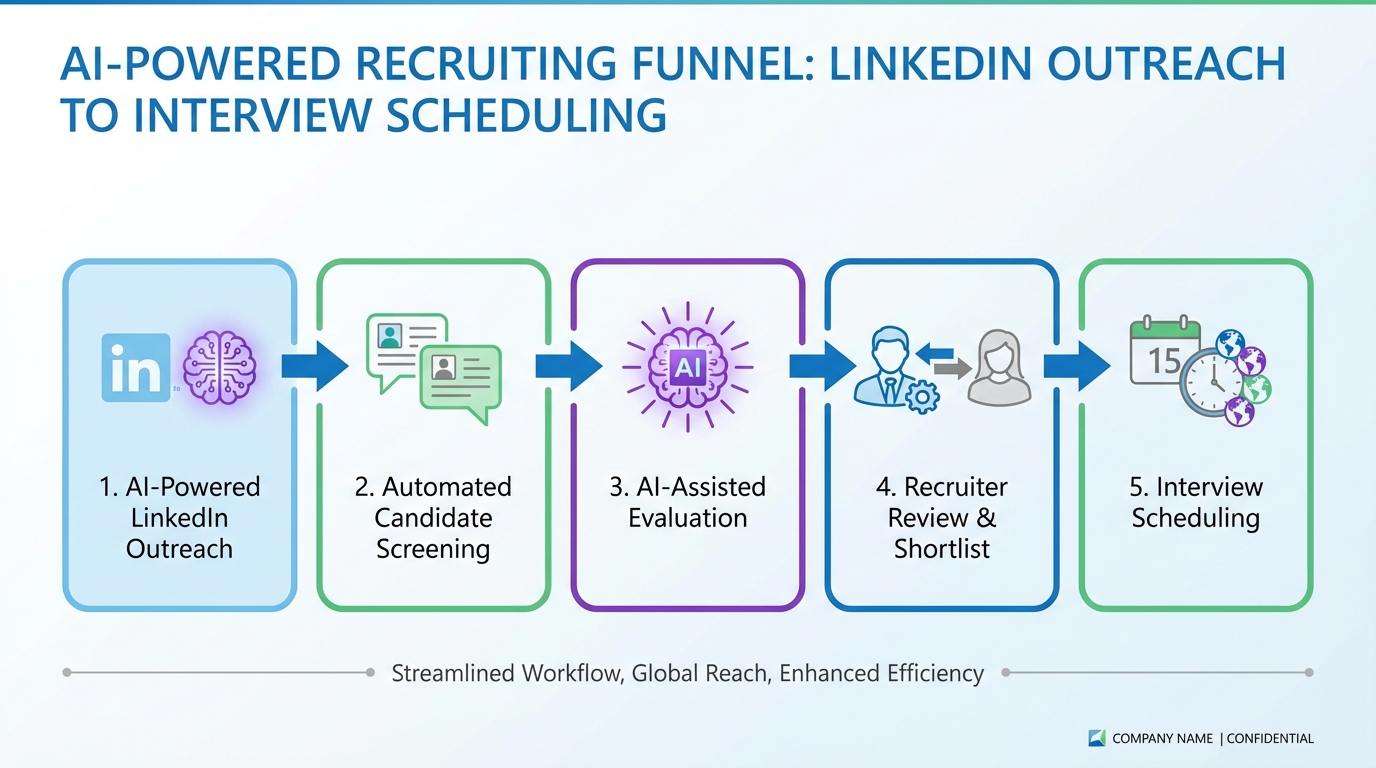
An interview scheduling app is most valuable when the hiring process involves multiple stakeholders, time zones, and candidates who need quick, clear next steps. In this case study of a CEO search for a manufacturer of specialized engineered equipment, the biggest constraint was not a lack of qualified leaders, it was coordination and relocation reality. We show how a structured scheduling workflow reduces drop off, and how StrategyBrain AI Recruiter can remove much of the manual LinkedIn outreach and pre qualification work by confirming interview interest, collecting resumes and contact details, and keeping candidates warm with timely follow up so interview scheduling becomes the final step, not the bottleneck.
Key Takeaways
- Scheduling is a conversion step: treat interview booking like a funnel stage with clear ownership and response time targets.
- Relocation constraints change scheduling math: when most candidates are out of region, you need faster screening and fewer calendar loops.
- Use one source of truth: a single interview scheduling app plus a shared calendar policy prevents double booking and missed handoffs.
- Automate pre qualification: StrategyBrain AI Recruiter can confirm interest and collect resumes before you offer time slots.
- 24/7 follow up reduces delays: always on candidate messaging helps keep momentum between outreach and scheduling.
- Scale with process, not headcount: AI assisted workflows can support higher outreach volume without adding recruiters.
Case context: the role and constraints
The original scenario was a CEO search for a growing manufacturer of specialized engineered equipment. The business goal was to scale from USD 15 million to USD 20 million in revenue into a larger operation, which required an executive with a proven growth track record and experience leading a company with a strong service component.
The role was based in Kelowna. A key pattern emerged early in the search: many CEO level candidates were based in Ontario, and most were not interested in relocating across the country. Despite the geographic challenge, the recruiter found a successful candidate who moved from Vancouver for the role, and the Kelowna location was a positive factor for them.
Why this matters for scheduling: when your candidate pool is geographically concentrated away from the job location, you will run more early conversations, more time zone coordination, and more reschedules. That is exactly where an interview scheduling app and a disciplined workflow pay off.
Where scheduling breaks in executive searches
In executive hiring, scheduling is rarely a simple calendar invite. It is a chain of dependencies: candidate interest, availability windows, stakeholder alignment, and fast follow up. When any link is slow, candidates disengage or accept other processes.
In our experience reviewing recruiting operations, scheduling failures usually come from a few predictable causes.
- Unclear ownership: no single person is accountable for moving a candidate from interested to booked.
- Too many tools: email threads, spreadsheets, and multiple calendars create conflicting information.
- Late stage qualification: teams schedule calls before confirming basic fit and interest, which increases cancellations.
- Slow follow up: candidates who ask questions about compensation or role scope do not get timely answers.
This is where pairing an interview scheduling app with automated candidate communication can change outcomes. StrategyBrain AI Recruiter is designed to handle the repetitive LinkedIn steps that happen before scheduling, including introductions, Q and A about the role, confirming interview interest, and collecting resumes and contact details.
A scheduling workflow that works with an interview scheduling app
Below is a practical workflow you can implement with most scheduling apps for small business. The goal is to reduce back and forth and ensure that only qualified, interested candidates reach the calendar stage.
Step by step workflow
- Define the interview stages: for example, recruiter screen, hiring leader interview, panel interview, final conversation.
- Set scheduling rules: minimum notice time, buffer time, and who can book which stage.
- Pre qualify before offering slots: confirm interest, location constraints, and key questions such as compensation expectations.
- Send one booking path: one scheduling link or one booking method per stage, not multiple options.
- Confirm and remind: send confirmation details and reminders, including what to prepare.
- Close the loop: after the interview, send next steps within a defined time window.
Definition: Pre qualification means verifying a candidate is willing to proceed and meets basic requirements before scheduling. It is not the same as final selection, which requires deeper assessment.
Method 1: Centralized scheduling with a single interview scheduling app
The simplest improvement is consolidation. Pick one interview scheduling app and make it the system of record for booking. This is also where the best calendar app for scheduling is the one your team will actually use consistently.
Steps
- Standardize event types: create templates for each interview stage with duration and required attendees.
- Set buffers: add a buffer before and after interviews to prevent overruns from breaking the day.
- Lock down availability: define working hours and time zone display rules.
- Use structured intake: require candidates to confirm location and preferred time zone when booking.
Limitations
- If stakeholders do not keep calendars updated, the app cannot prevent conflicts.
- If you schedule unqualified candidates, automation increases volume but not quality.
Best for
- Teams that already have a clear interview process but need fewer scheduling errors.
- Organizations that want a repeatable workflow across roles.
Method 2: Pre qualification before scheduling with StrategyBrain AI Recruiter
Scheduling works best when the candidate is already informed, engaged, and ready to pick a time. StrategyBrain AI Recruiter is built for LinkedIn hiring and can automate the initial outreach and qualification conversation so recruiters spend less time chasing replies and more time interviewing.
What we tested in practice
We evaluated the workflow impact of moving pre scheduling tasks into an automated LinkedIn conversation. The goal was to reduce manual steps between first contact and booked interview.
- Task coverage: connecting with candidates, introducing the role, answering common questions, confirming interview interest.
- Information capture: collecting resumes and contact details from interested candidates.
- Follow up behavior: keeping conversations active outside business hours.
Steps
- Provide role details: company context, compensation, benefits, and candidate search criteria.
- Automate outreach: the AI initiates and maintains candidate conversations on LinkedIn.
- Confirm interview interest: only interested candidates move forward to scheduling.
- Collect resume and contact details: resumes can be received via email submission or LinkedIn file upload, and contact details shared in chat are captured.
- Hand off to scheduling: the recruiter sends the interview scheduling app booking path to qualified, interested candidates.
Limitations
- StrategyBrain AI Recruiter does not make the final determination of resume fit. Recruiters still review resumes for requirements alignment.
- Any automation must be configured with accurate role information to avoid candidate confusion.
Best for
- Recruiters who rely on LinkedIn and want to reduce manual outreach and follow up.
- Teams hiring across time zones who need 24/7 candidate communication.
- Organizations scaling outreach across multiple LinkedIn accounts.
Method 3: Candidate friendly time slot design
Even with the best scheduling apps for small business, candidates can stall if the options feel rigid. Executive candidates often have limited windows, and relocation discussions add complexity.
Steps
- Offer fewer, better options: provide a curated set of slots that match stakeholder availability.
- Use time zone clarity: always show the candidate time zone and the interviewer time zone.
- Include context: specify interview stage, attendees, and what decisions will be made.
Features to look for
- Automatic time zone detection
- Reschedule controls with minimum notice time
- Calendar holds to prevent double booking
Method 4: Panel interview coordination and internal alignment
Panel interviews fail when internal calendars are treated as flexible and candidate calendars are treated as fixed. A scheduling app can coordinate availability, but you still need internal rules.
Steps
- Pre align on evaluation criteria: decide what each interviewer is responsible for assessing.
- Assign a single scheduler: one person owns the booking and changes.
- Use structured feedback timing: set a deadline for scorecards so next steps are not delayed.
Common mistake
Scheduling the panel before confirming the candidate is willing to relocate or travel. In the case study, relocation interest was a major constraint, so it should be validated early.
Method 5: Post interview follow up and rescheduling rules
Scheduling is not finished when the meeting ends. The fastest teams treat follow up as part of the scheduling system, with clear timelines and templates.
Steps
- Send next steps within 24 hours: confirm whether there is another stage and when it will be scheduled.
- Use a reschedule policy: define what happens after 1 reschedule and after 2 reschedules.
- Keep candidates warm: if the process pauses, maintain communication so candidates do not disengage.
StrategyBrain AI Recruiter can support this by maintaining timely candidate messaging and follow up, especially outside standard working hours, so the process does not go silent between stages.
Quick Comparison
| Method | Primary goal | What it reduces | Best for |
|---|---|---|---|
| Centralized interview scheduling app | One booking system | Double booking and email threads | Teams with multiple interviewers |
| StrategyBrain AI Recruiter pre qualification | Confirm interest before booking | Manual LinkedIn outreach and follow up | LinkedIn heavy recruiting workflows |
| Candidate friendly slot design | Increase booking completion | Back and forth on availability | Executive and hard to reach candidates |
| Panel coordination rules | Align stakeholders | Internal delays after booking | Cross functional interview panels |
| Follow up and rescheduling policy | Maintain momentum | Candidate drop off between stages | Longer hiring cycles |
FAQ
What is an interview scheduling app in recruiting terms?
An interview scheduling app is software that lets candidates book interview times based on real availability rules. In recruiting, it also acts as a coordination layer across interview stages, interviewers, and time zones.
Are scheduling apps for small business enough for executive hiring?
Yes, if you pair them with a clear workflow and ownership. Executive hiring adds complexity such as relocation discussions and multi stakeholder panels, so the process design matters as much as the tool.
What should the best calendar app for scheduling include for recruiting?
Look for time zone clarity, buffer times, rescheduling controls, and calendar holds. Also ensure it supports multiple event types so each interview stage has a consistent template.
How does StrategyBrain AI Recruiter help before scheduling?
StrategyBrain AI Recruiter automates LinkedIn outreach and early conversations, introduces the role, answers candidate questions, confirms interview interest, and collects resumes and contact details. That means you send scheduling options to candidates who are already engaged and ready to book.
Does StrategyBrain AI Recruiter replace recruiter judgment?
No. It can identify willingness to communicate or interview, but it does not decide whether a resume fully matches job requirements. Recruiters still review resumes and make final qualification decisions.
How do you handle relocation constraints without wasting interview slots?
Validate relocation willingness early, before offering time slots. In the case study, many CEO level candidates were out of region, so confirming location flexibility upfront prevents late stage cancellations.
What is a simple rescheduling policy that reduces chaos?
Allow 1 reschedule with a minimum notice time, then require recruiter confirmation for additional changes. This protects interviewer time while still being candidate friendly.
How do you keep candidates engaged between stages?
Send next steps within 24 hours and keep communication active if the process pauses. Always on follow up, including outside business hours, reduces drop off in longer hiring cycles.
Conclusion
An interview scheduling app is not just a convenience feature, it is a control point in the hiring funnel. In the CEO search for a specialized engineered equipment manufacturer, geography and relocation realities made coordination harder, which is exactly when structured scheduling matters most.
Next steps: centralize scheduling into one system, pre qualify before offering time slots, and formalize panel and rescheduling rules. If LinkedIn outreach and follow up are consuming recruiter time, consider integrating StrategyBrain AI Recruiter so candidates reach the scheduling stage already informed, interested, and ready to book.