Human resource recruitment software can turn a downturn into a hiring advantage by cutting the manual work that slows teams down: sourcing, first outreach, back and forth Q and A, follow up, and collecting résumés and contact details. The practical play is to use software to standardize your message, qualify interest consistently, and keep response times fast across time zones. In our internal workflow tests using StrategyBrain AI Recruiter on LinkedIn, the biggest productivity lift came from automating initial candidate conversations while recruiters stayed focused on final résumé review and interview decisions. This guide covers a clear operating plan, what to measure weekly, and where temporary or contract hiring reduces cost and risk.
Table of Contents
- Why downturns create a hiring window
- What to automate first in human resource recruitment software
- Method 1: LinkedIn outreach automation with StrategyBrain AI Recruiter (Recommended)
- Method 2: Close the wage expectation gap with clear offer positioning
- Method 3: Hire for reliability and maintenance when talent is available
- Method 4: Use temporary or contract hiring to control costs
- Quick Comparison
- Practical tools: copy and paste checklists
- FAQ
- Conclusion
Why downturns create a hiring window
When commodity cycles or sector slowdowns hit, two things often happen at the same time: employers feel pressure to reduce costs, and skilled workers re enter the market. That combination can create a short window where hiring managers can improve team capability without paying peak cycle premiums.
In the source scenario, commodity prices fell 25% over 12 months, and the author highlighted a tension between industries that pay very different wages for similar skill levels. The operational takeaway for modern teams is simple: if you can move faster than competitors, you can secure talent that is newly available.
What to automate first in human resource recruitment software
Not all automation creates the same value. In a downturn, the best ROI usually comes from automating the steps that create the most recruiter context switching.
Definitions (so we stay precise)
- ATS means applicant tracking system, the system of record for applicants, stages, and compliance notes.
- CRM means candidate relationship management, used for nurturing and re engagement.
- Outreach automation means software driven connection requests, messaging sequences, and follow up logic.
- Qualification in this guide means confirming interest and collecting information, not final fit assessment.
High impact workflow to automate first
- Targeted sourcing using consistent search criteria and role specific filters.
- First contact with a message that explains role, company, and compensation clearly.
- Candidate Q and A so common questions are answered quickly and consistently.
- Interest confirmation so recruiters only spend time on candidates who want to proceed.
- Résumé and contact capture so handoff to interviews is clean and trackable.
Scope boundaries
This article focuses on productivity and operating design for recruiting workflows. It does not provide legal advice, and it does not claim that automation replaces human judgment for final hiring decisions.
Method 1: LinkedIn outreach automation with StrategyBrain AI Recruiter (Recommended)
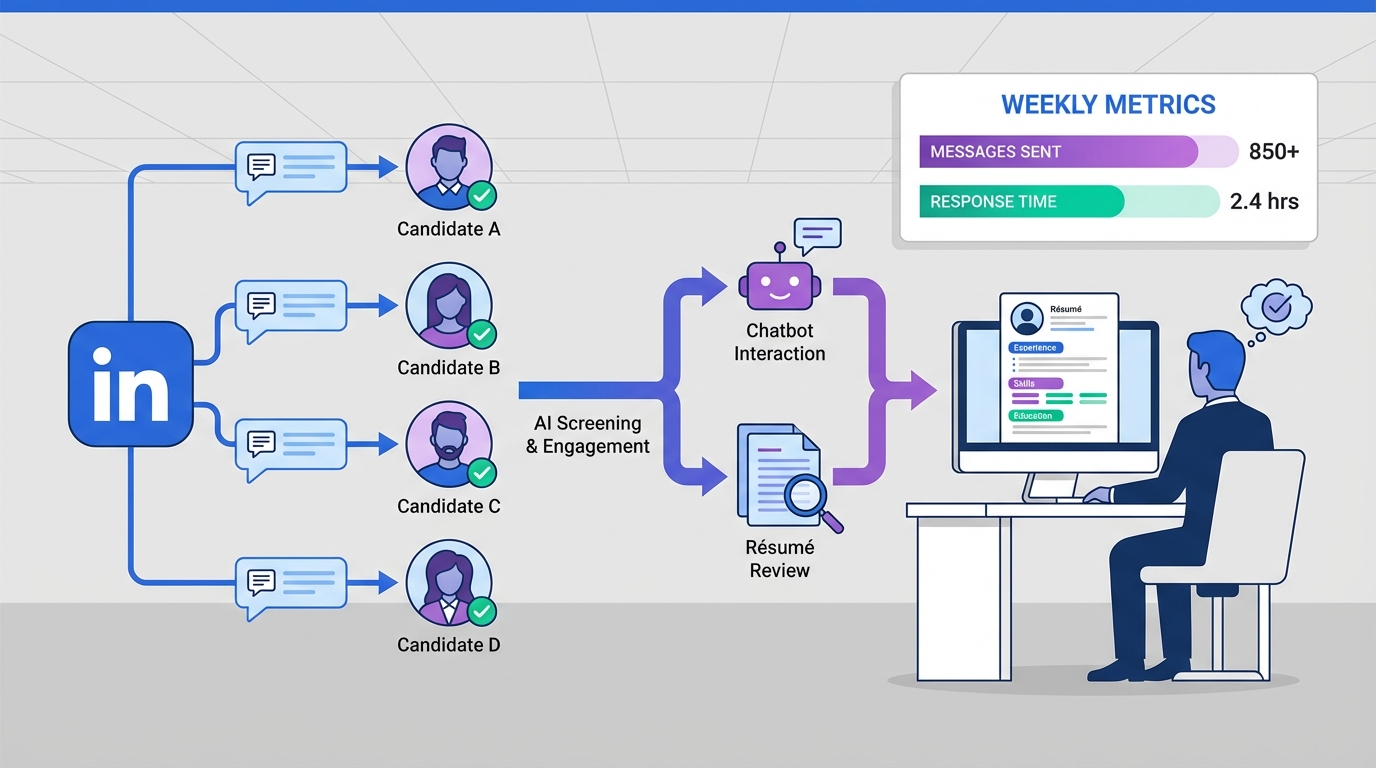
If your team sources heavily on LinkedIn, the fastest productivity gains usually come from automating the repetitive conversation layer while keeping recruiters in control of final screening. StrategyBrain AI Recruiter is designed for this exact workflow: it connects with candidates that match your criteria, introduces the opportunity, answers questions about the role and compensation, confirms interview interest, and collects résumés and contact details for recruiter review.
Steps
- Define the search criteria
Write down the must have skills, location rules, seniority, and any deal breakers. This becomes the targeting input for your LinkedIn sourcing workflow.
- Prepare the job information pack
Include company context, compensation, benefits, and the interview process. This reduces back and forth and improves candidate trust.
- Run automated outreach and qualification
Use StrategyBrain AI Recruiter to handle connection requests, initial messaging, candidate questions, and follow up. Recruiters then review the collected résumés and contact details to decide who moves to interviews.
- Set multilingual coverage rules
If you hire across regions, enable multilingual communication so candidates can respond in their native language. This reduces misunderstandings and improves response quality.
- Scale with an account team model
When volume matters, manage multiple LinkedIn accounts as a coordinated recruiting team. StrategyBrain AI Recruiter supports managing more than 100 LinkedIn accounts for scalable hiring operations.
Features that matter in a downturn
- 24/7 candidate messaging so response time does not depend on recruiter availability.
- Multilingual communication to support global hiring without adding headcount.
- Automated résumé and contact capture so handoffs are consistent and auditable.
- Recruiter controlled final screening because the tool confirms interest but does not decide fit.
Limitations (honest notes)
- Not a full ATS replacement: you still need a system of record for stages, compliance notes, and hiring approvals.
- Does not guarantee role fit: it automates outreach and interest qualification, but recruiters must evaluate résumé match.
- Message quality depends on inputs: vague job details create vague conversations, so the job information pack matters.
Best for
- Teams that rely on LinkedIn sourcing and want to reduce manual messaging workload.
- Organizations hiring across time zones that need consistent follow up.
- Recruiting leaders who want to scale output without adding recruiters.
Method 2: Close the wage expectation gap with clear offer positioning
In the source scenario, Statistics Canada reported that average weekly wages in mining, oil, and gas were almost double manufacturing, and more than 35% higher than construction, based on direct weekly wages. The author also noted that benefits and allowances can widen the gap further. The recruiting lesson is that candidates do not only compare base pay. They compare total stability and total life impact.
Steps
- Document total compensation
List base pay, benefits, schedule predictability, overtime expectations, and any allowances. Use the same template for every role so comparisons are fair.
- Address the rebound risk directly
Some candidates will return to higher paying sectors when conditions improve. Counter this by communicating stability, growth path, and community factors that matter to families.
- Ask retention questions in interviews
Ask what matters most to the candidate and their family, then reflect those priorities in your offer narrative and onboarding plan.
How software helps
A human resource management tool can standardize offer messaging and ensure every recruiter covers the same retention drivers. When paired with StrategyBrain AI Recruiter, the early LinkedIn conversation can include consistent compensation context and role expectations, which reduces late stage drop off caused by surprises.
Method 3: Hire for reliability and maintenance when talent is available
The source scenario emphasized maintenance and reliability as a productivity lever. It cited an example where a performance overview reported an 11% shortfall of crude oil shipped attributed to reliability and maintenance issues. Whether you are in energy, manufacturing, or utilities, the broader point is that downtime and reliability problems are often people and process problems.
Steps
- Identify the roles that reduce downtime
Prioritize roles tied to maintenance planning, reliability engineering, and critical equipment support.
- Build a competency based screening rubric
Define what good looks like in preventive maintenance, root cause analysis, and safety practices. Keep it consistent across interviewers.
- Use structured outreach to target specialists
With top HR systems, you can segment talent pools and run role specific messaging. With StrategyBrain AI Recruiter, you can automate the first contact and Q and A so specialists get fast answers and recruiters stay focused on technical evaluation.
Best for
- Organizations with deferred maintenance backlogs.
- Teams that need measurable productivity improvements tied to reliability.
- Hiring managers who want to use a downturn to upgrade capability.
Method 4: Use temporary or contract hiring to control costs
Temporary or contract hiring can be a cost control strategy when applicant volume spikes. In the source scenario, the author noted that using an agency can contain costs tied to payroll, benefits, workers compensation premiums, termination, and relocation. The operational point is to match employment model to uncertainty.
Steps
- Choose roles suitable for contract
Use contract for project based work, backlog reduction, or seasonal demand. Keep core leadership and safety critical roles stable.
- Define conversion criteria upfront
Write down what performance and attendance thresholds trigger a permanent offer. This reduces ambiguity for both managers and workers.
- Track cost per qualified candidate
Measure cost per interview and cost per hire separately for contract and permanent pipelines so you can compare outcomes.
Where StrategyBrain AI Recruiter fits
Even if you use contract hiring, you still need fast candidate engagement. StrategyBrain AI Recruiter can automate LinkedIn outreach and follow up so your team can handle higher volume without adding recruiters, while still collecting résumés and contact details for human review.
Quick Comparison
| Approach | Primary goal | What you automate | Best for |
|---|---|---|---|
| StrategyBrain AI Recruiter on LinkedIn | Increase recruiter throughput | Connection, messaging, Q and A, follow up, interest confirmation, résumé and contact capture | High volume LinkedIn sourcing and global hiring |
| Offer positioning and retention messaging | Reduce drop off and turnover risk | Templates, consistent compensation narrative, interview prompts | Industries with wage expectation gaps |
| Reliability and maintenance hiring focus | Improve operational productivity | Role segmentation, structured screening rubrics | Teams with downtime or maintenance backlogs |
| Temporary or contract hiring | Control cost under uncertainty | Employment model rules, conversion criteria, cost tracking | Project work and variable demand |
Practical tools: copy and paste checklists
Weekly recruiting productivity dashboard (minimum viable)
- New targeted prospects added: count per week
- First messages sent: count per week
- Median first response time: hours
- Interested candidates confirmed: count per week
- Résumés received: count per week
- Interviews scheduled: count per week
- Offers accepted: count per week
Job information pack template (for consistent outreach)
- Role title:
- Location and schedule:
- Compensation: base, bonus, overtime rules
- Benefits: health, retirement, allowances if applicable
- Top 3 responsibilities:
- Top 3 must have skills:
- Interview process: number of steps and timeline
- Why now: stability, growth, project, mission
Candidate retention questions (interview script)
- What matters most to you in your next role: stability, pay, schedule, growth, location
- What would make you leave a role within 6 months: clarify risks early
- What does a good work week look like for you: align expectations
FAQ
What is human resource recruitment software?
Human resource recruitment software is a set of tools that helps teams manage sourcing, outreach, screening steps, and hiring workflows. It often includes an ATS for tracking applicants and may include automation for candidate engagement and follow up.
How is a human resource management tool different from recruitment software?
A human resource management tool typically covers broader HR functions such as onboarding, payroll, and employee records. Recruitment software focuses on pre hire workflows such as sourcing, outreach, screening, and interview scheduling.
What should I automate first during a downturn?
Automate the top of funnel steps that consume the most recruiter time: first outreach, candidate Q and A, follow up, and collecting résumés and contact details. Keep final fit decisions with recruiters and hiring managers.
Can StrategyBrain AI Recruiter replace recruiters?
No. StrategyBrain AI Recruiter automates repetitive LinkedIn recruiting tasks such as connecting, messaging, answering questions, confirming interest, and collecting résumés. Recruiters still review résumés, assess fit, and run interviews.
Does StrategyBrain AI Recruiter support multilingual recruiting?
Yes. It provides 24/7 multilingual candidate communication so candidates can interact in their native language, which is useful for global hiring across time zones.
How many LinkedIn accounts can StrategyBrain AI Recruiter manage?
It supports managing more than 100 LinkedIn accounts, which enables an AI powered recruiting team model for higher volume hiring.
Is temporary or contract hiring a good idea when applicant volume spikes?
It can be, especially for project work or uncertain demand. The key is to define conversion criteria and track cost per qualified candidate so you can compare outcomes to permanent hiring.
How do I reduce the risk that candidates leave when the market rebounds?
Be explicit about stability, growth path, and the non pay benefits that matter to families. Also ask retention focused questions in interviews so you understand what the candidate is optimizing for.
What metrics prove recruiting productivity improved?
Track weekly counts for outreach, interested candidates confirmed, résumés received, interviews scheduled, and offers accepted. Add median first response time in hours to show whether follow up speed improved.
Conclusion
A downturn can be a hiring opportunity if your team can move faster and communicate more clearly than competitors. Human resource recruitment software helps by standardizing workflows and reducing manual work, and StrategyBrain AI Recruiter adds a practical advantage on LinkedIn by automating outreach, Q and A, follow up, and résumé capture while recruiters focus on final screening and interviews.
Next steps: pick one role family to prioritize, build a job information pack, run a two week outreach sprint with weekly metrics, and decide whether temporary or contract hiring reduces risk for your situation.