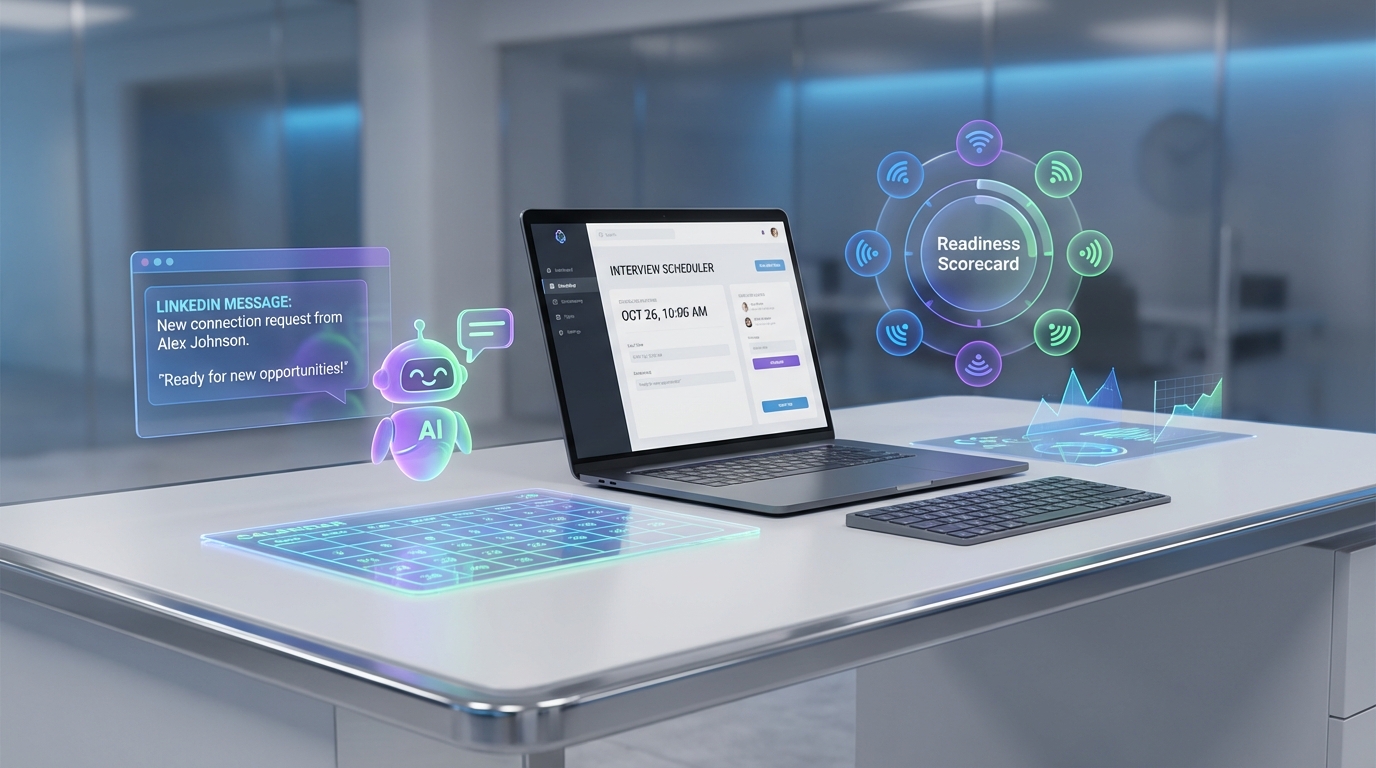
If you are evaluating whether a high performer is ready to become a manager, the fastest way to reduce bias and speed up the decision is to use a simple readiness scorecard and then run a structured interview process with an interview scheduling app. Start by looking for eight observable signals such as team first language, initiative, accountability, and resilience. Then validate those signals with consistent interview questions, documented examples, and a repeatable scheduling workflow that keeps every stakeholder aligned. This guide covers the eight signs, a copy and paste scorecard, and a practical scheduling workflow including how StrategyBrain AI Recruiter can automate early candidate conversations on LinkedIn and hand off only qualified, interested people for interviews.
Key Takeaways
- Use observable signals: Evaluate leadership readiness using 8 behaviors you can see and verify, not gut feel.
- Standardize the interview: A structured interview plus a scorecard improves consistency across interviewers.
- Speed up coordination: An interview scheduling app reduces back and forth and keeps panels aligned.
- Keep evidence: Require 2 concrete examples per signal to avoid over weighting charisma.
- Automate early outreach: StrategyBrain AI Recruiter can handle initial LinkedIn conversations, confirm interest, and collect resumes before scheduling.
- Scale globally: 24/7 multilingual messaging helps you engage candidates across time zones before interviews are booked.
Why readiness decisions need a system
Promoting from within can be a strong strategy, but it also creates a predictable risk: you may confuse current performance with future leadership capability. A system helps because it forces you to define what you mean by “ready,” collect evidence, and compare candidates fairly.
In practice, the system has two parts. First, you evaluate leadership signals with a scorecard. Second, you run a structured interview and use an interview scheduling app to keep the process consistent, timely, and auditable.
The 8 signs someone is ready to become a manager
The signals below are written as observable behaviors. For each one, you will see what to look for and how to validate it in an interview. This keeps the assessment grounded in evidence rather than impressions.
1) From “me” to “us”
What to look for: They define success in terms of team outcomes, not only personal wins. Their language naturally includes shared ownership and shared credit.
How to validate: Ask for a recent example where they improved someone else’s performance. Require specifics: who, what changed, and what metric or outcome improved.
2) Shows initiative
What to look for: They identify problems without being asked and propose a plan to fix them. Initiative is stronger when it includes stakeholder alignment and follow through.
How to validate: Ask them to walk through one improvement they led end to end. Listen for how they diagnosed the issue, influenced others, and measured results.
3) Takes responsibility
What to look for: They step into leadership moments such as leading a system implementation, coordinating a cross functional effort, or owning a critical deliverable.
How to validate: Ask what they owned, what decisions they made, and how they handled tradeoffs. Then confirm whether peers accepted their leadership in that moment.
4) Owns mistakes and learns
What to look for: They can name a mistake, explain the root cause, and describe what they changed afterward. This is a practical indicator of self awareness.
How to validate: Ask for a mistake from the last 12 months and what they did differently afterward. If the answer is vague, ask for the exact action they took next time.
5) Consistency in performance
What to look for: They deliver high quality work repeatedly, not only in bursts. Consistency matters because managers must be reliable under changing priorities.
How to validate: Review performance evidence across at least 2 review cycles and ask for examples of how they maintained quality during peak workload periods.
6) Communication style that earns trust
What to look for: They can be assertive without being disrespectful. They can push back, clarify expectations, and communicate decisions in a way that keeps relationships intact.
How to validate: Use a scenario question: give them a conflict situation and ask what they would say. Look for clarity, respect, and a plan to align on next steps.
7) Resilience and planning under pressure
What to look for: They do not freeze when obstacles appear. They show grit and can propose alternatives such as plan B, plan C, and plan D when needed.
How to validate: Ask for a time a project went off track and what they did in the first 48 hours. Strong candidates describe prioritization, communication, and recovery steps.
8) They are already managing informally
What to look for: Others already treat them as a go to person. They coach peers, unblock work, and help the team navigate ambiguity even without the title.
How to validate: Ask for examples of mentoring or coaching. Then ask who benefited and what changed afterward. If possible, collect peer feedback to confirm the pattern.
Copy and paste readiness scorecard
Use this scorecard to keep the evaluation consistent across interviewers. The goal is not to “average” your way to a decision. The goal is to make evidence visible and comparable.
Readiness Scorecard (1 to 5)
- From “me” to “us”: Score ____ / 5. Evidence: Example 1 ________. Example 2 ________.
- Initiative: Score ____ / 5. Evidence: Example 1 ________. Example 2 ________.
- Responsibility: Score ____ / 5. Evidence: Example 1 ________. Example 2 ________.
- Owns mistakes: Score ____ / 5. Evidence: Example 1 ________. Example 2 ________.
- Consistency: Score ____ / 5. Evidence: Example 1 ________. Example 2 ________.
- Communication: Score ____ / 5. Evidence: Example 1 ________. Example 2 ________.
- Resilience: Score ____ / 5. Evidence: Example 1 ________. Example 2 ________.
- Already managing: Score ____ / 5. Evidence: Example 1 ________. Example 2 ________.
Interview workflow using an interview scheduling app
This workflow is designed for internal promotions and also works for external hiring. The key is to separate evaluation from logistics. Your interview scheduling app handles coordination so interviewers can focus on evidence.
-
Define the role outcomes
Write 3 outcomes the new manager must deliver in the first 90 days. Example: improve on time delivery, reduce rework, or stabilize stakeholder communication.
-
Choose the interview panel
Use 3 to 5 interviewers with distinct perspectives such as the hiring manager, a cross functional partner, and a people leader. Assign each interviewer 2 signals from the scorecard to probe deeply.
-
Standardize questions
For each signal, write 2 questions and 1 scenario prompt. This reduces interviewer drift and makes feedback comparable.
-
Set scheduling rules in the interview scheduling app
Configure interview length, buffer time, and time windows. If you need a calendar website free option for a small team, keep the rules simple: one interview type, one panel template, and one shared availability block.
-
Run the interviews and capture evidence
Require interviewers to submit scorecards within 24 hours of the interview. Evidence must include at least 2 concrete examples per signal.
-
Hold a decision meeting
Review evidence signal by signal. If scores differ by 2 points or more on any signal, ask interviewers to cite the exact evidence that drove their rating.
Common scheduling pitfalls and fixes
- Pitfall: Interviewers ask overlapping questions. Fix: Assign signals per interviewer and share the question bank in advance.
- Pitfall: Feedback arrives late. Fix: Set a 24 hour submission rule and block the decision meeting until all scorecards are in.
- Pitfall: Candidates wait too long between steps. Fix: Pre book time slots in the interview scheduling app for the next stage before the current stage happens.
Where StrategyBrain AI Recruiter fits before scheduling
Scheduling is only efficient when you are scheduling the right people. In our experience, the biggest time sink is not the calendar. It is the manual outreach, follow up, and early qualification that happens before anyone is ready to book time.
StrategyBrain AI Recruiter is designed to automate that pre scheduling work on LinkedIn. It can automatically connect with candidates who match your search criteria, introduce the opportunity, answer questions about the role, company, and compensation, confirm interview interest, and collect resumes and contact details from interested candidates. Once a candidate is genuinely interested and has provided the required information, your team can move them into the interview scheduling app with far less back and forth.
Practical handoff checklist
- Before scheduling: Confirm interest, collect resume, and capture contact details.
- During scheduling: Send the correct interview type and panel template based on role level.
- After scheduling: Share the scorecard and question assignments with the panel.
Limitations to be aware of
- AI Recruiter does not make the final fit decision: It can confirm willingness to interview and collect information, but the recruiter or hiring manager still evaluates whether the resume matches requirements.
- Leadership readiness still needs evidence: For internal promotions, you must validate the eight signals with examples and structured interviews.
Quick comparison: scheduling options
| Option | Best for | Strength | Limitation |
|---|---|---|---|
| Interview scheduling app | Coordinating panels and reducing back and forth | Standardized availability and reminders | Does not solve pre scheduling qualification by itself |
| Calendar website free | Small teams with simple scheduling needs | Low friction setup | Limited governance for complex panels and workflows |
| StrategyBrain AI Recruiter plus scheduling | High volume LinkedIn recruiting and global outreach | Automates outreach, follow up, multilingual messaging, and resume collection before booking | Still requires human review for final qualification and interview decisions |
FAQ
What is an interview scheduling app?
An interview scheduling app is software that coordinates interview availability between candidates and interviewers, then confirms the meeting details. It reduces manual coordination and helps standardize interview steps.
Can I use a calendar website free option for interviews?
Yes, a calendar website free option can work if your process is simple, such as one interviewer and one interview type. If you run panel interviews or multiple stages, you will usually need stronger workflow controls and templates.
How do I avoid bias when assessing manager readiness?
Use a structured scorecard with observable signals and require evidence for each rating. Then run consistent interview questions across candidates and compare evidence signal by signal.
How many interviewers should assess an internal promotion?
Three to five interviewers is a practical range for most teams. Fewer can miss key perspectives, while more can slow scheduling and dilute accountability.
Does StrategyBrain AI Recruiter replace recruiters?
No. StrategyBrain AI Recruiter automates early LinkedIn outreach, Q and A, follow up, and information collection, but recruiters still review resumes and make final qualification and hiring decisions.
Can StrategyBrain AI Recruiter communicate in multiple languages?
Yes. It supports multilingual communication and can respond 24/7, which helps when candidates are in different countries and time zones.
What information should be collected before scheduling an interview?
At minimum, confirm the candidate is interested, collect a resume, and capture reliable contact details. For internal promotions, also collect examples that map to the readiness signals so interviews can probe deeper.
How do I keep interview feedback consistent across the panel?
Assign each interviewer specific signals to evaluate, use the same question bank, and require scorecard submission within 24 hours. Review disagreements by asking for the exact evidence behind each score.
Conclusion and next steps
To decide whether someone is ready to become a manager, focus on eight observable leadership signals and validate them with a structured interview and a scorecard. Then use an interview scheduling app to keep the process fast, consistent, and easy to coordinate.
Next steps: copy the scorecard, assign signals to your interview panel, and set up your scheduling rules. If your biggest bottleneck is LinkedIn outreach and follow up before interviews, consider adding StrategyBrain AI Recruiter to automate early conversations, confirm interest, and collect resumes so your calendar is reserved for the right candidates.