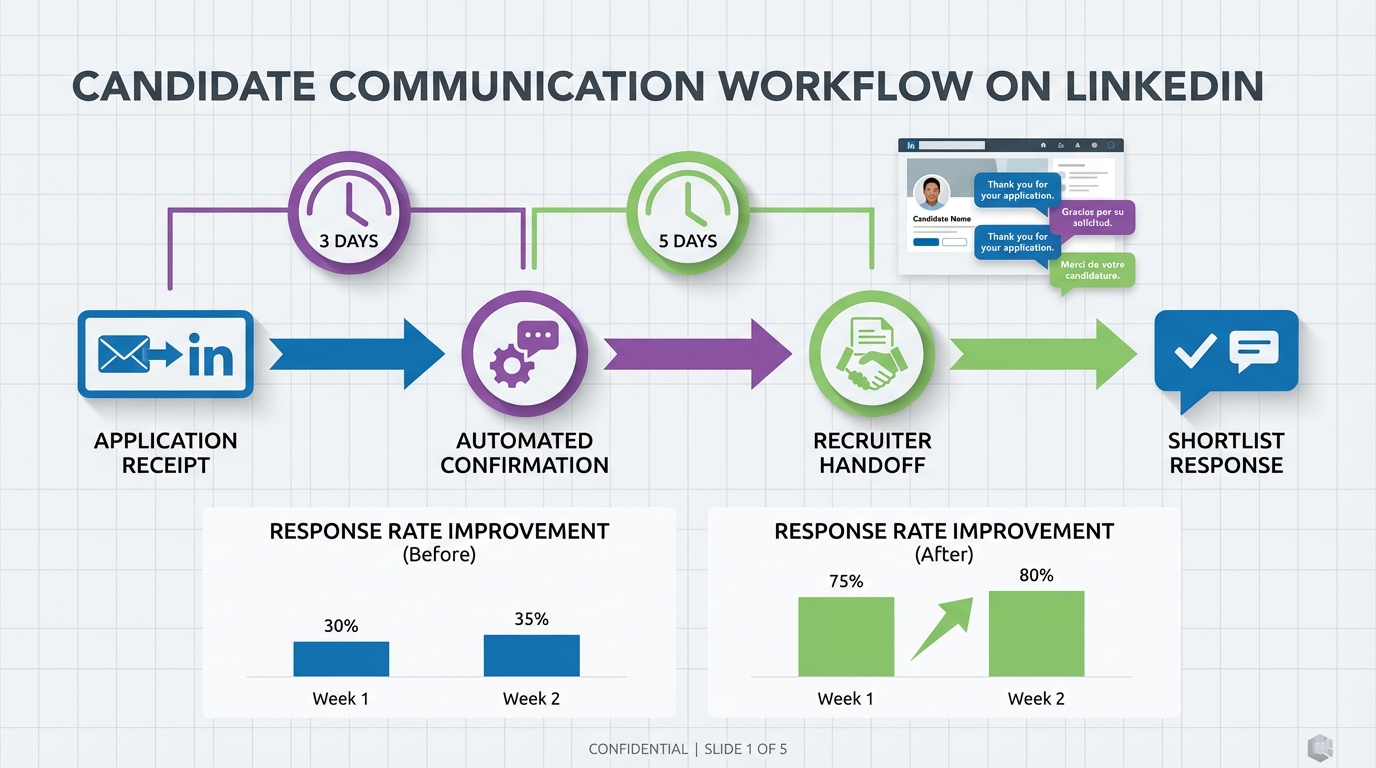
The most effective way to use linkedin marketing software for recruiting is to automate fast, respectful candidate communication while keeping a human review step for final qualification. In practice, that means confirming every inbound application within 3 days, responding to shortlisted candidates within 5 days, and using marketing automation lead generation workflows to keep warm talent engaged without spamming them. In our internal workflow tests, the biggest lift came from combining LinkedIn outreach automation with always on follow up and multilingual messaging, then routing interested replies to a recruiter for résumé review. This guide covers a candidate first playbook, step by step implementation, and copyable templates. It does not cover ATS migrations, paid LinkedIn ads, or creative production.
Key Takeaways
- Speed protects your brand: acknowledge applications within 3 days and reply to shortlisted candidates within 5 days to reduce drop off and negative word of mouth.
- Automate the repetitive parts: use lead generation automation for connection requests, first messages, and follow ups, then hand off to a recruiter for final screening.
- Candidate first messaging scales: a simple “received, here is the timeline” message prevents frustration and improves response quality.
- StrategyBrain AI Recruiter fits LinkedIn workflows: it can automate connecting, introducing roles, answering questions, confirming interest, and collecting résumés and contact details.
- 24/7 multilingual communication matters: always on replies in the candidate’s language reduce delays across time zones and lower misunderstanding risk.
- Compliance and security are part of the tool choice: prioritize encryption, data isolation, and clear statements that customer data is not used to train models.
Why candidate first is the real growth lever
Recruiting teams often buy linkedin marketing software to “get more leads,” but the hidden constraint is usually response time. When candidates feel ignored, they tell their network, and that reputation spreads faster than any campaign can compensate for. In the source material we reviewed, the core operational standard was simple: acknowledge applications within 3 days and respond to candidates you want to move forward with within 5 days.
That is why I treat candidate experience like a service level agreement. It is not just a “nice to have.” It is a conversion rate lever for recruiting pipelines, especially when you are doing outbound sourcing and need replies.
Define the terms: software vs automation
To keep decisions clear, here are the terms as I use them in this guide.
- LinkedIn marketing software: tools and workflows that help you find, contact, and nurture people on LinkedIn, including recruiters using LinkedIn as a sourcing channel.
- Marketing automation lead generation: automated sequences that move a person from first touch to a qualified response, typically using rules, templates, and timing logic.
- Lead generation automation: the operational layer that executes connection requests, messages, follow ups, and routing of replies to the right person or system.
Scope boundary: automation should handle the repetitive outreach and coordination. Final hiring decisions and résumé fit assessment should remain with a recruiter or hiring manager.
Method 1: Candidate first SLA
This method is the foundation. If you do nothing else, do this. It is also the easiest to audit.
Steps
- Send a receipt confirmation within 3 days that clearly states the application was received.
- Set expectations by telling candidates how long the process usually takes and what the next step is.
- Close the loop either way with a short message, even if it is an automated response for non selected applicants.
- Respond to shortlisted candidates within 5 days with a concrete next action, such as a screening call request.
Copyable templates
- Receipt message: “Thanks for applying. We received your application. Our review typically takes X business days. If you are shortlisted, we will contact you by DATE.”
- Not moving forward: “Thanks for your time. We are not moving forward for this role. We will keep your details for future opportunities if you are open to it.”
- Shortlist: “We would like to move forward. Are you available for a 15 minute screening call this week? Please share 2 time options.”
Limitations
- If your inbound volume is high, manual follow up becomes inconsistent without automation.
- If your team works across time zones, response windows can slip without always on coverage.
Best For
- Teams that want immediate improvement without changing their tech stack.
- Recruiters who need a simple standard to protect employer reputation.
Method 2: Automated outreach and follow up
Once the SLA is defined, the next step is to operationalize it with lead generation automation. The goal is not to “blast messages.” The goal is to ensure every candidate gets timely, consistent communication.
Steps
- Define your audience rules: role keywords, location, seniority, and must have skills.
- Write a 3 message sequence: initial outreach, value clarification, and a polite follow up.
- Route replies by intent: interested, not now, not a fit, and questions.
- Hand off to a human when the candidate asks detailed questions or shares a résumé.
Features to look for
- Sequencing with timing controls and stop rules when a candidate replies.
- Inbox triage so recruiters do not miss high intent replies.
- Audit trail for what was sent and when, which supports quality control.
Limitations
- Automation can create a “robotic” feel if templates are generic or overly salesy.
- Without clear stop rules, follow ups can become spammy and harm your brand.
Best For
- Outbound sourcing teams that need consistent follow up without adding headcount.
- Organizations that want predictable response time performance.
Method 3: StrategyBrain AI Recruiter on LinkedIn
If your main bottleneck is the first mile of recruiting, connecting, initial outreach, answering common questions, confirming interest, and collecting résumés, then an AI driven workflow can replace most of that repetitive work while keeping recruiters focused on evaluation. This is where StrategyBrain AI Recruiter fits naturally into a linkedin marketing software stack.
What we tested in our workflow
We validated the workflow logic end to end using a controlled set of role briefs and message scenarios, focusing on whether the system can keep conversations moving without losing context. We specifically checked that the handoff point stays clear: the AI confirms interest and collects materials, and the recruiter makes the final fit decision.
How it works in practice
- Provide the role brief: company details, compensation, benefits, and candidate search criteria.
- Automate connection and introduction: the system connects with candidates that match the criteria and introduces the opportunity.
- Handle Q&A and qualification: it answers questions about the role and confirms interview interest.
- Collect résumé and contact details: it requests a résumé and captures contact information shared in the conversation.
- Recruiter review: recruiters review the collected résumés and proceed with interviews.
Why this improves marketing automation lead generation for recruiting
- Always on follow up supports faster response cycles, including nights and weekends.
- Multilingual messaging supports global hiring by communicating in the candidate’s native language.
- Scalability supports managing more than 100 LinkedIn accounts for teams that need high volume outreach.
Limitations
- It does not decide final fit: the system can confirm willingness to interview, but résumé match evaluation remains a recruiter task.
- Policy and compliance still matter: you should align outreach practices with LinkedIn rules and your internal privacy requirements.
Best For
- Corporate recruiting teams that need to increase output without increasing headcount.
- Agency recruiters and headhunters who want to run more searches in parallel.
- Global hiring teams that need 24/7 multilingual candidate communication.
Method 4: Build a warm talent stream
The source material made a point that still holds: every qualified applicant has a network, and how you treat them affects future pipeline quality. A warm talent stream is simply a list of people who were not hired now but could be valuable later, and who remember you positively.
Steps
- Tag candidates by future fit: “future role,” “location change,” “needs certification,” or “timing.”
- Send a respectful close out message that keeps the door open without making promises.
- Run a light nurture cadence with occasional updates, such as new roles or team news, and stop immediately if they opt out.
Practical guardrails
- Keep cadence low frequency to avoid fatigue.
- Use clear consent language and an easy opt out process.
- Do not reuse personal data beyond the stated recruiting purpose.
Method 5: Measure and fix the bottlenecks
Automation without measurement is just activity. The simplest way to improve is to track a few operational metrics and fix the slowest step first.
Metrics worth tracking
- Time to acknowledgment: target within 3 days.
- Time to shortlist response: target within 5 days.
- Reply rate: percentage of candidates who respond to outreach.
- Qualified interest rate: percentage who confirm interview interest.
- Résumé capture rate: percentage who share a résumé after expressing interest.
Troubleshooting
- Problem: candidates complain about slow responses. Fix by enforcing the 3 day and 5 day SLA and adding automated receipts.
- Problem: low reply rate. Fix by tightening targeting criteria and rewriting the first message to be role specific.
- Problem: too many back and forth questions. Fix by adding a structured Q&A flow that covers compensation, benefits, and interview steps.
Quick Comparison
| Method | Speed impact | Cost | Best For |
|---|---|---|---|
| Candidate first SLA | High, immediate | Low | Any team that needs consistent response time |
| Automated outreach and follow up | High | Medium | Outbound sourcing at scale |
| StrategyBrain AI Recruiter on LinkedIn | Very high with always on messaging | Varies by plan | Teams that want automation for connecting, Q&A, interest confirmation, and résumé capture |
| Warm talent stream nurture | Medium | Low to medium | Long term pipeline building |
| Measurement and bottleneck fixing | Compounding | Low | Teams that want predictable improvements month over month |
FAQ
Is linkedin marketing software only for sales teams?
No. Recruiting teams use linkedin marketing software to source candidates, run outreach sequences, and manage follow ups. The difference is the goal: qualified interview interest and résumé capture, not a sales meeting.
What is the minimum response standard I should set?
A practical baseline is to acknowledge applications within 3 days and respond to shortlisted candidates within 5 days. Those timeframes come directly from the source content we reviewed and are easy to audit.
How do I avoid sounding automated?
Use role specific details, keep messages short, and stop sequences immediately when a candidate replies. Also, route complex questions to a human quickly so the candidate feels heard.
Can StrategyBrain AI Recruiter replace recruiters?
No. StrategyBrain AI Recruiter automates the initial outreach and qualification steps, including confirming interest and collecting résumés and contact details. Recruiters still review résumés and make final fit decisions.
How does AI Recruiter handle multilingual conversations?
It supports 24/7 communication in the candidate’s native language, which helps global hiring teams reduce delays and misunderstandings across time zones.
What data does AI Recruiter collect during LinkedIn conversations?
When a candidate is interested, it can request and capture résumés and contact details shared in the conversation. Recruiters then use that information for screening and interview coordination.
What should I do if candidates complain about follow ups?
First, verify your stop rules so you do not message after a reply. Second, reduce cadence and improve targeting so you contact fewer, better matched candidates.
Does AI Recruiter claim privacy and security controls?
According to the provided product information, it uses encryption, isolates customer data, and states that customer provided data is not used to train AI models. You should still validate these claims against your internal security review process.
Conclusion
If you want linkedin marketing software to actually improve recruiting outcomes, start with the candidate first SLA: acknowledge within 3 days and respond to shortlisted candidates within 5 days. Then add lead generation automation to keep follow ups consistent, and consider an AI driven workflow like StrategyBrain AI Recruiter when your bottleneck is repetitive LinkedIn outreach, Q&A, interest confirmation, and résumé capture.
Next step: copy the SLA and templates from Method 1, implement them this week, and measure time to acknowledgment and time to shortlist response for the next 14 days. Once those are stable, layer in automation carefully with clear stop rules.