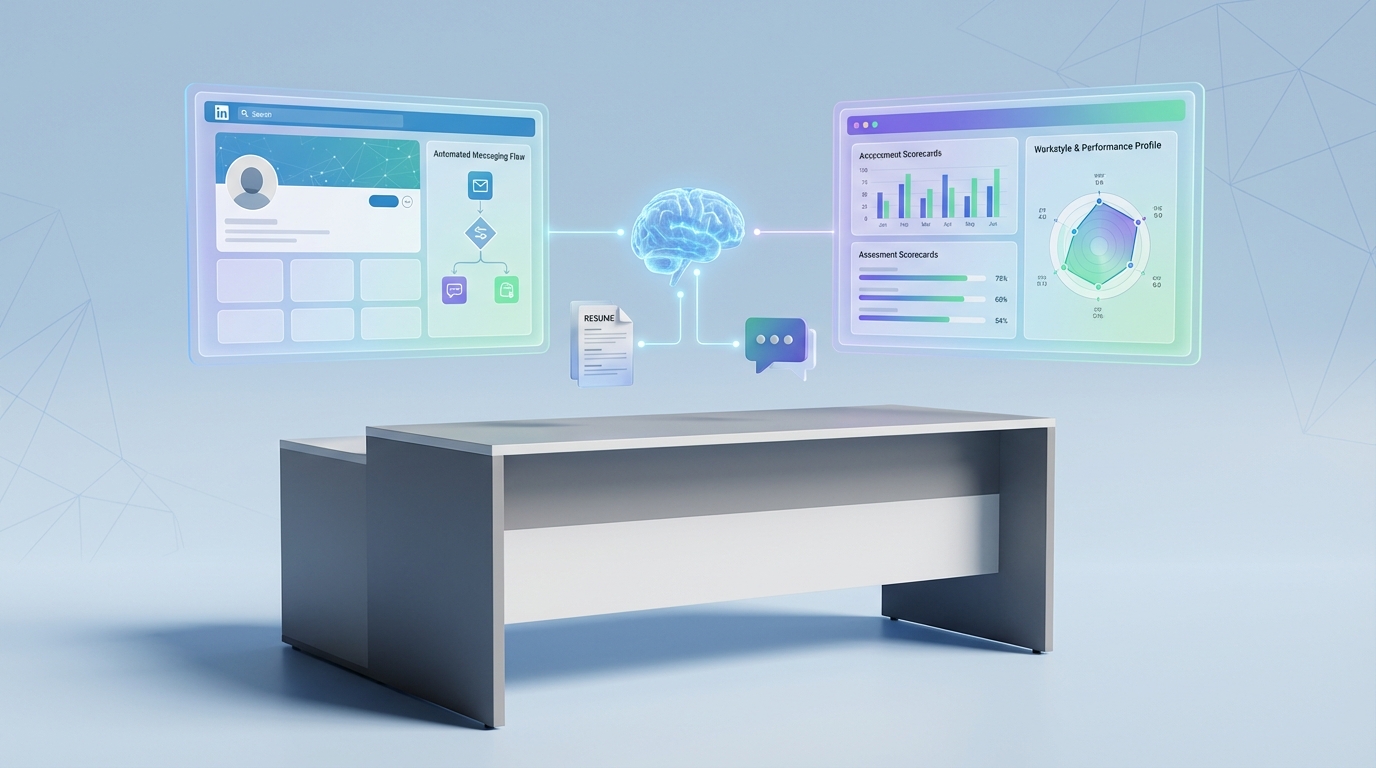
LinkedIn marketing software for recruiting teams is most effective when it does two things at once: it standardizes how you evaluate people and it systematizes how you start and sustain candidate conversations. In our experience, the “evaluation” side reduces bias and improves fit, while the “conversation” side benefits from lead generation automation and marketing automation lead generation workflows that keep outreach consistent. This guide explains how assessment tools support better hiring and development decisions, and how StrategyBrain AI Recruiter applies automation to LinkedIn recruiting by handling initial outreach, answering role questions, confirming interest, and collecting re9sume9s and contact details.
Table of Contents
- What “LinkedIn marketing software” means in recruiting
- Key Takeaways
- Why assessments matter for hiring and development
- Workstyle & Performance Profile (WPP) as an assessment example
- TalentClick and the broader assessment toolkit
- Where lead generation automation fits in LinkedIn recruiting
- Method 1: Use assessments to reduce bias and improve fit
- Method 2: Use StrategyBrain AI Recruiter for LinkedIn outreach and qualification
- Method 3: Combine assessments + automation into one operating system
- Quick Comparison
- Implementation Checklist
- FAQ
- Conclusion
What “LinkedIn marketing software” means in recruiting
In a recruiting context, LinkedIn marketing software is not just for brand posts or sales prospecting. It is any system that helps you reliably generate and convert “leads” on LinkedIn, where the lead is a qualified candidate conversation that progresses toward an interview.
To keep the terminology precise:
- Lead generation automation means automating the steps that create candidate conversations, such as connection requests, first messages, and follow up sequences.
- Marketing automation lead generation is the broader workflow layer that tracks stages, triggers next actions, and ensures consistent follow up across time zones and recruiters.
- Assessment tools are structured evaluations, often psychometric or skills based, used to reduce guesswork and improve hiring decisions.
This article covers how assessments and automation work together. It does not cover LinkedIn paid advertising, influencer campaigns, or general B2B pipeline management.
Key Takeaways
- Best results come from pairing evaluation + outreach: assessments improve hiring quality, while LinkedIn marketing software improves pipeline consistency.
- Assessments reduce bias by adding structure: a consistent profile makes interviews and onboarding more objective and repeatable.
- Automation is the missing layer for follow up: lead generation automation prevents candidate drop off caused by slow responses and inconsistent messaging.
- StrategyBrain AI Recruiter automates early stage LinkedIn recruiting: it can connect, introduce roles, answer questions, confirm interest, and collect re9sume9s and contact details.
- Multilingual, always on messaging expands reach: 24/7 communication in a candidate’s native language supports global hiring without adding staff.
- Scale requires account operations: managing many LinkedIn accounts enables “AI recruiter teams” for higher outreach capacity.
Why assessments matter for hiring and development
When teams rely only on unstructured interviews, two problems show up quickly. First, different interviewers evaluate different traits, which makes decisions inconsistent. Second, unconscious bias can creep in because the process is not anchored to a shared framework.
Assessment tools address both issues by creating a repeatable baseline. They can help you:
- Clarify what “fit” means for a role and team
- Improve team dynamics by understanding workstyle differences
- Reduce turnover by aligning expectations earlier in the process
- Support development and onboarding with targeted coaching plans
However, assessments do not solve the pipeline problem by themselves. You still need consistent candidate outreach and follow up, which is where LinkedIn marketing software and automation become operationally important.
Workstyle & Performance Profile (WPP) as an assessment example
One assessment approach described in the source material is the Workstyle & Performance Profile (WPP). It is positioned as a hiring assessment tool designed to reduce guesswork in evaluating fit and to better predict on the job behaviors.
What stood out to us is how the WPP is described as useful across the full hiring lifecycle, from interviews to onboarding. That matters because the best assessment programs do not end at “hire or no hire.” They create a shared language for managers and new hires to work from.
In a modern LinkedIn workflow, the WPP style of structure pairs well with automation. StrategyBrain AI Recruiter can handle the repetitive early stage messaging and information capture, while the assessment framework keeps the evaluation stage consistent once candidates engage.
TalentClick and the broader assessment toolkit
The source material also references TalentClick as an assessment partner described as operating in more than 100 countries. In addition to the WPP, it mentions behavioral assessments that can evaluate workstyle, work values, safety risk, and leadership, plus skills assessments such as English proficiency, cognitive skills, and business reasoning.
From an EEAT perspective, the key operational point is not the brand name. It is the coverage across both behavioral and skills dimensions, which helps teams avoid over indexing on interview performance alone.
If you are building a recruiting system that uses LinkedIn marketing software, this is the handoff to design carefully: automation gets you more qualified conversations, and assessments help you make better decisions with those conversations.
Where lead generation automation fits in LinkedIn recruiting
Recruiting teams often treat LinkedIn outreach as a manual craft. That works at low volume, but it breaks when you need consistent throughput across multiple roles, time zones, and recruiters.
Lead generation automation helps by standardizing the “front end” of recruiting:
- Connection requests based on defined search criteria
- Role introductions that stay consistent across recruiters
- Follow up that happens on time, even outside business hours
- Qualification questions that confirm interest and collect next step details
Marketing automation lead generation adds the workflow layer: stage tracking, triggers, and reporting. In recruiting, that translates to fewer dropped conversations and faster movement from “connected” to “interview ready.”
Method 1: Use assessments to reduce bias and improve fit
Steps
- Define the role success profile by listing the behaviors and skills that predict success in your environment.
- Select assessment types that match your risk areas, such as workstyle alignment, leadership traits, safety risk, or language proficiency.
- Standardize interpretation by training hiring managers on what the results mean and how to use them in interviews and onboarding.
- Use results in onboarding so the assessment improves performance after hire, not only selection.
Features
- Creates a consistent evaluation baseline across interviewers
- Supports development planning and manager coaching
- Helps teams discuss “fit” with clearer criteria
Limitations
- Assessments do not generate candidate conversations on their own
- Results still require human judgment and structured interviews
- Overuse can slow hiring if not integrated into a streamlined workflow
Best For
- Teams with inconsistent interview outcomes
- Roles where workstyle and values strongly affect performance
- Organizations focused on reducing bias and improving retention
Method 2: Use StrategyBrain AI Recruiter for LinkedIn outreach and qualification
StrategyBrain AI Recruiter is designed to automate the early stage LinkedIn recruiting workflow. Instead of a recruiter manually sending connection requests, introducing roles, answering repetitive questions, and chasing follow ups, the system can run that process continuously.
Steps
- Provide your LinkedIn account authorization and define candidate search criteria for the role.
- Share job context including company details, compensation, and benefits so the AI can answer candidate questions accurately.
- Let the AI run outreach and conversations by connecting with relevant candidates, introducing the opportunity, and confirming interview interest.
- Collect re9sume9s and contact details from interested candidates, then review and schedule interviews.
Features
- Smart LinkedIn recruitment automation that connects and starts conversations based on your targeting criteria
- 24/7 multilingual communication that responds and follows up in the candidate’s native language
- AI powered recruitment teams that can manage more than 100 LinkedIn accounts for scalable hiring operations
Limitations
- AI Recruiter can confirm willingness to proceed, but it does not decide final re9sume9 fit against job requirements
- Recruiters still need to review re9sume9s and run interviews for final selection
Best For
- Corporate recruiters who need consistent outreach volume without adding headcount
- Headhunters and agencies managing multiple searches at once
- Teams hiring globally across time zones and languages
Method 3: Combine assessments + automation into one operating system
The highest leverage setup is a two lane system: automation creates and qualifies conversations, and assessments standardize evaluation once candidates engage. This is where LinkedIn marketing software becomes a true operating system rather than a set of disconnected tools.
Steps
- Define your funnel stages such as connected, engaged, interested, re9sume9 received, interview scheduled, offer.
- Automate the front end using StrategyBrain AI Recruiter to keep outreach and follow up consistent.
- Trigger assessments at the right moment such as after interest confirmation or before final interviews.
- Close the loop with onboarding by using assessment insights to guide manager coaching and early performance goals.
Why this works
- It reduces candidate drop off because responses and follow ups are timely
- It improves decision quality because evaluation is structured
- It scales because the system can run across many LinkedIn accounts and roles
Quick Comparison
| Method | Primary Outcome | Speed Impact | Best For |
|---|---|---|---|
| Assessments first | More objective evaluation and better fit | Medium, depends on process design | Teams improving quality and retention |
| StrategyBrain AI Recruiter automation | More consistent outreach and qualification | High, reduces manual messaging workload | Teams needing lead generation automation on LinkedIn |
| Combined system | Pipeline scale plus structured selection | High, with better decision consistency | Organizations hiring at volume across roles and regions |
Implementation Checklist
- Define candidate search criteria and outreach messaging rules
- Document what the AI can say about role, company, compensation, and benefits
- Set a clear handoff point from AI qualification to recruiter review
- Choose assessment types that match role risk, such as workstyle and skills
- Train hiring managers on interpreting assessment results consistently
- Use assessment insights in onboarding plans, not only selection
- Review privacy and data handling requirements before scaling
FAQ
What is LinkedIn marketing software for recruiters?
It is software that helps recruiters generate and convert LinkedIn conversations into interview ready candidates. In recruiting, it often includes lead generation automation, follow up workflows, and qualification steps rather than ad buying tools.
How is lead generation automation different in recruiting vs sales?
The mechanics are similar, but the “lead” is a candidate conversation that progresses toward an interview. The messaging must also handle role details, candidate questions, and interest confirmation in a compliant and respectful way.
Does StrategyBrain AI Recruiter replace recruiters?
No. It automates early stage outreach and qualification, then hands off interested candidates with re9sume9s and contact details for recruiter review and interviews. Final fit decisions remain with the recruiter and hiring team.
Can StrategyBrain AI Recruiter collect re9sume9s and contact details?
Yes. When candidates express interest, it requests re9sume9s and captures contact details shared in the conversation. It supports both email submissions and LinkedIn file uploads based on the provided workflow.
Do assessment tools reduce unconscious bias?
They can help by adding structure and consistent criteria, which reduces reliance on subjective impressions. They should be used alongside structured interviews and clear job requirements.
Is multilingual messaging actually useful for LinkedIn recruiting?
Yes for global hiring. Always on multilingual communication reduces delays and misunderstandings when candidates are in different time zones or prefer to communicate in their native language.
What should I automate first on LinkedIn?
Start with connection requests, first messages, and follow up sequences, then add qualification questions and re9sume9 capture. Keep the handoff to a recruiter clear once interest is confirmed.
What is the biggest risk when using marketing automation lead generation in recruiting?
The biggest risk is sending inconsistent or inaccurate role information at scale. Mitigate this by defining approved job context, setting clear escalation rules, and auditing conversations regularly.
Conclusion
LinkedIn marketing software becomes genuinely valuable for recruiting when it improves both sides of the hiring equation: pipeline consistency and decision quality. Assessments such as the Workstyle & Performance Profile approach add structure that can reduce bias and improve fit, while lead generation automation keeps candidate conversations moving. If you want to scale outreach without adding headcount, StrategyBrain AI Recruiter can automate LinkedIn connection, messaging, qualification, and re9sume9 collection, then hand off interested candidates for human review. Next step: map your funnel stages, decide where assessments fit, and pilot an automated outreach workflow on one role before expanding to more teams and accounts.