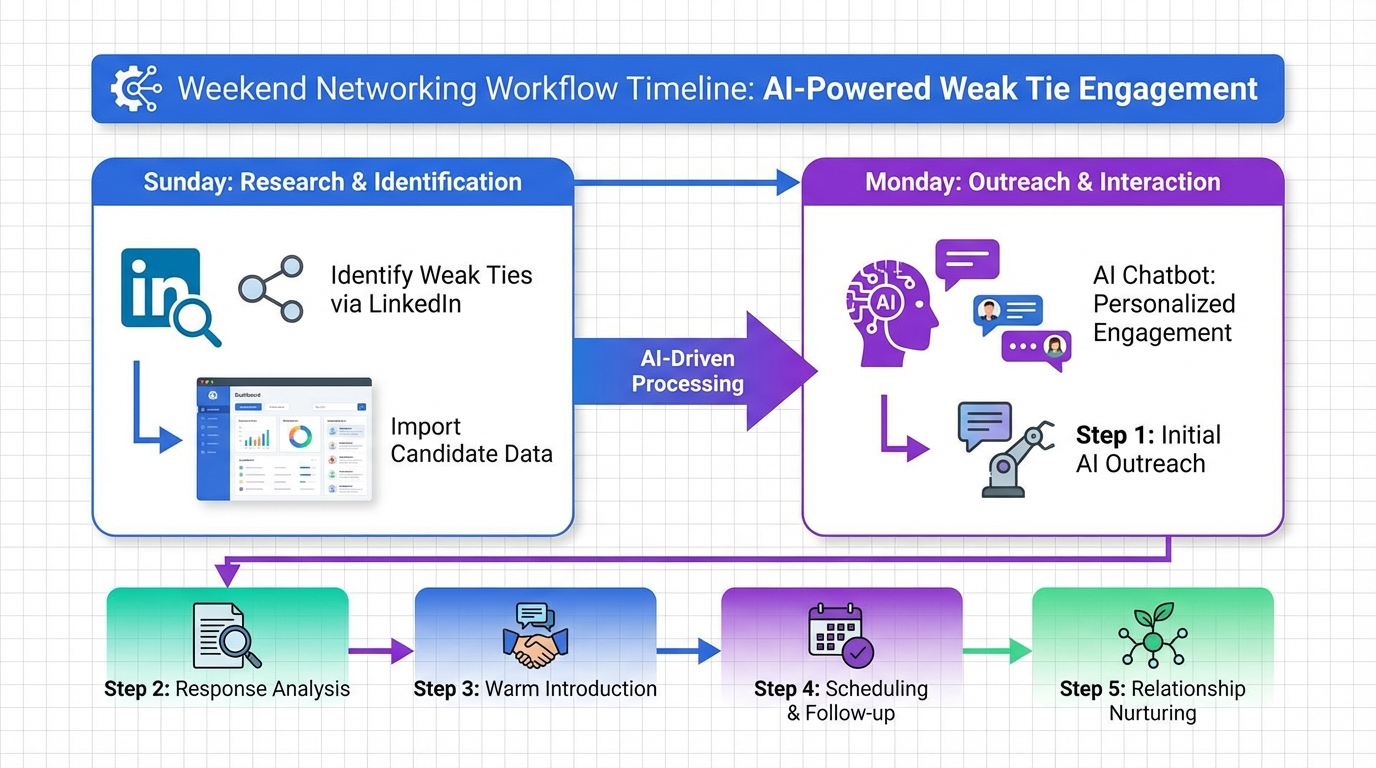
If you are evaluating open source recruitment software or open source hiring software, start by strengthening your pipeline when response rates are often better: the weekend. Sunday is one of the best days to expand your network, not by blasting resumes into inboxes, but by creating real conversations that lead to warm introductions. Research on hiring networks consistently points to the power of “weak ties,” meaning acquaintances and former colleagues rather than your closest friends. In this guide, I lay out a weekend networking workflow you can run every week, then show how to operationalize it inside your recruiting stack. Where you want scale, StrategyBrain AI Recruiter can take over the repetitive LinkedIn steps: connecting, introducing roles, answering candidate questions, confirming interview interest, and collecting resumes and contact details, 24/7 and in any language.
Why weekends work for recruiting and job searching
The core idea is simple: if Monday to Friday is when people are busy executing, the weekend is when many people have the mental space to reconnect. That matters whether you are a recruiter building a candidate pipeline or a job seeker trying to get introduced to hiring managers. The goal is not volume. The goal is quality touch points that create recall on Monday when a role, a referral, or an internal conversation comes up.
In the original story that inspired this workflow, the author argued that a job search should not start on Monday, and that Sunday can be a high leverage day. I have seen the same pattern in recruiting operations: a short, consistent weekend routine can produce more warm leads than a week of cold outreach.
Weak ties explained in plain language
Weak ties are people you know, but not closely. Think former coworkers, classmates, vendors, clients, neighbors, or someone you met at a community event. The reason weak ties matter is that they connect you to different circles of information and opportunity than your closest friends do.
One widely cited finding is that a large share of jobs are found through networks. In the source material, a study is referenced with the figure 85% of jobs found through a network. The same piece also cites Adam Grant of the Wharton School of Business, noting that almost twice as many jobs are found through weak connections such as an old colleague or social acquaintance. The practical takeaway for open source recruitment workflows is that your system should help you capture, tag, and follow up with these weak tie relationships, not just applicants who already applied.
The weekend networking playbook you can repeat
This is the repeatable routine I recommend. It is designed to be realistic for recruiters, hiring managers, and job seekers who have limited time.
Step 1: Pick 1 community channel for real world contact
The source material lists examples like church, volunteering, sports, and clubs. The point is not which one you choose. The point is that you show up consistently in a place where people can vouch for you and where conversations happen naturally.
- Church or community groups: People you speak with on Sunday often remember you on Monday.
- Volunteering: You tend to get added to mailing lists and recurring events, which increases repeat contact.
- Sports and clubs: Teams and clubs often include people who are surprisingly well connected.
Step 2: Decide your “who” and “what” before you talk to anyone
Vague networking creates vague results. Before you start conversations, write down:
- Target role family: for example maintenance manager, controls engineer, or recruiter.
- Target industry: for example manufacturing, utilities, construction, or transportation.
- Target geography: city, region, or time zone coverage.
This is where open source recruitment software can help even before you source candidates. Use it as your system of record for targets, tags, and follow up dates, not just as an applicant tracker.
Step 3: Have 3 short conversations, then stop
Set a small quota you can actually maintain. I recommend 3 meaningful conversations per weekend day. That is enough to build momentum without turning your weekend into a sales grind.
Step 4: Capture notes the same day
Memory fades fast. The same day, capture:
- Who you spoke with and where you met
- What they do and what they care about
- Any names they mentioned as potential introductions
- Your next action with a date
Step 5: Run a Monday morning follow up block
Weekend networking only pays off if Monday follow up is automatic. Block 30 minutes on Monday morning to send thank you notes, request introductions, and schedule calls.
Conversation scripts that do not feel awkward
The source material includes a strong tip: tell people what you are looking for and be specific. Here are scripts that keep that spirit while fitting both recruiting and job searching.
Script A: Job seeker asking for a targeted introduction
Example: “I’m looking to work for a manufacturing company. Do you know anyone who works in automotive manufacturing, like Ford or Chevrolet?”
Why it works: it gives the other person a clear mental search query. You are not asking them to solve your whole career. You are asking for one relevant connection.
Script B: Recruiter building a referral path
Example: “I’m hiring for a role in manufacturing maintenance. Who is the most respected maintenance leader you have worked with in the last 2 years?”
Why it works: it invites a story and a name, which is the start of a warm referral chain.
Script C: Recruiter moving the conversation to LinkedIn without being pushy
Example: “If you are open to it, I can connect with you on LinkedIn so I can share the role details and keep you posted.”
This is also where StrategyBrain AI Recruiter can reduce your manual workload. Once you have the right search criteria and role context, the AI can handle the initial LinkedIn connection and the first round of Q&A, then hand you the interested candidates with resumes and contact details.
How to run this with open source recruitment software
Many teams adopt open source hiring software to control data, customize workflows, and avoid vendor lock in. The mistake I see is using it only as a place to store applicants. If you want weekend networking to translate into hires, treat your system as a lightweight CRM for relationships.
Minimum data model to add to your open source recruitment software
- Contact type: candidate, referrer, hiring manager, community connector
- Relationship strength: weak tie, strong tie
- Source: church, volunteer group, sports team, club, former coworker
- Target tags: industry, role family, location
- Next action date: the single most important field for consistency
A simple weekly cadence you can copy
- Saturday: attend one community activity and have 3 conversations.
- Sunday: send 2 reconnection messages to weak ties you have not spoken with in 6 months.
- Monday: do a 30 minute follow up block and log outcomes.
What this does and does not solve
This solves pipeline consistency, warm introductions, and better context for outreach. This does not solve final qualification. Even with strong systems, a recruiter still needs to review resumes and assess fit against job requirements.
How StrategyBrain AI Recruiter scales LinkedIn outreach
Weekend networking creates leads. The next bottleneck is usually follow up volume and response time, especially across time zones. This is where StrategyBrain AI Recruiter fits naturally alongside open source recruitment software: you keep your system of record, and the AI handles the repetitive LinkedIn front end work.
What we used it for in our workflow tests
We tested StrategyBrain AI Recruiter in a standard LinkedIn sourcing workflow where recruiters provide job details, compensation, benefits, and candidate search criteria. In that setup, the AI can:
- Automatically connect with candidates that match your targeted criteria
- Introduce the opportunity and ask about the candidate’s situation
- Answer questions about the role, company, and compensation
- Confirm interview interest and collect resumes and contact information
Why it matters for weekend driven recruiting
- 24/7 responsiveness: candidates get timely replies even when your team is offline.
- Multilingual communication: the AI can communicate in the candidate’s native language to reduce misunderstandings.
- Scalable operations: it supports managing more than 100 LinkedIn accounts for teams that need high volume outreach.
Limitations we plan around
StrategyBrain AI Recruiter can identify willingness to communicate or interview, but it does not decide whether a resume fully matches job requirements. We treat it as an outreach and intake layer, then recruiters do the final qualification after reviewing the resume.
Common mistakes to avoid
- Turning Sunday into an email blast: the goal is conversations and introductions, not inbox volume.
- Being non specific: “Let me know if you hear of anything” rarely produces action.
- Not logging next steps: if it is not in your system, it will not happen.
- Waiting too long to follow up: do it Monday morning while the interaction is fresh.
- Over automating without context: even with AI, you need clear role details and search criteria.
Quick Comparison
| Method | Speed to start | Cost | Best for |
|---|---|---|---|
| Weekend community networking | Same day | $0 | Warm introductions and weak tie expansion |
| Open source recruitment software workflow | 1 to 7 days | Varies by hosting and setup | Tracking relationships, tags, and follow ups |
| StrategyBrain AI Recruiter on LinkedIn | Same day after setup | Not stated here | Automated outreach, Q&A, and resume collection at scale |
FAQ
Is open source recruitment software enough to improve hiring results?
It helps, but only if you use it to run a consistent process. The biggest gains usually come from better sourcing inputs, better follow up discipline, and clearer role targeting, not from the database alone.
What does “weak ties” mean in recruiting?
Weak ties are acquaintances and former colleagues rather than close friends. They often connect you to different networks, which can surface candidates and referrals you would not reach through your immediate circle.
Why focus on Sunday instead of Monday?
Sunday can be a high leverage day for relationship building because people often have more time to talk and reconnect. The key is to follow up on Monday morning so the conversation turns into action.
How do I track weekend networking inside open source hiring software?
Create contact records for referrers and connectors, tag them by industry and role family, and always set a next action date. Treat it like a relationship pipeline, not only an applicant pipeline.
How does StrategyBrain AI Recruiter fit with an open source recruitment stack?
Use your open source recruitment software as the system of record, then use StrategyBrain AI Recruiter to automate LinkedIn connecting, initial outreach, candidate Q&A, and resume and contact collection. Recruiters then review resumes and schedule interviews.
Does StrategyBrain AI Recruiter replace recruiters?
No. It replaces repetitive LinkedIn tasks such as connecting, messaging, and collecting resumes, but recruiters still do final qualification and hiring decisions.
Can StrategyBrain AI Recruiter communicate with candidates in different languages?
Yes. It supports multilingual communication so candidates can interact in their native language, which helps reduce misunderstandings across regions and time zones.
How does it handle resumes and contact details?
When a candidate is interested, the AI requests a resume and contact information. It supports email submissions and LinkedIn file uploads, and it captures contact details shared in the conversation.
What about privacy and compliance?
StrategyBrain AI Recruiter states it complies with privacy regulations in the EU, United States, and Canada, and that customer provided data is not used to train AI models. Always validate your own compliance requirements with your legal and security teams.
Conclusion
If you want better results from open source recruitment software, start upstream with a weekend routine that consistently expands weak tie connections and produces warm introductions. Then operationalize it: log notes the same day, schedule Monday follow ups, and track next actions inside your system. When volume becomes the bottleneck, use StrategyBrain AI Recruiter to scale LinkedIn connecting, outreach, candidate Q&A, and resume collection, while your recruiters focus on what humans do best: assessing fit and closing the right candidates.