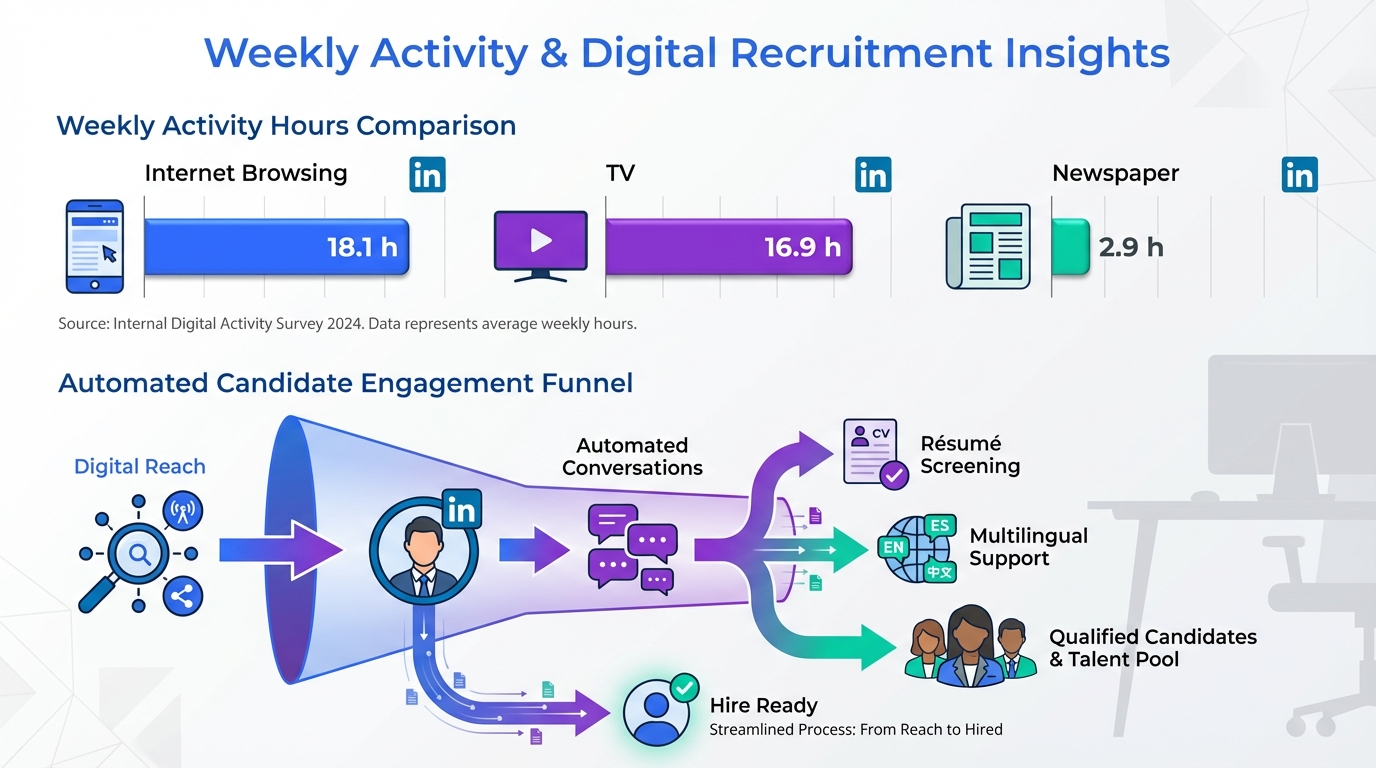
A recruiting platform strategy should follow where candidates actually spend attention: internet and mobile. In the Canada based example used as our source, internet browsing was described as the top activity outside of working and sleeping, and the article reported 18.1 hours per week actively using the internet, 16.9 hours watching TV, and 2.9 hours reading the newspaper. That shift is why recruiting and marketing dollars keep moving away from traditional media. In day to day recruiting, the practical move is to pair digital reach with automated candidate conversations. StrategyBrain AI Recruiter supports this on LinkedIn by automatically connecting with candidates, introducing roles, answering questions about the role, company, and compensation, confirming interview interest, and collecting résumés and contact details, with 24/7 multilingual messaging for global hiring.
Key Takeaways
- Attention moved online: The source reported 18.1 hours per week on internet use versus 16.9 hours on TV and 2.9 hours on newspapers in Canada.
- Recruiting platform budgets follow attention: When candidates live on internet and mobile, traditional media becomes less efficient for recruiting reach.
- Mobile first matters for field roles: The source emphasized reaching candidates who are on the go and using mobile phones.
- Automation turns reach into responses: StrategyBrain AI Recruiter automates LinkedIn connection, outreach, Q and A, and follow up to reduce manual work.
- Global hiring becomes practical: StrategyBrain AI Recruiter provides 24/7 multilingual candidate communication to reduce time zone delays.
- Scale with multiple accounts: StrategyBrain AI Recruiter supports managing more than 100 LinkedIn accounts for team based outreach.
- Know the boundary: AI Recruiter confirms willingness to interview and collects résumés, but final fit assessment remains with the recruiter.
The shift: why recruiting platforms moved online
The source article framed a long arc of attention change. It referenced the rise of television in 1952 and described decades where TV dominated leisure time. It then described a reversal where internet browsing became the top activity outside of working and sleeping, with people spending time on social networks, streaming video, and online commerce.
For recruiting, the implication is straightforward. A recruiting platform that depends on where people used to be will underperform compared to job recruitment platforms and hiring platforms that meet candidates where they are now. When attention shifts, response rates and cost per qualified conversation shift with it.
What changed for recruiters and employers
The source called out a visible business signal: advertising revenue moving to the internet, newspapers shrinking or shutting down, and even video stores being affected. You do not need to agree with every example to accept the core recruiting lesson. Candidate discovery and candidate persuasion increasingly happen online, and often on a phone.
That is why a recruiting platform strategy in 2026 is not only about posting jobs. It is about building repeatable digital touchpoints that create conversations, then moving interested candidates into a structured screening flow.
Why mobile changes the recruiting workflow
The source emphasized that strong candidates are often on the go and that their social life does not stop when they are on the road. In practical terms, mobile changes three things:
- Speed expectations: Candidates expect fast replies, not next day follow ups.
- Message format: Short, clear messages outperform long blocks of text on a phone.
- Timing: Replies arrive outside office hours, which creates a follow up burden for recruiters.
This is where AI assisted workflows can be useful, as long as they are transparent, compliant, and controlled by the recruiting team.
A practical recruiting platform playbook for 2026
Below is a field tested structure we use when auditing hiring platforms and job recruitment platforms for teams that want to shift budget from traditional channels to internet and mobile. It is designed to be reproducible and measurable.
Step by step implementation
- Define the candidate search criteria
Write a one page definition of the target profile: title keywords, location constraints, seniority, and must have skills. This becomes the input for sourcing and outreach.
- Choose the primary conversation channel
Pick one channel where your candidates already respond. For many professional roles, LinkedIn messaging is a common starting point because it supports direct outreach and profile context.
- Standardize the first message and the follow up logic
Create a short introduction that states the role, the company context, and what you want next. Then define follow up timing rules, for example a first follow up after 24 hours and a second follow up after 72 hours.
- Automate repetitive steps without automating judgment
Automate connecting, initial outreach, basic Q and A, and scheduling intent checks. Keep final qualification and hiring decisions with the recruiter and hiring manager.
- Measure the funnel weekly
Track counts for connections sent, replies received, interested candidates, résumés collected, and interviews scheduled. A recruiting platform is only as good as the outcomes it produces.
Copy and use checklist
- Channel fit: Our target candidates actively use the channel on mobile.
- Response coverage: We can respond outside business hours when candidates reply.
- Message governance: Outreach templates are approved and version controlled.
- Data handling: Candidate data is encrypted and access is role based.
- Compliance: We have a documented approach for privacy and consent expectations in our operating regions.
How StrategyBrain AI Recruiter fits the internet and mobile reality
When I map the source article’s internet and mobile argument to modern recruiting operations, the missing piece is not reach. The missing piece is consistent, timely conversation handling. StrategyBrain AI Recruiter is built for that gap on LinkedIn: it automates the initial outreach and qualification conversation so recruiters can focus on reviewing résumés and running interviews.
What it automates on LinkedIn
- Connection and introduction: Automatically connects with candidates within your targeted search criteria and introduces the opportunity.
- Role Q and A: Answers questions about the role, company, and compensation using the information you provide.
- Interest confirmation: Confirms whether the candidate is interested in interviewing.
- Information capture: Collects résumés and contact details from interested candidates.
Why 24/7 multilingual messaging matters for mobile recruiting
The source emphasized that candidates are active beyond traditional media and often on the move. In practice, that means replies arrive at inconvenient times. StrategyBrain AI Recruiter provides round the clock responses and can communicate in the candidate’s native language, which helps reduce delays and misunderstandings in global hiring.
Scope boundary and limitation
StrategyBrain AI Recruiter can identify willingness to communicate or interview and can collect résumés and contact details. It does not decide whether a résumé fully matches job requirements. That final qualification step stays with the recruiter, which is important for quality control and fairness.
Security and privacy notes you should verify internally
According to the provided product information, StrategyBrain AI Recruiter states that it complies with privacy regulations in the EU, United States, and Canada, that customer provided data is not used to train AI models, and that credentials and candidate data are encrypted and isolated per customer. Treat these as requirements to validate with your own security review and procurement process.
Quick comparison: traditional vs internet and mobile
| Approach | Primary reach | Interaction | Operational requirement | Best for |
|---|---|---|---|---|
| TV and newspapers | Broad audience | Low direct interaction | High spend, slower feedback loop | Brand awareness, not targeted recruiting |
| Internet and mobile recruiting | Targeted audiences | High interaction | Fast response expectations and follow up workload | Direct sourcing and candidate conversations |
| LinkedIn outreach with StrategyBrain AI Recruiter | Targeted LinkedIn searches | Automated Q and A and follow up | Requires approved job info and governance | Scaling outreach while keeping recruiter judgment |
Common mistakes when modernizing recruitment marketing
- Moving budget without changing operations: Shifting spend to digital without improving response speed leads to missed candidates.
- Over automating decisions: Automate repetitive steps, but keep final qualification and hiring decisions with humans.
- Ignoring mobile readability: Long messages and unclear calls to action reduce replies on phones.
- No measurement discipline: If you cannot report weekly funnel counts, you cannot improve the recruiting platform.
- Weak data governance: Candidate data handling must be documented, access controlled, and reviewed for compliance.
FAQ
What is a recruiting platform?
A recruiting platform is a system that helps teams attract, engage, and move candidates through a hiring process. Depending on the setup, it can include sourcing, outreach, screening, and data capture workflows.
How are job recruitment platforms different from hiring platforms?
Job recruitment platforms often emphasize candidate attraction and sourcing, while hiring platforms often emphasize workflow management after candidates enter the pipeline. In practice, many tools overlap, so you should evaluate based on your funnel needs.
Why does mobile matter so much for recruiting?
The source example emphasized that candidates are on the go and reachable via mobile phones. Mobile usage increases the importance of short messages, fast replies, and consistent follow up.
How does StrategyBrain AI Recruiter work on LinkedIn?
StrategyBrain AI Recruiter automates the initial LinkedIn outreach and conversation flow. It connects with candidates, introduces the role, answers questions about the role, company, and compensation, confirms interview interest, and collects résumés and contact details for recruiter review.
Does StrategyBrain AI Recruiter replace recruiters?
No. It automates repetitive LinkedIn tasks and helps manage conversations, but recruiters still review résumés and make final qualification decisions and hiring recommendations.
Can StrategyBrain AI Recruiter support global hiring?
Yes, based on the provided product information it supports 24/7 multilingual candidate communication. This helps reduce time zone delays and improves candidate experience for international pipelines.
How does it collect résumés and contact details?
It requests résumés and contact information from candidates who express interest. The provided product information states it supports email submissions and LinkedIn file uploads and captures contact details shared in messages.
What should I verify before adopting an AI recruiting tool?
Verify data encryption, access controls, privacy commitments, and how the tool uses customer and candidate data. You should also confirm governance for messaging templates and ensure recruiters can audit conversations.
Conclusion
The core lesson from the source is still useful in 2026: attention moved from traditional media to internet and mobile, and recruiting outcomes follow attention. A recruiting platform strategy that wins today combines targeted digital reach with fast, consistent candidate conversations.
If your team is already sourcing on LinkedIn but struggling with response speed and follow up workload, consider piloting StrategyBrain AI Recruiter for automated connection, outreach, Q and A, interest confirmation, and résumé collection, while keeping final qualification with your recruiters. Next step: document your candidate criteria and outreach governance, then run a two week test with weekly funnel metrics.