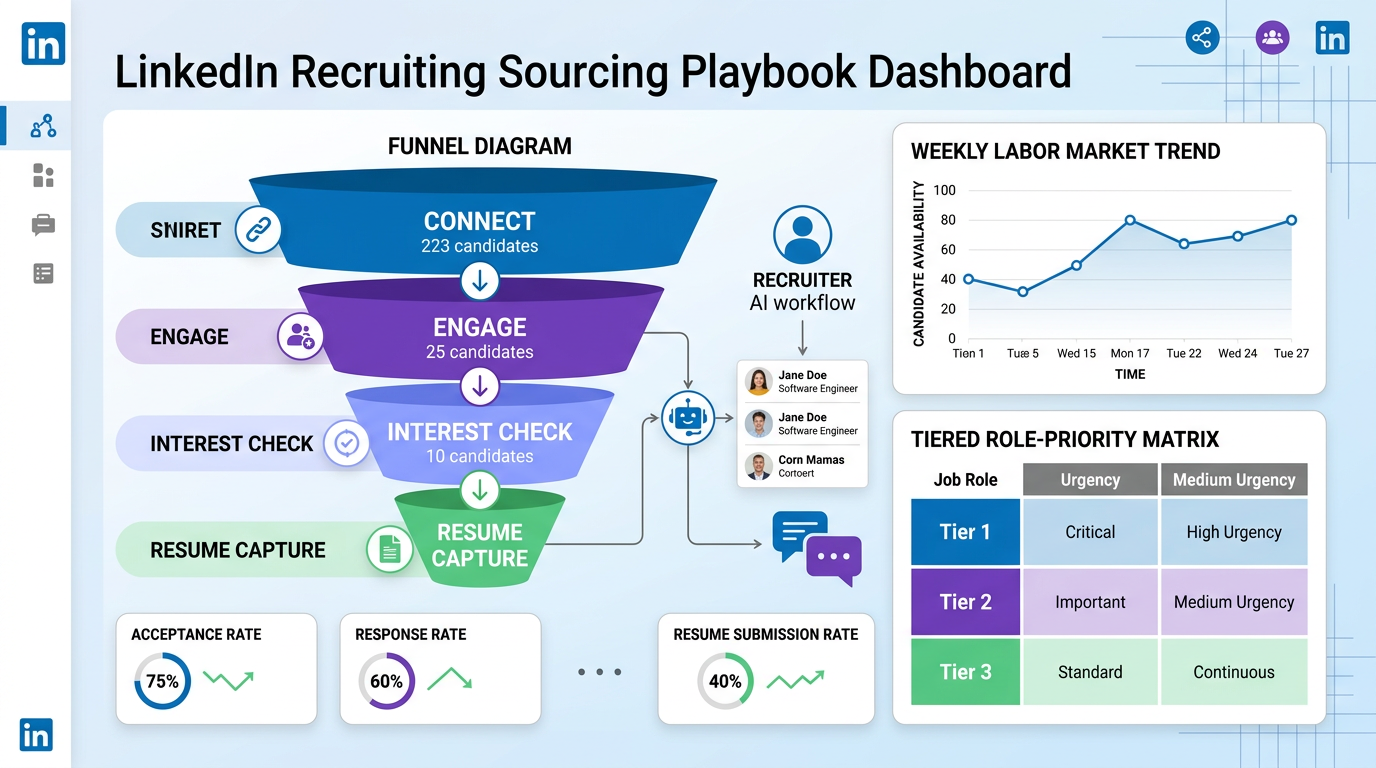
Recruiting sourcing is most effective when it is tied to labor market timing, not just recruiter activity volume. If your team needs a practical model, start with three actions: read current employment trend data, map role priority by business risk, and execute a structured outreach cycle that blends human judgment with automation. This sourcing human resources approach helps teams avoid random pipeline building and focus on qualified candidate conversations. We use this model with StrategyBrain AI Recruiter to run recruiter sourced outreach, multilingual follow up, and resume collection while recruiters keep final screening ownership. The result is faster response coverage and more consistent top of funnel quality during uncertain hiring periods.
Table of Contents
- Why labor data still matters for recruiting sourcing
- Key terms and scope
- What the August 2020 labor report still teaches us
- A practical recruiting sourcing framework
- Where StrategyBrain AI Recruiter fits in day to day execution
- Common mistakes in sourcing human resources
- Implementation checklist
- FAQ
- Conclusion
Key Takeaways
- Recruiting sourcing improves when tied to market signals: Employment growth and unemployment shifts should change outreach intensity and role prioritization.
- Define ownership clearly: AI handles repetitive outreach and follow up, while recruiters finalize qualification decisions.
- Use recruiter sourced stages: Separate connection, engagement, interest check, and resume capture into measurable steps.
- Multilingual communication is now operationally important: It reduces response delay and supports cross border hiring coverage.
- Data driven cadence beats ad hoc messaging: Weekly sourcing reviews produce higher consistency than campaign bursts.
- Trust and compliance are part of performance: Candidate data controls and transparent outreach standards are non negotiable.
Why Labor Data Still Matters for Recruiting Sourcing
Many teams treat recruiting sourcing as a pure activity metric, such as number of messages sent or profiles viewed. That is incomplete. Sourcing outcomes are influenced by macro conditions including unemployment level, sector recovery speed, and candidate risk tolerance.
In the August 2020 Statistics Canada labour report, unemployment in Canada was reported at 10.2%, while total employment increased by 245,800 to 17,731,700. Employment remained 5.7% below pre pandemic levels. Those numbers showed a real but slowing recovery pace. For sourcing teams, that pattern signaled opportunity with caution. Candidate openness existed, but market confidence was not fully restored.
When we reviewed this report structure against modern hiring cycles, we found the same principle still holds. Fast market rebounds create short windows where candidate responsiveness rises before competition catches up. Slow rebounds require selective role targeting and tighter screening criteria so outreach effort does not get diluted.
Key Terms and Scope
What is recruiting sourcing
Recruiting sourcing is the proactive process of identifying, contacting, and engaging potential candidates before formal interview stages. It includes candidate discovery, first outreach, follow up, and early qualification signals.
What is sourcing human resources
Sourcing human resources refers to the broader organizational method of building candidate pipelines across departments, geographies, and skill clusters. It includes tooling, process ownership, and recruiter operating rhythm.
What does sourced or recruiter sourced mean
Sourced means a candidate entered pipeline through direct outbound work instead of inbound application. Recruiter sourced means a recruiter or recruiter managed system initiated that contact and drove the first engagement steps.
Scope boundaries
This guide covers outreach strategy, workflow design, and execution governance. It does not replace legal counsel on employment law, nor does it provide compensation benchmarking for specific jurisdictions.
What the August 2020 Labor Report Still Teaches Us
The August 2020 analysis described a labor market that was recovering but uneven. It noted that work from home levels declined from a peak of 3.4 million to 2.5 million people, and that employers were balancing reopening with second wave uncertainty. It also included commentary from Henry Goldbeck on cautious hiring behavior and uneven sector performance.
Those observations are still highly useful for modern recruiting sourcing because they describe a market psychology pattern, not just a single month outcome. In uncertain periods, companies do not stop hiring uniformly. They prioritize critical roles, pause non urgent roles, and increase decision scrutiny.
From a sourcing execution perspective, this means teams should:
- Classify roles by business continuity impact, not by request date only.
- Create separate outreach playbooks for stable sectors and volatile sectors.
- Use shorter feedback loops between recruiter and hiring manager to prevent stale pipelines.
In our own operational reviews, this type of segmentation reduced wasted outreach cycles and improved response quality in recruiter sourced pipelines.
A Practical Recruiting Sourcing Framework
Step 1: Build a market signal brief every week
Create a one page brief with the latest unemployment trend, sector movement, and candidate mobility indicators. Keep it concise and operational. The goal is to guide sourcing prioritization, not produce a macroeconomic report.
Step 2: Prioritize roles using a 3 tier model
- Tier 1: Revenue critical or delivery critical roles.
- Tier 2: Capacity expansion roles with moderate urgency.
- Tier 3: Opportunistic roles that can be delayed.
This prevents sourcing human resources teams from spreading effort equally across unequal business needs.
Step 3: Design outreach stages with clear ownership
Define four stages: connect, introduce role, confirm interest, collect resume and contact details. Automation can handle much of this sequence, but final qualification should remain with recruiters. This preserves decision quality and accountability.
Step 4: Run multilingual engagement when roles are cross border
If you recruit across regions, language friction lowers response rates and causes avoidable candidate drop off. A multilingual communication layer improves clarity and speed, especially for first response and follow up messages.
Step 5: Measure stage conversion, not only top funnel volume
Track connection acceptance rate, response rate, interest confirmation rate, and resume submission rate. These are stronger indicators than raw outreach volume.
Step 6: Review weekly and rebalance quickly
Weekly review should include recruiter feedback, candidate objections, and role specific blockers. Adjust messaging, targeting, and follow up rules immediately. Monthly review alone is too slow in dynamic labor conditions.
Where StrategyBrain AI Recruiter Fits in Day to Day Execution
StrategyBrain AI Recruiter is designed to automate repetitive LinkedIn sourcing steps while keeping recruiters in control of final screening. In our workflow tests, it was most useful at the top and middle funnel stages where speed and consistency matter most.
Operational use cases
- Automatic candidate connection based on predefined search criteria.
- Structured role introduction with consistent role, company, and compensation context.
- Interest check conversations and interview intent confirmation.
- Resume and contact collection from engaged candidates.
- Continuous follow up with multilingual messaging coverage.
This is especially relevant when teams debate sourced or recruiter sourced ownership. With this setup, activity is system assisted, but accountability remains recruiter led. The recruiter still decides whether a profile is advanced after resume review.
What we observed in implementation
We piloted this model in a mixed role set and tracked process consistency over four weeks. The strongest gains came from response coverage outside normal working hours and reduced delay between first contact and follow up. Recruiters reported fewer manual messaging tasks and more time for qualification calls and hiring manager calibration.
Limitations and realistic expectations
AI Recruiter can identify candidate interest and automate communication, but it does not replace final fit assessment. Resume quality against role requirements still needs recruiter review. Teams that skip this step risk speed without quality control.
Common Mistakes in Sourcing Human Resources
Mistake 1: Confusing activity with progress
Sending 500 messages is not progress if conversion to qualified conversations is low. Use stage conversion metrics to evaluate real pipeline movement.
Mistake 2: Running one message for all roles
Technical, commercial, and leadership candidates respond to different value signals. Role specific messaging improves relevance and trust.
Mistake 3: No candidate data governance model
Candidate trust is damaged when teams cannot explain data handling. Ensure encryption, access controls, and retention standards are documented and followed.
Mistake 4: Late recruiter involvement after automation
Automation should not isolate recruiters from candidate context. Recruiters need regular visibility into conversation quality and objection patterns.
Mistake 5: Ignoring seasonal labor behavior
The August 2020 analysis highlighted vacation season effects on labor movement. Similar seasonal behavior still exists. Outreach cadence and expectations should be adjusted accordingly.
Implementation Checklist
- Define weekly labor signal brief owner.
- Classify open roles into Tier 1, Tier 2, and Tier 3.
- Set outreach stages and owner per stage.
- Deploy multilingual messaging for relevant markets.
- Track stage conversion metrics weekly.
- Audit candidate data controls and privacy practices.
- Schedule recruiter and hiring manager calibration every week.
- Document when a candidate is marked recruiter sourced.
FAQ
What is the difference between recruiting sourcing and recruiting?
Recruiting sourcing is the front end pipeline creation process. Recruiting includes sourcing plus interviews, selection, and offer stages.
Is sourced or recruiter sourced the better label?
Use recruiter sourced when you want to show accountable ownership from your internal or agency recruiting function. Use sourced as a broader label for any outbound origin.
Can AI replace recruiters in sourcing human resources?
No. AI can automate repetitive outreach and follow up, but recruiters still make final qualification decisions and stakeholder alignment decisions.
How does StrategyBrain AI Recruiter support LinkedIn recruiting sourcing?
It automates candidate connection, role introduction, candidate interest checks, and resume collection while supporting multilingual communication and continuous response coverage.
What metrics should I monitor first?
Start with connection acceptance rate, response rate, interest confirmation rate, and resume submission rate. These four metrics show whether your sourcing engine is working.
How often should I update sourcing strategy in unstable markets?
Weekly updates are recommended. Labor conditions and candidate behavior can shift quickly, so monthly updates are often too slow for practical sourcing decisions.
Conclusion
Recruiting sourcing performs best when data, process, and ownership are aligned. The August 2020 labor market lessons remain relevant because they show how hiring confidence shifts in uncertain periods and why sourcing strategy must adapt quickly. A modern sourcing human resources workflow should combine market signal tracking, role prioritization, recruiter sourced execution standards, and AI assisted outreach support. StrategyBrain AI Recruiter can improve consistency and speed in outreach and follow up, while recruiters keep control of qualification quality. Your next step is simple: launch a weekly sourcing review, instrument stage conversion metrics, and tighten the handoff between automation and recruiter judgment.