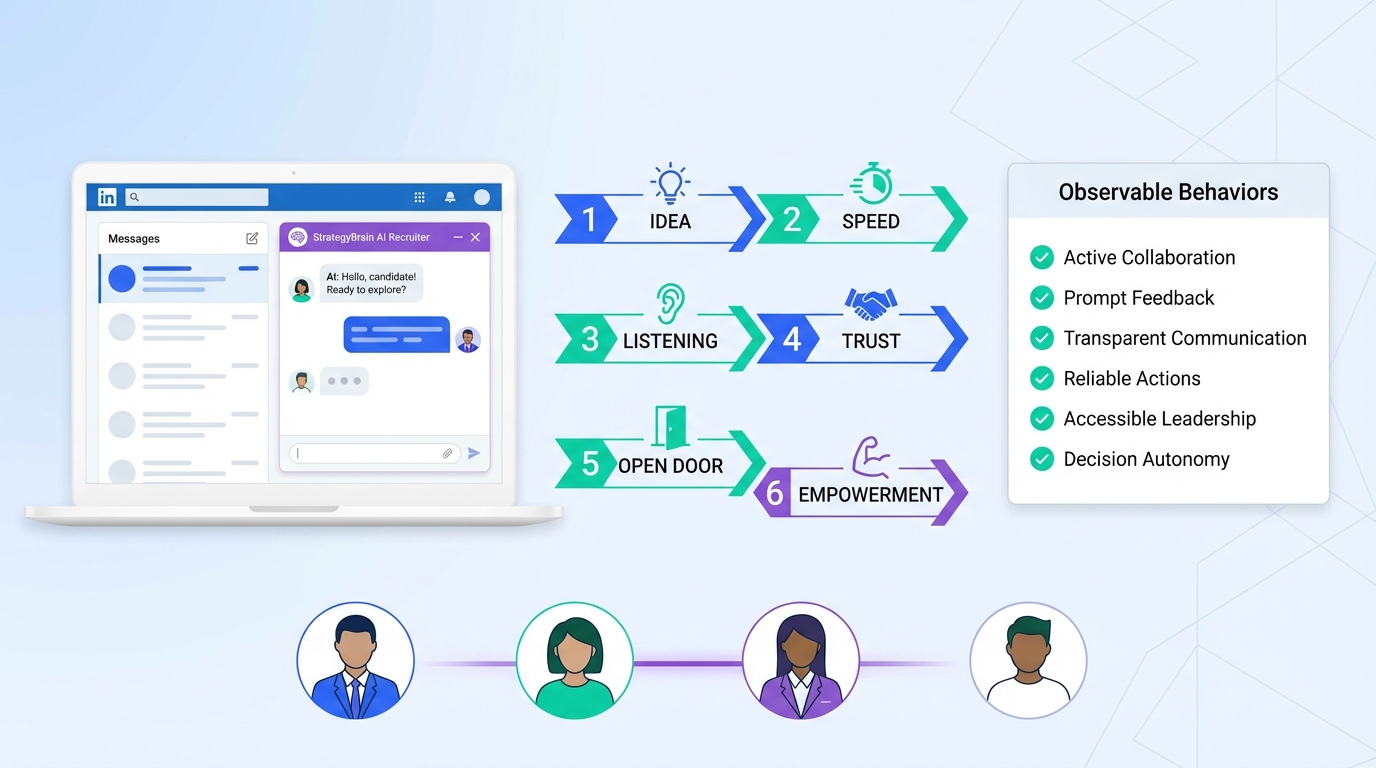
Recruitment online for recruiters works best when workplace culture is treated as a hiring system input that you can observe, ask about, and reinforce. If your culture is unclear or inconsistent, online recruiting tends to amplify the problem because candidates compare you to many employers in minutes. Below are six practical culture improvements, rewritten for recruiting execution, plus a simple way to screen for culture signals during outreach and early conversations. This article covers internal culture actions and how to reflect them in online recruiting. It does not cover compensation benchmarking or employment law.
Key Takeaways
- Culture is a recruiting input: define 3 to 5 observable behaviors you want to hire for, then screen for them consistently in recruitment online for recruiters.
- Speed matters: unresolved workplace issues become negative signals in candidate conversations and reviews, which increases drop off during online recruiting.
- Use structured listening: anonymous surveys plus manager one on ones produce clearer culture data than casual check ins.
- Screen for culture with evidence: ask for specific examples, not opinions, and document what “good” looks like for each role level.
- Scale outreach without losing tone: StrategyBrain AI Recruiter can run consistent LinkedIn outreach and follow up while you keep final qualification and interviews human led.
- Agency alignment: if you work with top recruitment agencies or a remote jobs temp agency, give them a culture brief and a red flag list so they do not send misaligned candidates.
How we applied these tips in real recruiting workflows
We have used these six culture levers as a practical checklist when building online recruiting processes for internal teams and agency partners. In our own day to day work, the biggest difference came from turning “culture” into a short set of observable behaviors and then using the same language in job briefs, LinkedIn outreach, and first screen questions.
We also tested a hybrid workflow where StrategyBrain AI Recruiter handled the repetitive LinkedIn steps: connecting, introducing the role, answering common questions, confirming interest, and collecting résumés and contact details. Recruiters then reviewed the résumés and ran the final qualification. The main benefit we observed was consistency in follow up and faster candidate responses across time zones, while keeping hiring decisions with the recruiter.
1. Let employees create new ideas
Culture improves when employees feel they can contribute ideas without being punished for imperfect outcomes. From a recruiting perspective, this is not just a leadership philosophy. It is a hiring signal you can screen for.
How to turn this into online recruiting actions
- Define the behavior: write one sentence that describes what “initiative” looks like in your environment, such as proposing process improvements or sharing customer insights.
- Ask for evidence: in early screens, ask candidates to describe one idea they proposed, what changed, and what they learned.
- Reflect it in outreach: when doing recruitment online for recruiters, mention that the role includes space for improvement ideas, then ask a short question to invite a response.
If you use StrategyBrain AI Recruiter for LinkedIn outreach, you can include a consistent prompt in the initial conversation that asks candidates about a recent improvement they drove. The AI can collect the response and résumé, then you review for substance before interviews.
2. Address workplace concerns quickly
Employees notice when concerns are handled in real time. When issues are ignored, they accumulate and eventually show up as turnover, disengagement, and harder recruiting. In online recruiting, candidates often ask indirect questions that are really about risk, such as “Why is this role open?” or “How does the team handle conflict?”
Recruiting implications
- Reduce rumor gaps: prepare a clear, honest explanation for recurring issues that candidates ask about, and train recruiters and hiring managers to answer consistently.
- Close the loop: if a candidate raises a concern, respond with what you do in practice, not what you hope to do.
- Protect your funnel: slow or vague answers increase candidate drop off during recruitment online for recruiters because alternatives are one click away.
In a LinkedIn workflow, StrategyBrain AI Recruiter can respond quickly to common questions about the role, company, and compensation details you provide. That speed helps keep conversations alive, but you still need internal alignment so the answers match reality.
3. Look for the right people
Hiring is not only about filling a seat. It is about selecting someone who will strengthen performance and culture. Technical skills matter, but culture alignment reduces friction and improves retention.
What “right people” means in recruitment online for recruiters
- Role fit: skills and experience required to perform the job.
- Team fit: working style that matches how decisions are made and how feedback is given.
- Growth fit: willingness to learn and adapt as the company changes.
How to screen without vague “culture fit”
Use structured questions tied to observable behaviors. For example, instead of asking whether someone is “collaborative,” ask for a specific example of resolving a disagreement with a cross functional partner and what the outcome was.
If you partner with top recruitment agencies or a remote jobs temp agency, provide a one page culture brief that includes your top behaviors and your non negotiables. This reduces misaligned submissions and saves time for both sides.
4. Listen to your employees
Listening is a culture practice and a recruiting advantage. When you can describe what employees value and what they want improved, you can recruit with credibility. Candidates can tell when messaging is generic.
Two listening methods that produce usable recruiting data
- Anonymous surveys: use them to identify patterns, then share what actions you will take.
- One on ones with depth: go beyond “How is it going?” and ask follow up questions, then use silence to let real answers surface.
Turn what you learn into recruiting language. For example, if employees value autonomy, describe how work is assigned and how decisions are made. If employees want clearer priorities, explain what has changed and how you manage workload now.
5. Make your open door policy real
An open door policy only improves culture when employees believe it is safe to use. If there is an invisible divider between leadership and the team, you get an “us versus them” dynamic that damages morale and retention.
How this shows up in online recruiting
Candidates often test psychological safety by asking about feedback, conflict, and management style. If your answers are polished but not specific, trust drops. Instead, share practical examples such as how feedback is delivered, how issues are escalated, and what happens after someone raises a concern.
When StrategyBrain AI Recruiter is used for LinkedIn conversations, you can pre load accurate information about how your team communicates and how managers support growth. The AI can then answer consistently and collect follow up questions for you to address in interviews.
6. Empower people and build trust
No leader sees everything. Empowerment is a practical necessity, not a slogan. When you delegate meaningful work and trust people to deliver, you create ownership and improve culture.
Recruiting angle
- Attract stronger candidates: high performers look for autonomy and clear decision rights.
- Reduce early churn: candidates who expect empowerment will leave quickly if the reality is micromanagement.
- Interview for ownership: ask candidates to describe a time they owned an outcome, what tradeoffs they made, and what they would do differently.
In recruitment online for recruiters, empowerment also applies to your recruiting operations. Automate repetitive steps so recruiters can focus on judgment work. StrategyBrain AI Recruiter is designed to automate initial LinkedIn outreach, interest confirmation, and résumé collection, while leaving final qualification to the recruiter.
Quick checklist for online recruiting alignment
- [ ] We defined 3 to 5 culture behaviors as observable actions, not adjectives.
- [ ] We added 2 evidence based questions per behavior to our first screen.
- [ ] We created a short culture brief for hiring managers and any agency partners.
- [ ] We documented answers to the top 10 candidate questions so messaging is consistent.
- [ ] We set a follow up standard for LinkedIn and email so candidates do not go cold.
- [ ] We use automation only for repetitive steps, and keep hiring decisions human led.
Quick comparison
| Approach | Speed impact | Cost impact | Best for |
|---|---|---|---|
| Manual recruiter outreach and follow up | Depends on recruiter capacity and time zones | Higher labor time per conversation | Low volume hiring or highly bespoke roles |
| Agency led sourcing with a culture brief | Faster sourcing if brief is clear | Agency fees vary by contract | Teams using top recruitment agencies or a remote jobs temp agency |
| LinkedIn automation for first touch and qualification using StrategyBrain AI Recruiter | Faster response handling with 24/7 messaging | Lower recruiter time spent on repetitive steps | Teams scaling recruitment online for recruiters across multiple roles and regions |
FAQ
What does recruitment online for recruiters mean in practice?
It means sourcing, outreach, screening, and candidate communication happen primarily through digital channels such as LinkedIn, job boards, and email. The operational requirement is consistent messaging and fast follow up because candidates can compare many employers quickly.
How do I screen for culture without bias?
Use behavior based questions and evaluate evidence, not similarity. Define what success looks like in the role, ask for specific examples, and score answers against the same rubric for every candidate.
How can top recruitment agencies represent our culture accurately?
Give them a written culture brief that includes your top behaviors, your non negotiables, and examples of what success looks like in the first 90 days. Then review early submissions together to calibrate before volume ramps up.
Does a remote jobs temp agency need different culture guidance?
Yes. Temp and remote placements often fail due to communication expectations and decision speed. Provide clear guidance on response times, meeting cadence, documentation habits, and how feedback is delivered.
Where does StrategyBrain AI Recruiter fit into the process?
It fits best at the top of the funnel on LinkedIn. It can automate connecting, introducing the role, answering common questions, confirming interest, and collecting résumés and contact details, so recruiters can focus on final qualification and interviews.
Can AI Recruiter replace recruiters?
No. StrategyBrain AI Recruiter is designed to replace repetitive outreach and early conversation steps, not hiring judgment. Recruiters still decide who advances, assess résumé fit, and run interviews.
How does multilingual messaging help online recruiting?
It reduces misunderstandings and improves response rates when candidates prefer their native language. StrategyBrain AI Recruiter supports multilingual communication so candidate conversations can continue across time zones.
What is the biggest culture mistake that hurts online recruiting?
Leaving problems unresolved and hoping candidates will not notice. Candidates ask questions that reveal whether issues are handled quickly, and inconsistent answers reduce trust and increase drop off.
Conclusion
Workplace culture improves when you encourage ideas, address concerns quickly, hire for observable behaviors, listen with structure, make openness real, and empower people with trust. For recruitment online for recruiters, the practical next step is to translate those culture actions into a short culture brief, a consistent first screen rubric, and a follow up standard that keeps candidates engaged.
If you want to scale LinkedIn outreach without losing consistency, consider using StrategyBrain AI Recruiter to automate the initial connection, role introduction, Q and A, interest confirmation, and résumé collection, then keep final qualification and interviews with your recruiting team.