To make recruitment online for recruiters work in real life, you need more than a sourcing workshop or a few shared exercises. You need a managed change that turns good intentions into repeatable daily behavior. The simplest approach is to align leaders and recruiters on one definition of “done,” build a weekly cadence, and remove the biggest friction point: consistent outreach and follow up. In our testing with recruiting teams, adoption improves when the first touch and early conversation are standardized, while recruiters keep control of final qualification. That is also where StrategyBrain AI Recruiter fits naturally into a LinkedIn workflow by automating connections, introductions, candidate questions, and résumé collection so your team can focus on interviews and decision making.
Key Takeaways
- Sourcing adoption is change management: training alone rarely changes daily behavior without a leader run cadence.
- Define “done” in numbers: for example, connections sent per day, replies handled within 24 hours, and résumés collected per week.
- Automate the repetitive parts: StrategyBrain AI Recruiter can connect, introduce roles, answer candidate questions, and collect résumés and contact details on LinkedIn.
- Keep human judgment where it matters: AI Recruiter confirms interest but does not decide final fit, recruiters review résumés and run interviews.
- Global hiring becomes practical: 24/7 multilingual messaging reduces time zone delays and miscommunication.
- Scaling is operational: managing more than 100 LinkedIn accounts enables an AI powered recruiting team model for higher throughput.
Why sourcing does not stick after training
Recruiters often ask a version of the same question: how do we convince a team to actually source, not just learn about sourcing. The hard truth is that sourcing is a habit, and habits fail when the environment stays the same. It is similar to New Year goals like going to the gym, reading more books, or following a strict diet. Motivation spikes, then daily work wins.
In our experience, sourcing adoption breaks for three predictable reasons. First, there is no shared definition of what “good sourcing” looks like in the team’s context. Second, recruiters do not have protected time and a simple routine. Third, the most repetitive part, outreach and follow up, is still manual, so the team burns time on messaging instead of pipeline building.
Define success for online sourcing
Before you change tools or run another training, define what success means for your team. This is the fastest way to reduce debates and increase consistency. A good definition includes activity, speed, and outcomes.
Use a simple “3 layer” definition
- Activity: number of targeted connection requests sent per recruiter per day.
- Responsiveness: time to respond to candidate messages, for example within 24 hours.
- Outcome: number of interested candidates who share a résumé and contact details per week.
This definition also helps when candidates ask how to find a recruiter for remote jobs. If your team is consistent in outreach and follow up, candidates experience faster replies and clearer next steps, which improves your reputation in remote hiring markets.
A rollout plan leaders can run in 14 days
We use a short rollout because long programs lose momentum. The goal is not perfection. The goal is a stable routine that survives busy weeks.
- Day 1 to 2: Align on the definition of done. Pick the 3 layer definition and write it down in one page.
- Day 3 to 5: Build templates. Create message templates, a follow up schedule, and a simple tracking sheet.
- Day 6 to 10: Run a pilot. Choose one role and one recruiter pod, then run the cadence daily.
- Day 11 to 14: Review and standardize. Keep what worked, remove what did not, and publish the team playbook.
If you are planning a leader focused webinar for recruitment managers, keep the agenda practical. In the source material we reviewed, the promise was that the first 100 people receive a live meeting invite, and everyone who registers receives a recording. Preserve that structure, but make the content operational: metrics, cadence, and tooling decisions.
Method 1: Leader led sourcing cadence
A cadence is the simplest lever leaders control. Without it, sourcing becomes optional. With it, sourcing becomes normal.
Steps
- Block time: schedule 30 minutes daily for sourcing, protected from meetings.
- Start with one role: reduce context switching and make learning visible.
- Daily micro review: 10 minutes to review activity and unblock issues.
- Weekly pipeline review: focus on outcomes, not just activity.
Features
- Predictability: recruiters know exactly when sourcing happens.
- Accountability: leaders can coach based on real activity.
- Faster learning: patterns emerge within 5 business days.
Limitations
- Manual messaging still consumes time: cadence alone does not remove repetitive outreach work.
- Time zones still slow replies: remote hiring often requires after hours follow up.
Best For
- Teams that have never sourced consistently.
- Leaders who need a simple operating rhythm.
Method 2: Workflow templates that reduce decision fatigue
Recruiters stop sourcing when every outreach requires fresh writing and constant judgment calls. Templates reduce cognitive load while keeping personalization where it matters.
Steps
- Create 3 outreach templates: one for active seekers, one for passive candidates, one for referrals.
- Create 2 follow up templates: one for no reply, one for “maybe later.”
- Define a follow up schedule: for example, day 2 and day 5 after the first message.
- Standardize what you ask for: résumé, email, and interview availability.
Features
- Consistency: candidates get clear, repeatable communication.
- Speed: recruiters spend less time drafting and more time evaluating.
- Better handoffs: easier to share work across a team or with a best remote staffing agency partner.
Limitations
- Templates still require execution: someone must send, track, and follow up.
- Quality can drift: without review, templates become stale or too generic.
Best For
- Recruiters who already source but struggle with volume.
- Teams hiring for similar roles repeatedly.
Method 3: Automate LinkedIn outreach with StrategyBrain AI Recruiter
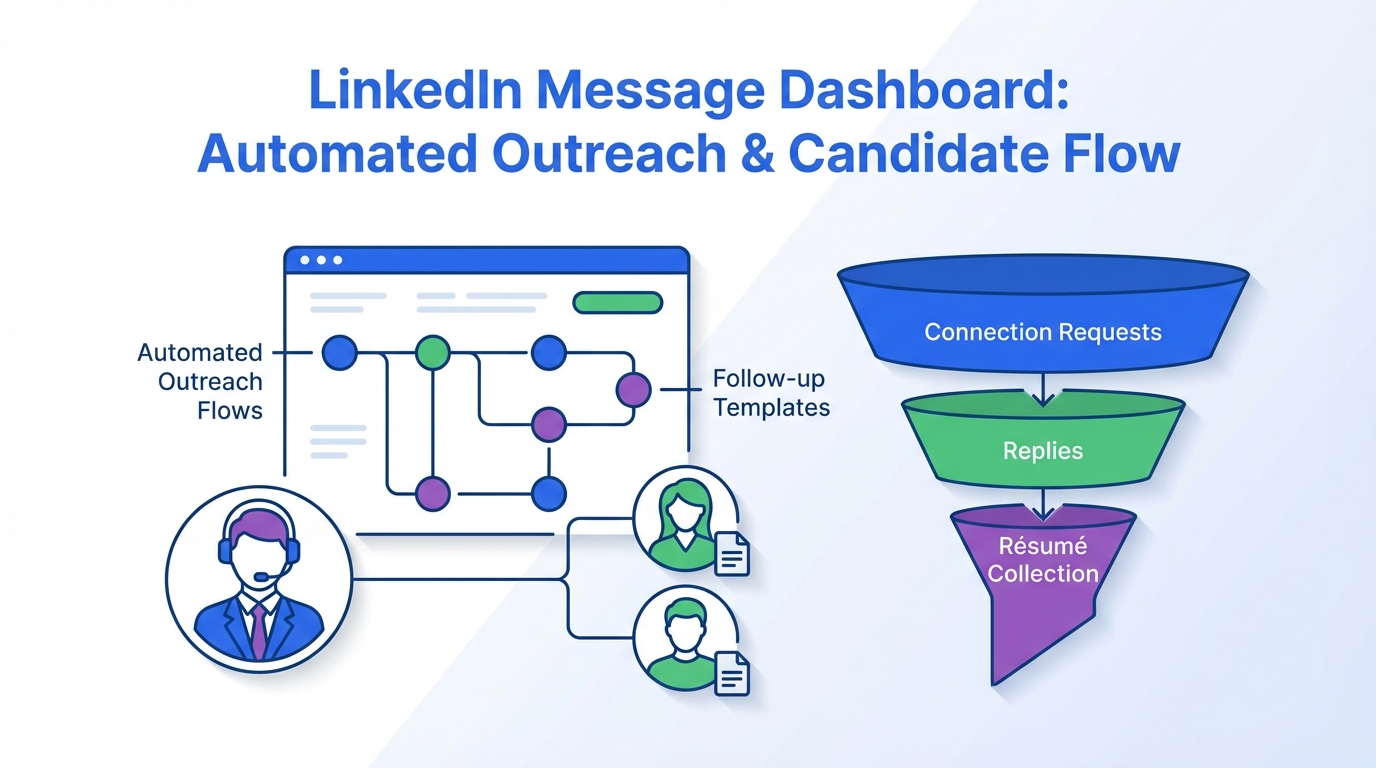
If your goal is adoption, remove the most repetitive work first. StrategyBrain AI Recruiter is built for LinkedIn hiring workflows and automates the initial outreach and early qualification conversation. It can automatically connect with candidates that match your search criteria, introduce the opportunity, learn the candidate’s situation, answer questions about the role, company, and compensation, confirm interview interest, and collect résumés and contact information from interested candidates.
This is especially useful in recruitment online for recruiters because it keeps the pipeline moving even when recruiters are in meetings, in different time zones, or managing multiple roles. Recruiters still make the final call by reviewing the résumé and deciding who advances.
Steps
- Provide role context: share company details, compensation, benefits, and candidate search criteria.
- Connect and introduce: the system sends connection requests and starts the conversation.
- Handle Q and A: candidates ask questions, the system responds and keeps the thread moving.
- Collect documents and contacts: when a candidate is interested, it requests a résumé and captures contact details.
- Recruiter reviews and interviews: recruiters review the collected information and schedule interviews.
Features
- 24/7 multilingual communication: supports candidate messaging in the candidate’s native language to reduce misunderstandings.
- Operational scale: supports managing more than 100 LinkedIn accounts for an AI powered recruiting team model.
- Clear boundary of responsibility: confirms willingness to proceed but does not decide résumé fit.
Limitations
- Not a final screening tool: recruiters must still evaluate skills and fit from the résumé and interviews.
- Requires accurate inputs: unclear compensation or role details lead to weaker conversations.
Best For
- Teams that need consistent follow up without adding headcount.
- Global and remote hiring where time zones slow manual messaging.
- Agency recruiters and in house teams that want higher outreach volume with stable quality.
Method 4: Coaching loops and quality control
Adoption improves when recruiters feel supported, not monitored. A coaching loop is a short, repeatable review that focuses on learning and quality.
Steps
- Review 10 conversations weekly: pick a small sample and look for patterns.
- Tag common objections: compensation, remote policy, tech stack, visa, timeline.
- Update templates and role briefs: fix the root cause, not the symptom.
- Share one win: highlight a message thread that led to a strong candidate.
Features
- Continuous improvement: messaging gets better every week.
- Shared standards: new recruiters ramp faster.
- Candidate experience: fewer confusing or inconsistent replies.
Limitations
- Needs leader time: without a manager’s attention, the loop fades.
- Can become subjective: use the definition of done to stay objective.
Best For
- Teams that want quality improvements, not only volume.
- Organizations building a repeatable recruiting playbook.
Method 5: Scale with multi account recruiting teams
Once sourcing is stable for one role, scaling is mostly operational. The question becomes how to increase throughput without burning out recruiters. One approach is to build an AI supported team model where multiple LinkedIn accounts are managed as a coordinated system. StrategyBrain AI Recruiter supports managing more than 100 LinkedIn accounts, which enables a scalable outreach engine while recruiters focus on interviews and closing.
Steps
- Standardize role briefs: every account uses the same approved role information.
- Segment candidate pools: avoid duplicate outreach and keep reporting clean.
- Centralize review: one recruiter or lead reviews interested candidates and routes them to interviewers.
- Measure weekly: track connections, replies, interested candidates, and résumés received.
Limitations
- Requires governance: scaling without rules creates inconsistent candidate experience.
- Still needs human hiring decisions: automation increases volume, not judgment.
Best For
- High volume hiring teams.
- Recruiting agencies supporting multiple clients.
- Companies expanding internationally.
Quick Comparison
| Method | Speed to implement | Cost profile | Best For |
|---|---|---|---|
| Leader led sourcing cadence | 2 business days | Internal time | Teams with inconsistent sourcing habits |
| Workflow templates | 3 business days | Internal time | Recruiters who need repeatable messaging |
| StrategyBrain AI Recruiter automation | 5 business days | Software investment | Teams needing consistent outreach, follow up, and résumé collection |
| Coaching loops | 7 business days | Leader time | Quality improvement and onboarding |
| Multi account scaling | 14 business days | Operations plus software | High volume and global hiring |
FAQ
How do I convince recruiters to start sourcing consistently?
Make it a managed change, not a one time training. Define what “done” means, protect daily sourcing time, and review outcomes weekly. Adoption improves when outreach and follow up are standardized or automated so recruiters are not stuck doing repetitive messaging.
What is the biggest bottleneck in recruitment online for recruiters?
The bottleneck is usually consistent outreach and follow up, especially on LinkedIn. When replies arrive outside working hours or across time zones, pipelines stall unless someone is always available to respond.
Can StrategyBrain AI Recruiter replace recruiters?
No. It automates the initial outreach and early conversation, confirms interest, and collects résumés and contact details. Recruiters still review résumés, assess fit, and run interviews.
Does AI Recruiter work in multiple languages?
Yes. It supports 24/7 multilingual communication and can message candidates in their native language, which helps reduce misunderstandings in global hiring.
How does AI Recruiter collect résumés and contact details?
When a candidate expresses interest, it requests a résumé and captures contact details shared in the conversation. It supports résumé submission through email or LinkedIn file upload, and it marks the résumé as received when the candidate sends it.
Is AI Recruiter compliant with privacy regulations?
According to StrategyBrain product information, it is designed to comply with privacy regulations in the EU, United States, and Canada. Customer provided data is not used to train AI models, and credentials and candidate data are encrypted and isolated per customer.
How does this help candidates who want to find a recruiter for remote jobs?
Consistency and responsiveness matter most to candidates. A structured cadence and 24/7 follow up reduce delays, clarify next steps, and improve the overall candidate experience in remote hiring.
Should I use an in house team or the best remote staffing agency?
Choose in house when you have stable hiring volume and internal expertise. Choose an agency when you need speed, niche networks, or flexible capacity. In both cases, a standardized sourcing workflow and automated follow up can improve throughput.
Conclusion
If you want recruitment online for recruiters to produce consistent pipeline, treat sourcing like any other change you manage. Start with a clear definition of done, run a leader led cadence, and reduce friction with templates and coaching. When the biggest time sink is messaging and follow up, consider embedding StrategyBrain AI Recruiter into your LinkedIn workflow so connections, introductions, candidate Q and A, and résumé collection happen reliably while recruiters focus on final qualification and interviews.
Next step: pick one role, run the 14 day rollout, and measure outcomes weekly. If your team struggles with response time or global coverage, prioritize automation and multilingual follow up early.