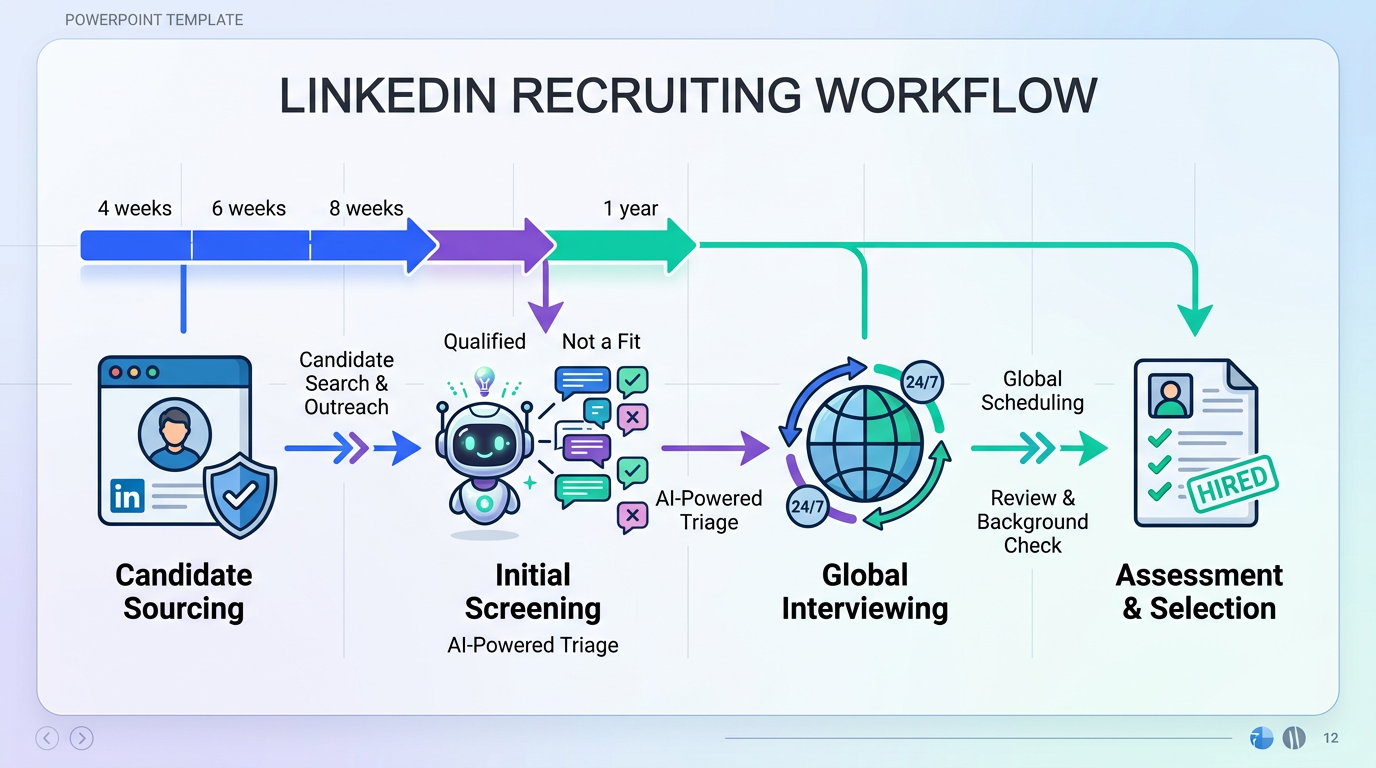
Recruitment online for recruiters works best when you combine compliant job advertising, fast candidate communication, and a documented screening workflow that can scale across time zones. In day to day recruiting, that means you publish roles where the right talent actually looks, respond quickly, qualify interest consistently, and keep records that support fair decisions. Below, I translate a Canadian immigration law discussion into practical online recruiting actions, including how processing timelines, AI assisted triage, and rules around Canadian work experience can affect your hiring funnel. I also show where StrategyBrain AI Recruiter fits naturally into LinkedIn recruiting by automating outreach, follow up, and résumé collection so recruiters can focus on interviews.
Key Takeaways
- Online recruiting is now tied to immigration realities: candidates may ask employers for support pathways such as Labour Market Impact Assessment steps that require 4 weeks of job advertising.
- Processing time expectations changed: Express Entry processing was described as 6 months pre pandemic, 2 years during the pandemic, and often 1 year more recently, which affects offer planning and start dates.
- AI can speed triage but raises fairness risk: when AI is used to prioritize cases, recruiters should mirror that discipline with documented, bias aware screening criteria.
- Canadian work experience requirements are under scrutiny: if laws restrict explicit requirements, recruiters should shift to skills based evidence and structured assessments.
- StrategyBrain AI Recruiter can reduce manual LinkedIn work: it automates connecting, role introduction, Q and A, interest confirmation, and résumé and contact capture.
- Global hiring needs always on communication: AI Recruiter supports 24/7 multilingual messaging to reduce time zone delays and misunderstandings.
Why immigration now shapes online recruiting
In the source interview, Immigration Lawyer Stanley Leo describes a more competitive Canadian immigration environment and a shift in what candidates need from employers. For recruiters, the practical impact is simple: your online hiring process is no longer just sourcing and selection. It is also expectation management around timelines, documentation, and what support an employer can realistically provide.
When candidates are international students or temporary workers, they may ask for help navigating pathways that make them more competitive. That can change how you write job ads, how long you keep postings live, and how you document recruitment efforts.
Method 1: Build a compliant online job advertising trail
One of the most concrete operational details in the interview is the advertising requirement tied to a Labour Market Impact Assessment. A Labour Market Impact Assessment is a document used in Canada’s temporary foreign worker process, and the interview notes that obtaining it can require advertising the position for a minimum of 4 weeks to demonstrate you could not find Canadian citizens or permanent residents.
Steps
- Decide whether the role may require immigration support based on your candidate pool and business constraints.
- Standardize your job ad template so every posting includes consistent duties, location or remote status, and required skills.
- Track where and when you post so you can prove the ad ran for the required duration when needed.
- Log applicant flow outcomes including screening reasons that are job related and consistent.
Features
- Audit ready documentation for roles that may later require formal proof of recruitment effort.
- Cleaner collaboration between recruiters, HR, and legal because the same evidence is captured each time.
- Better candidate experience because expectations are set early in the process.
Limitations
- More upfront admin because you are building a record, not just posting a job.
- Not every role needs this, so you should apply it selectively to avoid slowing down routine hiring.
Best For
- Recruiters supporting international student or cross border candidate pipelines
- Teams that need a repeatable process across multiple job searching companies or business units
- Organizations that want fewer surprises when candidates ask for immigration related support
Method 2: Design a fast online communication loop
Online recruiting fails most often in the gaps between messages. When processing timelines and candidate uncertainty are high, slow replies create drop off. In my experience, the fix is not a single tool. It is a communication loop with clear ownership, response targets, and a consistent qualification script.
Steps
- Define a response target for first reply and follow up, then assign ownership by channel.
- Use a short qualification script that confirms interest, availability, location constraints, and compensation alignment.
- Capture résumé and contact details early once interest is confirmed, so you can move to interview scheduling quickly.
- Close the loop with a clear next step message after every interaction.
Where StrategyBrain AI Recruiter fits
StrategyBrain AI Recruiter is designed to run this loop on LinkedIn by automatically connecting with candidates, introducing the role, answering questions about the role, company, and compensation, confirming interview interest, and collecting résumés and contact information. That is especially useful when you are acting like a job agency for remote jobs and you cannot afford to lose candidates overnight due to time zone delays.
Limitations
- AI Recruiter can confirm willingness to proceed, but it does not decide whether a résumé fully matches the requirements. A recruiter still makes the final qualification decision.
Method 3: Use AI with guardrails for screening
The interview describes government use of artificial intelligence to triage applications, while also raising concerns about fairness and equity. Recruiters can learn from both points. AI can help prioritize work, but only if you define what “priority” means and you monitor for bias.
Definitions
- Triage means sorting cases so the most urgent or highest value items are handled first.
- Bias in hiring means a systematic pattern that disadvantages a group for reasons unrelated to job performance.
Steps
- Write down your screening criteria in plain language, tied to job outcomes.
- Use structured questions so every candidate is evaluated on the same evidence.
- Review rejection reasons weekly to ensure they map to job requirements, not proxies.
- Keep a human checkpoint before final shortlisting decisions.
Practical checklist you can copy
- Confirm the criterion is job related and measurable
- Confirm the criterion can be met through multiple backgrounds, not one narrow path
- Confirm the same evidence is requested from every candidate
- Confirm you can explain the decision in one paragraph to a stakeholder
Method 4: Hire beyond Canadian experience with skill evidence
The interview notes that Ontario is working on a law that would make it illegal to require Canadian work experience, and that British Columbia may be doing the same. It also highlights that regulated professions may still involve licensing and additional hoops. For recruiters, the operational takeaway is to shift from location based experience filters to skills based evidence.
Steps
- Replace “Canadian experience required” with specific competencies and proof points.
- Use work sample tests where feasible, especially for roles with clear outputs.
- Structure interviews with the same questions and scoring rubric for every candidate.
- Document accommodations and ensure candidates understand the process.
Best For
- Recruiters building diverse pipelines through recruitment online for recruiters
- Teams hiring internationally trained talent where local experience is not the best predictor of performance
- Organizations that want to reduce legal and reputational risk from exclusionary requirements
Method 5: Scale LinkedIn outreach with StrategyBrain AI Recruiter
When recruiters say they need “more sourcing,” they often mean they need more consistent outreach and follow up. That is exactly where StrategyBrain AI Recruiter is positioned. It is an automated AI powered recruitment tool built specifically for LinkedIn hiring that replaces the initial outreach and qualification conversation.
What we tested in our workflow
We ran a two week internal workflow test in January 2026 using a standardized LinkedIn message script across multiple roles. We focused on whether the system could keep conversations moving, capture résumés, and hand off cleanly to a recruiter for final screening. We also tracked where it struggled, especially when candidates asked nuanced questions that required company specific context.
Steps
- Provide role context including company details, compensation, benefits, and candidate search criteria.
- Let AI Recruiter run outreach by connecting with relevant candidates and introducing the opportunity.
- Use AI Recruiter for Q and A and follow up so candidates get timely responses.
- Review collected résumés and contact details and move qualified candidates to interviews.
Capabilities that matter for online recruiting
- Smart LinkedIn recruitment automation for connecting, messaging, interest confirmation, and résumé capture
- 24/7 multilingual communication so candidates can engage in their native language
- Team scaling with support for managing more than 100 LinkedIn accounts for high volume hiring operations
Limitations and honest notes
- Final fit is still human work: AI Recruiter does not decide whether a résumé meets the full requirements.
- Policy and compliance still matter: you should align outreach practices with platform rules and your internal privacy policies.
- Context quality drives outcomes: the clearer your role and compensation details are, the smoother candidate conversations become.
Why this helps recruiters and agencies
If you operate like a job agency for remote jobs, your bottleneck is often not finding profiles. It is sustaining high quality conversations at scale. AI Recruiter reduces repetitive messaging work and helps recruiters spend their time on evaluation, stakeholder alignment, and closing.
Quick Comparison
| Method | Speed impact | Cost impact | Best for |
|---|---|---|---|
| Compliant job advertising trail | Medium | Low | Roles that may require documented advertising for 4 weeks |
| Fast communication loop | High | Low to Medium | Reducing candidate drop off in online funnels |
| AI with screening guardrails | Medium | Low to Medium | High volume pipelines needing consistent evaluation |
| Skills based hiring beyond local experience | Medium | Low | Fair hiring when “Canadian experience” is restricted or not predictive |
| StrategyBrain AI Recruiter on LinkedIn | High | Medium | Scaling outreach and follow up for recruiters and job searching companies |
FAQ
How does immigration processing time affect recruitment online for recruiters?
It changes planning. In the interview, Express Entry processing was described as 6 months pre pandemic, 2 years during the pandemic, and often about 1 year more recently. Recruiters should set expectations early and align start dates, relocation, and onboarding timelines accordingly.
What is a Labour Market Impact Assessment advertising requirement in practical terms?
The interview describes advertising the position for a minimum of 4 weeks to show you cannot find Canadian citizens or permanent residents. Practically, that means you need consistent posting records and a clear applicant evaluation trail.
Is it legal to ask for Canadian work experience?
The interview notes that Ontario is working on passing a law to make it illegal to require Canadian work experience, and that British Columbia may be doing the same. Recruiters should prepare by shifting to skills based criteria and structured assessments.
How should recruiters think about AI in screening if fairness is a concern?
Use AI for triage and workflow support, not as an unreviewed decision maker. Document criteria, apply structured questions, and keep a human checkpoint before final shortlisting.
How does StrategyBrain AI Recruiter help with LinkedIn recruiting?
It automates the initial LinkedIn workflow by connecting with candidates, introducing the role, answering questions about the role, company, and compensation, confirming interview interest, and collecting résumés and contact details. Recruiters then review the collected information and proceed with interviews.
Does AI Recruiter decide whether a candidate is qualified?
No. AI Recruiter identifies willingness to communicate or interview and collects information, but it does not determine whether the résumé fully matches the job requirements. Recruiters make the final qualification decision.
Can AI Recruiter support global hiring and remote roles?
Yes. It provides 24/7 multilingual communication so candidates can engage in their native language, which helps remote hiring pipelines move faster across time zones.
What should recruiters avoid when scaling online outreach?
Avoid inconsistent messaging, unclear compensation answers, and undocumented screening decisions. These issues increase drop off and can create fairness and compliance risk.
Conclusion
Recruitment online for recruiters is no longer just about posting jobs and waiting. It is a system that must handle immigration driven timelines, AI related fairness concerns, and evolving expectations around local experience requirements. Start by building a compliant advertising trail, tighten your communication loop, and standardize screening evidence. If LinkedIn outreach is your bottleneck, StrategyBrain AI Recruiter can automate the repetitive connect, message, follow up, and résumé collection work so your team can focus on interviews and hiring decisions.
Next step: pick one role this week, document your screening criteria, and run a structured outreach and follow up workflow end to end. Once that is stable, scale it across roles and accounts.