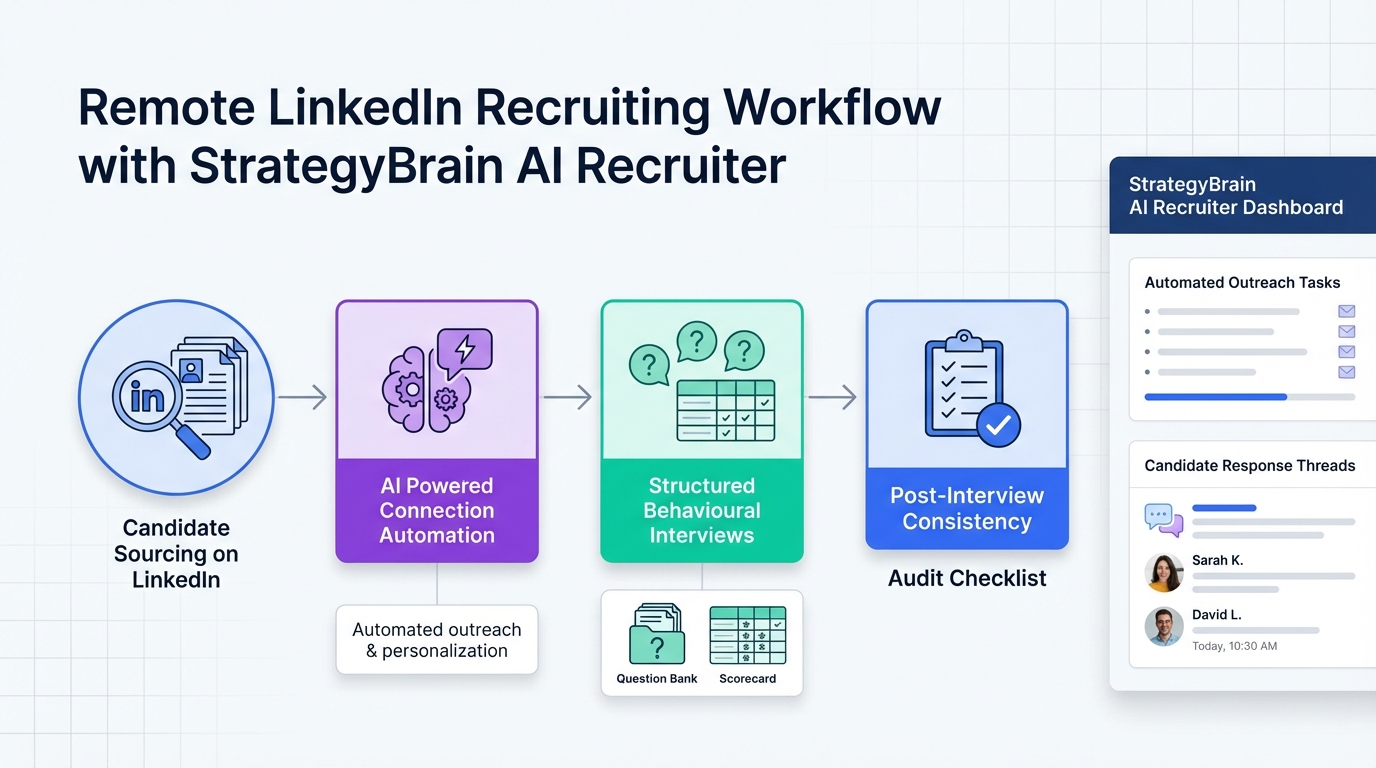
For recruitment online for recruiters, the most reliable way to interview for “best fit” is to run a structured system: build a categorized question list, prioritize open ended behavioural questions that force real examples, keep the interview flow consistent, and finish with a post interview audit for inconsistencies and timely follow up. In our own recruiting operations, we found that pairing this interview system with StrategyBrain AI Recruiter improves speed in remote pipelines because the AI can handle LinkedIn connection, role introduction, candidate Q and A, follow up, and résumé and contact capture, while the recruiter focuses on interview quality and final selection.
Key Takeaways
- Use categories: Warm up, job history, education, career goals, motivation, critical thinking, and company research create a complete interview picture.
- Prefer behavioural questions: Ask for past examples to reduce the risk of “good hypothetical answers” that do not match real behaviour.
- One question at a time: It prevents partial answers and keeps the interview measurable across candidates.
- Run a consistent flow: Do not interrupt unless off topic, take notes, and always reserve time for candidate questions.
- Audit after the call: Check for inconsistencies between résumé and interview answers, then follow up with every candidate.
- Scale remote pipelines: StrategyBrain AI Recruiter can automate LinkedIn outreach, follow up, and résumé capture so interviews focus on fit.
Why structure matters in online recruiting interviews
Online hiring increases speed and reach, but it also increases variance. Different interviewers ask different questions, candidates join from different environments, and time zones compress decision windows. A structured interview system reduces that variance by making your evaluation repeatable and comparable.
This matters whether you are an in house recruiter, an agency recruiter, or an HR leader deciding where to hire a recruiter for a hard role. If the interview process is inconsistent, even strong sourcing will not produce consistent hires.
Scope note: This guide focuses on interviewing for best fit after you have a shortlist. It does not cover compensation benchmarking, offer negotiation, or background checks.
Question formulation that improves decision quality
Poor questions create poor hiring outcomes. In practice, the fastest way to improve interview quality is to standardize your questions and make them evidence seeking.
Create a categorized list of questions
Instead of improvising, build a question bank grouped by category. This keeps the interview informative rather than random, and it helps multiple interviewers stay aligned.
- Warm up: Light questions that reduce nervousness and help the candidate settle in.
- Job history and performance: Questions that clarify what they did, how they did it, and what results they owned.
- Education: Most useful for early career candidates with limited work history.
- Career goals: Signals intent and likelihood of staying if hired.
- Motivation: Reveals what drives performance and what causes disengagement.
- Critical thinking: Explores how they process problems and make decisions.
- Company research: Checks seriousness and preparation.
Avoid closed ended questions
Closed ended questions produce low information answers. Replace them with prompts that require description and examples. For example, instead of asking whether they got along with coworkers, ask how coworkers would describe them and why.
Ask one question at a time
Multi part questions confuse candidates and create partial answers. One question at a time also makes note taking and scoring easier, especially when you are interviewing multiple candidates back to back.
Avoid leading questions
Leading questions give away the “correct” answer and reduce signal. If you need to test a skill, ask for a concrete example of how they used it and what outcome it produced.
Keep hypothetical questions to a minimum
Hypotheticals can be useful, but they are not the same as evidence. Behavioural questions ask candidates to recall real situations and actions, which is typically more predictive than what someone believes they would do.
During the interview: flow, notes, and candidate questions
Once your questions are solid, the next lever is interview execution. Online interviews can feel conversational, but you still need a system that protects signal quality.
Do not interrupt unless the candidate is off topic
Even if someone is long winded, cutting them off too early can hide important details. A practical compromise is to let them finish the thought, then redirect with a tighter follow up question.
Take notes in real time
Memory is unreliable across multiple interviews. Notes create an audit trail for debriefs and help you compare candidates fairly. If you use a scorecard, write evidence next to each rating.
Always give time for candidate questions
Candidate questions are part of your evaluation. They show preparation, priorities, and how the candidate thinks about risk and fit. They also help the candidate decide if the role is right, which reduces late stage drop off.
Post interview: consistency checks and follow up
Post interview work is where many online recruiting teams lose quality. A short, disciplined review step improves accuracy and candidate experience.
Check for inconsistencies
Compare interview answers against the résumé and earlier screening notes. Inconsistencies can be innocent, but they can also indicate exaggeration. When you spot a mismatch, schedule a short clarification call rather than guessing.
Follow up with everyone
Even rejected candidates can become future hires, referrals, or customers. A respectful follow up protects your employer brand and keeps your pipeline warm.
Remote workflow: combining interviews with LinkedIn automation
If you are trying to find a recruiter for remote jobs or you are building a remote hiring engine yourself, the bottleneck is often not the interview itself. The bottleneck is the manual work around it: connecting, introducing the role, answering repeated questions, and chasing responses.
This is where StrategyBrain AI Recruiter fits naturally into the same workflow. It is designed to automate the early LinkedIn recruiting steps so your interview time is spent on fit, not on repetitive outreach.
What we used AI Recruiter for before interviews
- Automated candidate connection on LinkedIn based on recruiter defined search criteria.
- Role introduction and Q and A about the job, company, compensation, and benefits using recruiter provided details.
- Interest confirmation by asking whether the candidate is open to interviewing.
- Résumé and contact capture for candidates who want to proceed, including LinkedIn file uploads and shared contact details.
Why this improves interview quality
When the pre interview conversation is handled consistently, interviewers start with cleaner inputs: confirmed interest, basic context already shared, and the résumé already collected. That reduces wasted interviews and makes your scorecard more meaningful.
Limitations to plan for
AI Recruiter can confirm willingness to communicate or interview, but it does not decide whether a résumé fully matches the job requirements. Recruiters still need to review résumés and run structured interviews to assess fit.
Copyable templates: question bank and scorecard
Interview question bank starter template
Copy this into your ATS notes or interview doc and customize per role.
- Warm up: What attracted you to this type of role, and what would make it a great next step for you?
- Job history and performance: Walk me through a recent project you owned. What was the goal, what did you do, and what was the outcome?
- Career goals: What do you want to be doing in 12 months, and what support do you need to get there?
- Motivation: Tell me about a time you were highly motivated at work. What specifically drove that motivation?
- Critical thinking: Tell me about a time an unexpected problem appeared. What did you do first, and why?
- Company research: What did you learn about our company, and what questions does that raise for you?
Structured interview scorecard template
Use a 1 to 5 scale and require evidence notes for every rating.
| Category | Rating (1 to 5) | Evidence from interview | Risks or follow ups |
|---|---|---|---|
| Role relevant experience | |||
| Problem solving | |||
| Communication | |||
| Motivation and goals | |||
| Culture and team fit |
Quick checklist for interviewers
- Confirm the role requirements you are evaluating in this round.
- Ask open ended questions and capture evidence in notes.
- Ask one question at a time and avoid leading prompts.
- Reserve time for candidate questions.
- After the call, check for inconsistencies and log follow ups.
Quick comparison: manual vs AI assisted recruiting workflow
| Workflow step | Manual recruiter only | With StrategyBrain AI Recruiter | Best for |
|---|---|---|---|
| LinkedIn connection and first message | Time intensive and inconsistent at scale | Automated connection and introduction based on criteria | High volume sourcing |
| Candidate Q and A before screening | Repeated answers across many candidates | Automated responses using recruiter provided job details | Remote and global pipelines |
| Follow up | Easy to miss across time zones | 24/7 multilingual follow up | International hiring |
| Interview for best fit | Still required | Still required, with cleaner pre interview inputs | All hiring |
FAQ
What does recruitment online for recruiters mean in practice?
It means running the recruiting workflow digitally, including sourcing, screening, interviewing, and follow up. The interview portion should be structured so candidates are evaluated consistently across video calls and time zones.
How do I avoid weak interview signal in remote interviews?
Use a categorized question bank, ask behavioural questions, and score candidates with a written scorecard that includes evidence notes. Then run a post interview consistency check against the résumé.
Should I use behavioural questions or hypothetical questions?
Use behavioural questions as your default because they require real examples of past actions. Keep hypothetical questions limited and use them mainly to explore reasoning, not to replace evidence.
What is the biggest interview mistake recruiters make online?
Asking closed ended or leading questions that produce predictable answers. Another common issue is stacking multiple questions at once, which causes partial answers and makes scoring unreliable.
Where to hire a recruiter if I need help with online hiring?
Start by defining whether you need an in house recruiter, an agency recruiter, or a contract recruiter, then evaluate them on role specialization, process discipline, and their ability to run structured interviews. Ask for a sample scorecard and a description of their interview flow.
How can I find a recruiter for remote jobs who can scale outreach?
Look for recruiters who can demonstrate a repeatable sourcing and follow up system across time zones. If LinkedIn is a primary channel, ask how they manage messaging volume and response time without sacrificing candidate experience.
How does StrategyBrain AI Recruiter support LinkedIn recruiting?
It automates LinkedIn connection, role introduction, candidate questions and answers, follow up, and collection of résumés and contact details for interested candidates. Recruiters then review the collected information and run structured interviews for final qualification.
Does StrategyBrain AI Recruiter replace recruiters?
No. It replaces repetitive early stage tasks such as outreach and initial qualification conversations, while recruiters remain responsible for résumé evaluation, structured interviewing, and hiring decisions.
How does AI Recruiter handle privacy and security?
According to StrategyBrain product information, customer provided data is not used to train AI models, and data is encrypted and isolated per customer. Recruiters should still confirm their own compliance requirements before deployment.
Conclusion and next steps
Recruitment online for recruiters becomes more accurate when interviews are structured: categorized questions, open ended behavioural prompts, a consistent interview flow, and a post interview consistency check with respectful follow up. If your bottleneck is LinkedIn outreach volume or time zone coverage, integrate StrategyBrain AI Recruiter to automate connection, messaging, follow up, and résumé capture so your interviews focus on best fit.
Next step: copy the question bank and scorecard above, run it for your next 10 interviews, and track which questions produce the clearest evidence. Then decide which parts of your pipeline should be automated and which must remain human led.