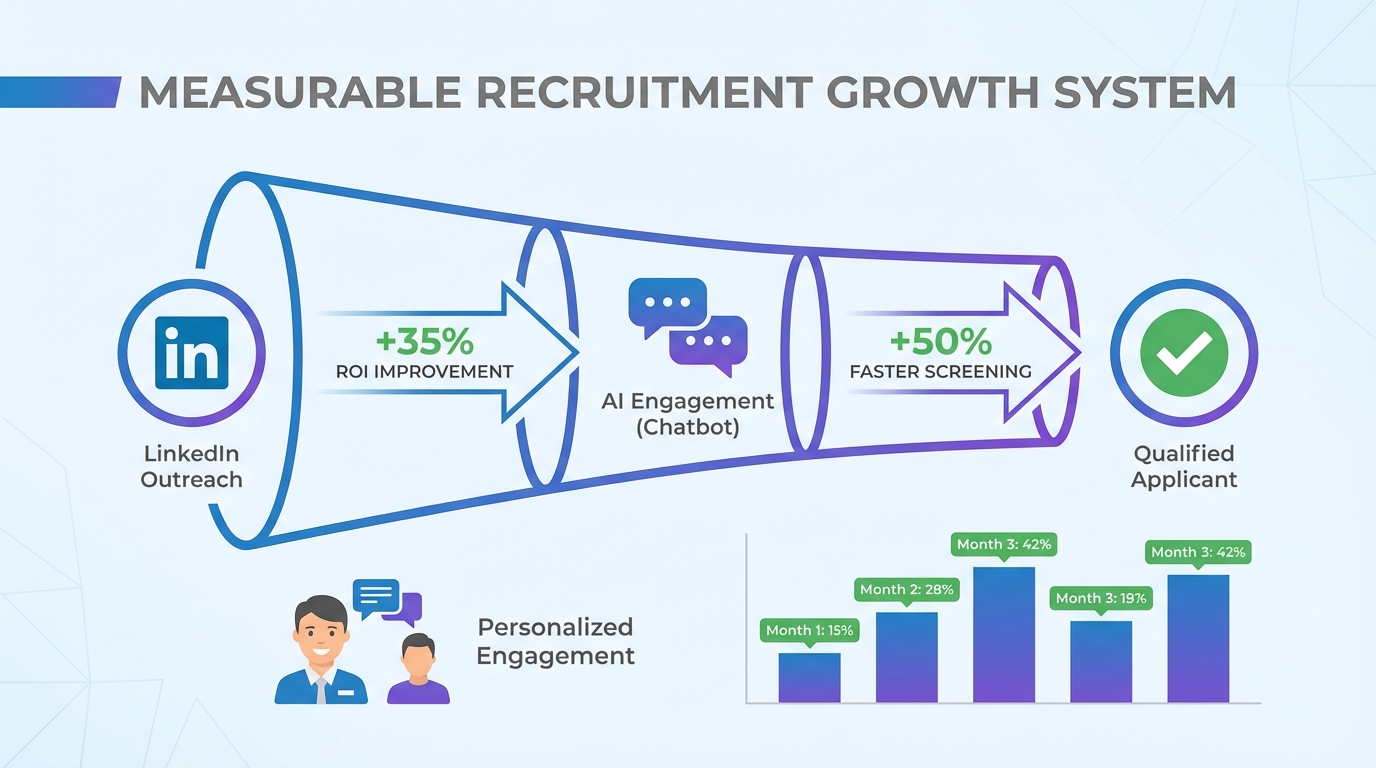
Recruitment online for recruiters works best in 2026 when you run recruitment marketing like a measurable growth system: optimize for AI search and social discovery, fix career site conversion, and track ROI from first click to qualified applicant. Jobseeker behavior is shifting quickly due to Gen AI and social platforms, but many teams still lean too heavily on job boards, lack visibility into performance, and do not measure the value their recruitment marketing spend delivers. The result is slower hiring and higher cost per qualified candidate. Below is a practical modernization plan that keeps authenticity while improving speed, including how StrategyBrain AI Recruiter can automate LinkedIn outreach and candidate conversations so recruiters can focus on final qualification and interviews.
Why recruitment marketing feels stuck
In the source discussion that inspired this article, the core question was blunt: is recruitment marketing stuck in a rut? The honest answer is yes for many teams, and it is usually not because recruiters are not working hard. It is because the system is outdated.
We repeatedly see three patterns in online recruitment operations:
- Overdependence on job boards, which can create volume without clarity on quality.
- Poor career site conversion, where interested visitors drop off before applying.
- Little visibility into ROI, meaning spend decisions are made without reliable performance feedback.
When those issues stack up, recruiters end up doing more manual outreach and more manual follow up, which slows response time and weakens candidate experience.
The modernization plan: 5 moves recruiters can execute
The plan below is designed for corporate TA teams, top rated employment agencies, and independent headhunters near me style practices that rely on speed and reputation. It focuses on measurable improvements, not trendy tactics.
- Move 1: Establish ROI measurement from click to qualified applicant.
- Move 2: Fix career site conversion friction.
- Move 3: Optimize content for AI search, classic search, and social distribution.
- Move 4: Maintain marketing momentum even with reduced budgets.
- Move 5: Scale candidate follow up with automation that still feels human.
Method 1: Measure ROI end to end
Some TA teams still are not correctly measuring the value their recruitment marketing spend delivers. If you cannot connect spend to outcomes, you cannot defend budget, and you cannot improve performance systematically.
Steps
- Define one primary outcome: qualified applicants, shortlist adds, or interviews scheduled. Pick one for the quarter.
- Standardize source tracking: use consistent UTM naming for every campaign and channel.
- Map the funnel: impression to click, click to landing view, landing view to apply start, apply start to completed application, completed application to qualified.
- Review weekly: one 30 minute review with a single dashboard beats monthly postmortems.
What to measure (copyable checklist)
- Career site conversion rate: completed applications divided by landing page sessions.
- Apply start rate: apply starts divided by landing page sessions.
- Qualified rate: qualified applicants divided by completed applications.
- Time to first response: median minutes from candidate message to first reply for key channels.
Limitations
Attribution is never perfect, especially when candidates see a role on social and apply later via direct search. The goal is directional accuracy and consistent measurement, not a flawless model.
Method 2: Improve career site conversion
Poor career site conversion is one of the most expensive hidden problems in recruitment marketing. You can buy more traffic, but if the page and application flow leak candidates, you are paying to lose them.
Steps
- Audit the first screen: ensure the role title, location, compensation range if available, and top 3 requirements are visible without scrolling.
- Reduce form friction: remove non essential fields from the initial application step.
- Clarify process: state the interview stages and expected timeline in plain language.
- Test on mobile: complete the application on a phone using cellular data.
Features to add
- Role FAQ block with 5 to 7 common questions, especially compensation, schedule, and remote policy.
- Authentic proof such as team quotes or day in the life details that sound like real employees.
- Clear next step after apply, including when candidates should expect a response.
Best For
- High volume roles where small conversion gains create large applicant increases.
- Hard to fill roles where every qualified applicant matters.
Method 4: Keep momentum with reduced budgets
Keeping marketing momentum with reduced budgets is possible when you stop treating every requisition like a new campaign. Instead, build reusable assets and a repeatable operating rhythm.
Steps
- Create a reusable content library: role templates, outreach scripts, and hiring manager interview notes.
- Prioritize channels with measurable outcomes: keep only the channels you can track to qualified outcomes.
- Run small experiments: one change per week, measured against the same baseline metrics.
Practical budget rule
If a channel cannot be tied to a funnel stage you can measure, treat it as brand spend and cap it intentionally. This keeps ROI conversations honest and prevents silent budget drift.
Method 5: Scale follow up with LinkedIn automation
In our experience, the fastest way to improve candidate experience is to reduce time to first response and keep follow up consistent. This is difficult to do manually across time zones, especially for agencies and headhunters managing multiple searches.
Steps
- Define your qualification boundary: decide what the system should confirm, such as interest, availability, and willingness to interview.
- Standardize the information candidates ask for: role scope, company context, compensation, benefits, and process.
- Automate the repetitive layer: use StrategyBrain AI Recruiter to connect with candidates, introduce the opportunity, answer questions, confirm interest, and collect resumes and contact details.
- Hand off to humans at the right moment: recruiters review collected resumes and proceed with interviews.
What we like in practice
- 24/7 multilingual communication so candidates can engage in their native language and get timely replies.
- Scalability through managing more than 100 LinkedIn accounts for organizations building AI powered recruitment teams.
- Clear division of labor where the AI handles outreach and early conversation, and recruiters handle final qualification.
Pain points and workarounds
- Pain point: if job details are incomplete, candidate questions become harder to answer consistently. Workaround: create a one page role brief with compensation, benefits, and process before launching outreach.
- Pain point: automation can feel generic if messaging is not grounded in real team context. Workaround: include authentic hiring manager notes and realistic day to day expectations in the role brief.
Quick Comparison
| Approach | Speed impact | Cost impact | Best for |
|---|---|---|---|
| ROI measurement baseline | Medium | Medium | TA leaders who need budget clarity and predictable outcomes |
| Career site conversion fixes | Medium | High | Teams paying for traffic but losing applicants in the funnel |
| AI search and social optimization | Medium | Medium | Recruiters competing for attention in crowded feeds |
| Reduced budget momentum system | Low to Medium | High | Teams that need consistent output without constant spend |
| StrategyBrain AI Recruiter for LinkedIn outreach and follow up | High | High | Top rated employment agencies and in house teams needing scalable candidate engagement |
FAQ
What does recruitment online for recruiters mean in 2026?
It means running recruiting as a measurable digital system across AI search, social discovery, career site conversion, and fast candidate communication. The goal is to connect spend and effort to qualified outcomes, not just clicks or applications.
Why do job boards feel less effective than before?
Job boards can still work, but many teams rely on them as the primary channel while candidate discovery shifts toward social and AI assisted search. Without ROI tracking and conversion improvements, job board spend can create volume without quality.
How do top rated employment agencies keep response times fast?
They standardize role briefs, use repeatable outreach scripts, and maintain a strict follow up rhythm. Many also automate the repetitive first layer of messaging so recruiters can focus on interviews and client management.
Can StrategyBrain AI Recruiter replace recruiters?
No. It automates initial LinkedIn outreach and early conversation tasks such as introductions, Q and A, confirming interest, and collecting resumes and contact details. Recruiters still do final qualification and run interviews.
Does StrategyBrain AI Recruiter support multilingual candidate communication?
Yes. It provides 24/7 multilingual communication so candidates can engage in their native language, which can reduce misunderstandings and improve response rates across time zones.
How should headhunters near me style practices use automation without losing authenticity?
Use automation for speed and consistency, but ground messaging in real role context and honest expectations. Keep a clear handoff point where the recruiter steps in once interest is confirmed and a resume is received.
What is the first metric I should fix if I have no dashboard today?
Start with career site conversion rate: completed applications divided by landing page sessions. It is simple to calculate and immediately reveals whether you are paying for traffic that does not convert.
How do I keep recruitment marketing momentum with a smaller budget?
Build reusable assets, run small weekly experiments, and keep only channels you can measure to qualified outcomes. This creates compounding improvements instead of one off campaigns.
Conclusion
Recruitment online for recruiters is not stuck because the market is impossible. It is stuck when teams rely on outdated tactics, accept poor career site conversion, and operate without ROI visibility. Modernizing means measuring the funnel, optimizing for AI search and social, keeping momentum with a repeatable system, and improving response speed without sacrificing authenticity.
If you want the fastest operational lift, start by setting a simple ROI baseline and fixing career site friction. Then use StrategyBrain AI Recruiter to automate LinkedIn outreach, candidate Q and A, and follow up so your recruiters can spend more time on final qualification and interviews.