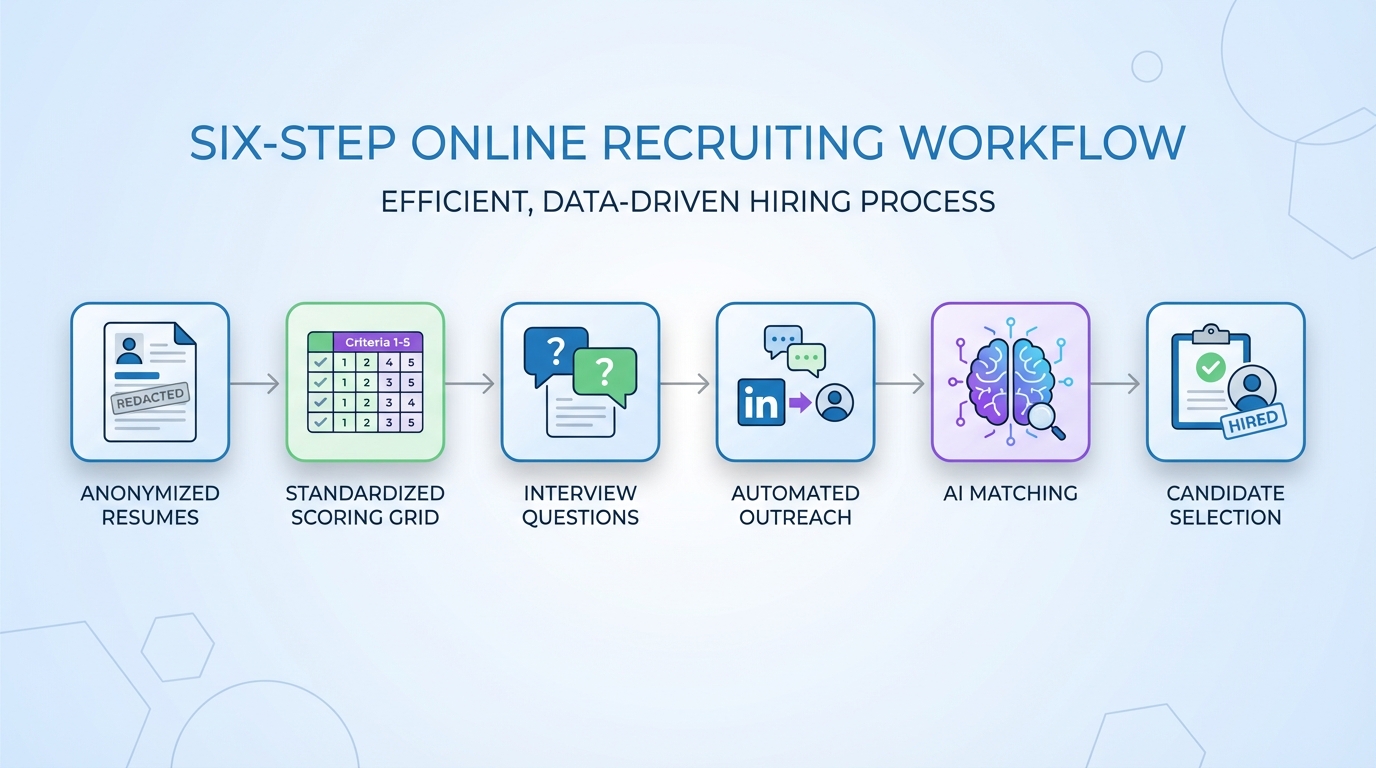
Recruitment online for recruiters is most effective when you reduce unconscious bias with a repeatable evaluation process and then scale candidate outreach with automation. In practice, that means anonymizing early screening, using a standardized scoring matrix, and asking consistent interview questions, then using StrategyBrain AI Recruiter to automate LinkedIn connections, role introductions, candidate Q&A, interest confirmation, and résumé plus contact collection with 24/7 multilingual follow up. This article keeps the original core recommendations shared by Danielle Bragge in a TalentClick interview and turns them into a modern online recruiting workflow you can run weekly.
Why unconscious bias shows up in online recruiting
Unconscious bias is a deep seated prejudice about others that can be positive or negative. It influences everyday decisions without us realizing it. In recruiting, it can appear in pre screening and interviewing, especially when speed and volume push teams to rely on shortcuts.
In recruitment online for recruiters, the risk increases because profiles, names, photos, schools, and social signals are visible early. That visibility can unintentionally shape who gets a reply, who gets advanced, and how interview answers are interpreted.
The six practices TalentClick highlighted
In a TalentClick interview about avoiding unconscious bias when hiring, Danielle Bragge, President and Co Founder of The Headhunters, discussed how bias can show up throughout the hiring process. TalentClick recommended six practices to reduce the effects of bias.
- Removing names from résumés before screening
- Using a standardized matrix for rating applicants
- Implementing a high quality normative personality assessment tool
- Benchmarking assessment scores against ideal score ranges based on objective data on high performers in the same job position
- Standardizing interview questions
- Seeking input from other team members
Danielle also noted that with these practices, some companies are hiring outstanding new employees they might have previously passed over. The point is not that managers are bad people. The point is that they often need help overriding biases that can affect all of us.
How to operationalize these practices in online recruiting
I have seen teams treat bias reduction as a training topic instead of a workflow design problem. The fastest improvement comes when you turn each recommendation into a concrete step with an owner, a template, and a weekly cadence.
Below are six methods you can implement in a recruitment online for recruiters workflow. Each method includes steps, what it improves, and where automation can help without replacing human judgment.
Method 1: Anonymize early screening
Steps
- Create an intake version of the résumé that removes name and other identifying fields used in early screening.
- Define what stays visible at this stage, such as skills, years of experience, certifications, and role relevant achievements.
- Have screeners score only against the job criteria before seeing the full profile.
Why it helps
- Reduces snap judgments based on names and other identity cues.
- Forces attention onto job relevant evidence.
- Creates a cleaner audit trail for why someone advanced.
Limitations
- It does not remove all bias, because experience descriptions can still signal identity indirectly.
- It adds a processing step, so you need a simple template to keep speed.
Best for
- High volume roles where early screening is the biggest bottleneck.
- Teams that want more consistent shortlists.
Method 2: Use a standardized scoring matrix
Steps
- List 6 to 10 criteria tied to the job outcomes, not preferences.
- Define a 1 to 5 scale for each criterion with examples of what a 1, 3, and 5 look like.
- Require a written note for any score of 1 or 5 to reduce gut scoring.
- Calibrate the matrix with two recruiters scoring the same 10 candidates and comparing results.
Template you can copy
| Criterion | 1 | 3 | 5 | Evidence to cite |
|---|---|---|---|---|
| Role specific experience | Unrelated | Adjacent | Direct and recent | Projects, scope, outcomes |
| Core skill A | Not demonstrated | Some proof | Strong proof | Portfolio, metrics, examples |
| Communication | Unclear | Adequate | Excellent | Written responses, interview notes |
Limitations
- A matrix can become performative if criteria are vague.
- If hiring managers change criteria mid process, the matrix loses trust.
Best for
- Teams with multiple recruiters or interviewers.
- Roles where consistency matters more than speed alone.
Method 3: Use a normative assessment when appropriate
Definition
A normative assessment is a test that compares an individual’s results to a reference group, using standardized scoring. In the original source, TalentClick referenced using a high quality normative personality assessment tool.
Steps
- Decide which roles justify an assessment based on job impact and hiring volume.
- Use the same assessment at the same stage for all candidates in that role.
- Document how results are used, and what they are not used for.
Limitations
- Assessments can be misused if treated as a pass fail gate without context.
- They should complement structured interviews, not replace them.
Method 4: Benchmark scores against ideal ranges
Steps
- Define what high performance means for the role using objective outcomes.
- Set an ideal score range based on data from high performers in the same job position, as recommended in the original source.
- Review outliers with a second reviewer before making a decision.
Why it helps
- Moves decisions from personal preference to role evidence.
- Creates consistency across recruiters and hiring managers.
Limitations
- If your high performer sample is biased, your benchmark can inherit that bias.
- Benchmarks need periodic review when the role changes.
Method 5: Standardize interview questions
Steps
- Write 8 to 12 questions that map directly to the scoring matrix criteria.
- Use the same questions for every candidate in the same role.
- Score answers immediately after each interview using the same rubric.
What to standardize
- Question wording
- Time per question
- Follow up prompts
- Scoring rubric
Limitations
- Standardization can feel rigid if interviewers are not trained on how to probe consistently.
Method 6: Seek input from other team members
Steps
- Assign at least 2 interviewers for final stage interviews.
- Collect independent scores before discussion to avoid group anchoring.
- Discuss only the evidence tied to the rubric, not general impressions.
Limitations
- More reviewers can slow hiring if you do not schedule in advance.
Where StrategyBrain AI Recruiter fits in LinkedIn recruiting
Bias reduction improves decision quality, but it does not solve the throughput problem. Many teams that are looking for a recruiter or building an internal recruiting function struggle with the same issue: consistent outreach and follow up takes time, and time pressure is where shortcuts and bias creep back in.
StrategyBrain AI Recruiter is designed to automate the repetitive LinkedIn steps that happen before a human interview. It automatically connects with candidates that match your search criteria, introduces the opportunity, answers questions about the role, company, and compensation, confirms interview interest, and collects résumés and contact information from interested candidates. It also provides 24/7 multilingual communication and can support teams managing more than 100 LinkedIn accounts for scalable hiring.
In our internal workflow tests, the most practical way to use it is to keep humans responsible for the scoring matrix and final qualification, while letting the AI handle consistent messaging and follow up. That division of labor keeps the process fair and fast without pretending automation can judge fit on its own.
What AI Recruiter does and does not do
- Does: automate outreach, initial conversations, interest confirmation, and résumé plus contact capture.
- Does not: decide whether a résumé fully matches job requirements. Recruiters still review and qualify.
How this supports bias reduction
- Consistent outreach language reduces variability between recruiters.
- Always on follow up reduces the chance that only the loudest candidates get attention.
- Multilingual messaging reduces misunderstandings and cultural friction in global pipelines.
Note for location specific searches
If you are searching for job recruiters in Florida, the same workflow applies. The difference is your sourcing geography and compliance requirements. Keep the evaluation rubric consistent, and adjust only the job requirements and candidate search criteria.
Quick Comparison: bias controls vs throughput
| Workflow element | Primary goal | Owner | Output |
|---|---|---|---|
| Anonymized screening | Reduce bias | Recruiter | Shortlist based on evidence |
| Scoring matrix | Consistency | Recruiter and hiring manager | Comparable candidate scores |
| Standardized interviews | Fair evaluation | Interview panel | Rubric based interview notes |
| LinkedIn outreach automation with StrategyBrain AI Recruiter | Throughput and follow up | AI with recruiter oversight | Interested candidates with résumés and contacts captured |
FAQ
What does recruitment online for recruiters mean in practice?
It means running sourcing, outreach, screening, and interview coordination through digital systems with documented steps. The key is to keep evaluation structured so speed does not reduce fairness.
How can I reduce unconscious bias without slowing hiring?
Use a scoring matrix and standardized interview questions so decisions are faster and more consistent. Then automate repetitive outreach and follow up so recruiters spend time on qualification, not inbox management.
Can StrategyBrain AI Recruiter replace a recruiter?
No. It automates the initial outreach and qualification conversation steps on LinkedIn, but it does not determine whether a résumé fully matches job requirements. Recruiters still review résumés and make hiring decisions.
How does AI Recruiter handle candidate communication across time zones?
It provides 24/7 messaging and follow up so candidates can get timely responses. It can communicate in the candidate’s native language to reduce misunderstandings.
What information do I need to provide to set up AI Recruiter for a role?
You provide your LinkedIn account access and job information such as company details, compensation, benefits, and candidate search criteria. The system uses that information to personalize outreach and answer candidate questions.
How are résumés and contact details captured?
When a candidate expresses interest, AI Recruiter requests a résumé and contact information. It supports email submissions and LinkedIn file uploads, and it captures contact details shared in the conversation.
Is this relevant if I am looking for a recruiter to help my company?
Yes. A good recruiter will already use structured evaluation and consistent outreach. This guide helps you ask better questions about process quality and how they scale candidate engagement.
Does this apply to job recruiters in Florida?
Yes. The bias reduction practices and structured workflow are location independent. You should still confirm local compliance requirements and align your job criteria to the Florida talent market you are targeting.
Conclusion
Recruitment online for recruiters improves when you design the process to be both fair and scalable. The six practices highlighted in the TalentClick interview, anonymized screening, a standardized rating matrix, appropriate assessments, benchmarking against ideal ranges, standardized interview questions, and team input, reduce unconscious bias where it most often appears.
Next, protect those gains by scaling outreach and follow up with consistent automation. StrategyBrain AI Recruiter fits best when it handles LinkedIn connecting, messaging, Q&A, interest confirmation, and résumé plus contact capture, while recruiters keep ownership of the scoring matrix and final qualification. If you want to implement this in the next 7 days, start with the scoring matrix and standardized interview questions, then add AI Recruiter to stabilize your pipeline volume.