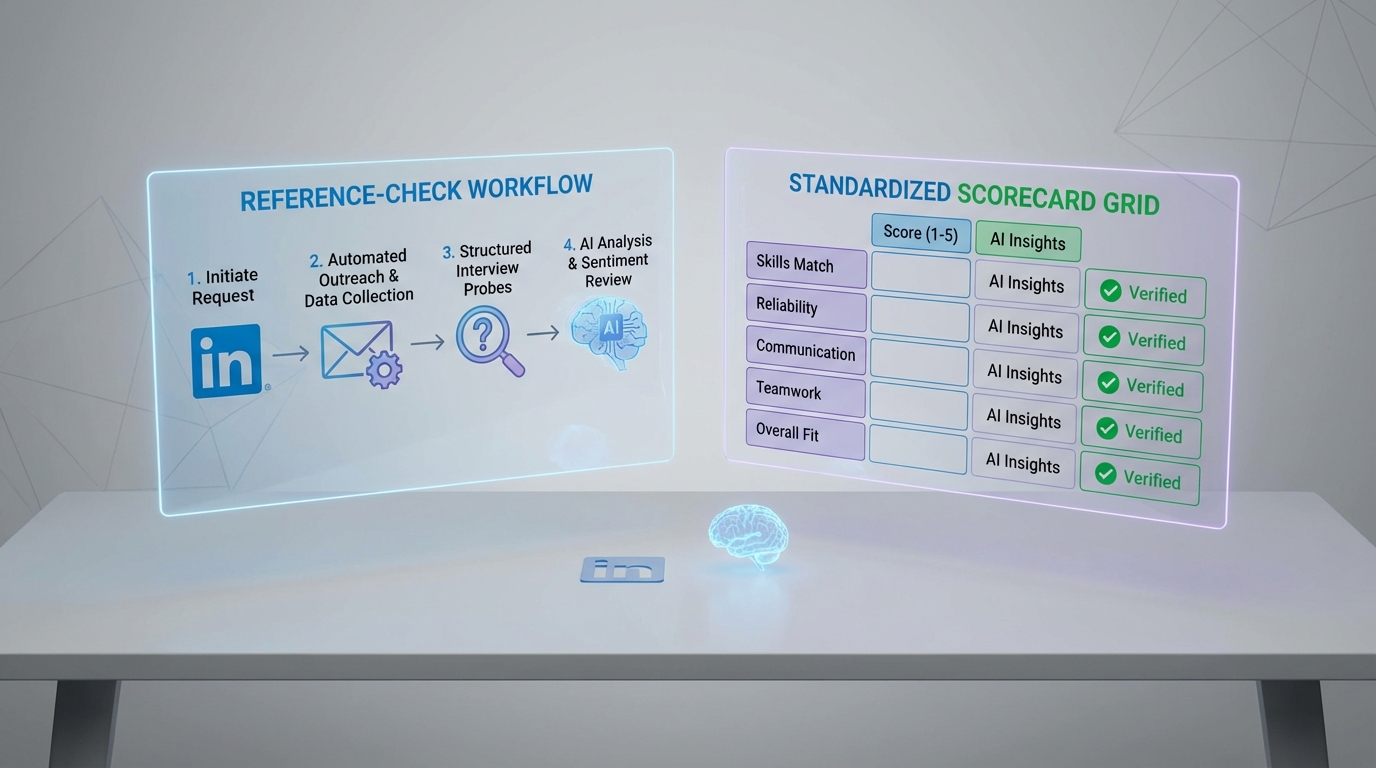
Recruitment online for recruiters still depends on one offline truth: reference checks are worthwhile when you run them with the right references, probing questions, and a consistent process. A CareerBuilder study found that 69% of employers changed their minds after speaking with a reference, and 29% reported catching fake references on applications. The practical takeaway for job agencies and in-house teams is simple: treat references as a structured verification step, not a courtesy call. In this guide, we show a repeatable reference-check workflow, a call script you can copy, and a scorecard you can standardize across your team. We also explain how StrategyBrain AI Recruiter can reduce the time you spend on repetitive outreach and follow-up in LinkedIn hiring so you can focus on higher judgment steps like reference evaluation and final selection.
Table of Contents
- Why reference checks still matter in online recruiting
- Before you call: confirm you have the right references
- Method 1: The structured reference-check workflow (recommended)
- Method 2: The probing-questions technique to get beyond surface answers
- Method 3: The confidentiality and compliance script
- Method 4: The reference-check scorecard for consistent decisions
- Method 5: Scaling the process with StrategyBrain AI Recruiter
- Quick Comparison
- FAQ
- Conclusion
Key Takeaways
- Reference checks are decision-changing: 69% of employers changed their minds after a reference conversation (Source: CareerBuilder press release, 2012-11-28).
- Fake references are common enough to plan for: 29% of employers reported catching fake references (Source: CareerBuilder press release, 2012-11-28).
- Start by validating the reference relationship: ask whether the reference conducted the candidate’s last performance review.
- Use probing questions: request specific examples and allow silence to encourage detail.
- Plan for time: a minimum of 2 to 3 reference checks per candidate can take up to 7 days when scheduling is slow.
- Scale the admin work: StrategyBrain AI Recruiter can automate repetitive LinkedIn outreach and follow-up so recruiters can reserve time for high-signal checks.
Why reference checks still matter in online recruiting
When teams talk about recruitment online for recruiters, the conversation often centers on sourcing, messaging, and speed. However, reference checks are one of the few steps that can reveal performance patterns you will not see in a résumé or a polished interview. In our experience supporting recruiter workflows, the value is not in hearing “they were great.” The value is in hearing concrete examples, context, and consistency across multiple references.
CareerBuilder’s survey results are a useful reminder that references can materially change outcomes. If you are hiring a recruiter, a sales leader, or any role where execution quality matters, references can help you validate how the person performs under pressure, how they collaborate, and what their manager had to coach repeatedly.
Before you call: confirm you have the right references
The biggest failure mode we see is not the call itself. It is calling the wrong people. A reference who cannot speak to day-to-day performance will default to vague compliments, which creates false confidence.
Reference validation questions to ask the candidate first
- Relationship: What was your reporting relationship with this person?
- Recency: When did you last work directly together?
- Performance review: Did this person conduct your last performance review?
- Scope: What projects or KPIs did they observe you on?
Scope boundaries for this guide
- Covered: reference checks for hiring decisions, including scripts, probing techniques, and documentation.
- Not covered: legal advice, jurisdiction-specific employment law, or background checks beyond references.
Method 1: The structured reference-check workflow (recommended)
This is the baseline process we recommend for job agencies and internal recruiting teams because it is reproducible and easy to audit later. It also works well when multiple recruiters share candidates and need consistent notes.
Steps
- Confirm identity and relationship: verify the reference’s role and how they worked with the candidate.
- Set expectations: explain the call length and what you will cover.
- Ask for examples: request specific situations, actions, and outcomes.
- Probe for coaching themes: ask what the candidate needed to improve and whether it changed.
- Close with a rehire question: ask whether they would rehire the candidate and under what conditions.
- Document immediately: capture quotes and examples while they are fresh.
Features
- Repeatable: every candidate is evaluated using the same structure.
- Comparable: notes map cleanly into a scorecard for side-by-side decisions.
- Defensible: you can show how the decision was made if questioned later.
Limitations
- Scheduling friction: reaching busy managers can slow the process.
- Reference bias: some references avoid negative statements, even when warranted.
- Not a skills test: references validate patterns, not technical competence in isolation.
Best For
- Job agencies managing multiple concurrent searches.
- Teams hiring a recruiter and wanting to validate execution habits.
- Roles where performance consistency matters more than interview polish.
Method 2: The probing-questions technique to get beyond surface answers
When a reference gives short, generic answers, your best tool is a calm follow-up that asks for detail. In practice, we have found that the difference between a low-signal call and a high-signal call is whether you consistently ask for examples.
Steps
- Ask an open question: “How did they perform in the role?”
- Probe for specifics: “Can you tell me more about that?”
- Request an example: “Can you give me a specific example from a project?”
- Use silence: pause for 3 to 5 seconds after the answer to invite more detail.
Copyable probing question bank
- Quality: “What did they do that you would call exceptional?”
- Reliability: “When deadlines were tight, what happened?”
- Collaboration: “How did they handle conflict with peers?”
- Coaching: “What feedback did you repeat more than once?”
- Growth: “What changed after they received that feedback?”
Method 3: The confidentiality and compliance script
References share more when they believe the conversation is confidential. The source material also notes that sharing reference feedback with the candidate is not allowed. Because rules vary by jurisdiction, treat this as a process reminder rather than legal advice.
Steps
- State confidentiality: explain that notes are used for hiring decisions and are not shared with the candidate.
- Ask for permission to take notes: confirm they are comfortable with you documenting key points.
- Keep it factual: focus on observed behavior, outcomes, and context.
Copyable script
Opening: “Thanks for taking the call. This conversation is confidential and used only for our hiring decision. I will take notes so I do not misquote you. Is that okay?”
Method 4: The reference-check scorecard for consistent decisions
Online recruiting creates volume. Volume creates inconsistency unless you standardize evaluation. A simple scorecard helps you compare candidates fairly and reduces the risk that one recruiter’s notes are more persuasive than another’s.
Copyable scorecard template
| Category | What to capture | Rating (1 to 5) |
|---|---|---|
| Role fit | Evidence they performed the same core responsibilities | 1 2 3 4 5 |
| Execution quality | Examples of outcomes, quality standards, and follow-through | 1 2 3 4 5 |
| Collaboration | How they worked with peers and handled conflict | 1 2 3 4 5 |
| Coachability | Repeated feedback themes and whether behavior changed | 1 2 3 4 5 |
| Rehire signal | Would rehire, and under what conditions | 1 2 3 4 5 |
Limitations
- Not a substitute for interviews: use it to validate, not to discover everything.
- Requires discipline: the scorecard only works if everyone uses it consistently.
Method 5: Scaling the process with StrategyBrain AI Recruiter
Reference checks are high-signal, but they are not the only time sink in modern recruiting. The repetitive work often happens earlier: connecting with candidates, introducing roles, answering basic questions, and following up across time zones. This is where StrategyBrain AI Recruiter fits naturally into recruitment online for recruiters, especially for teams that rely on LinkedIn hiring.
How StrategyBrain AI Recruiter supports a reference-first workflow
- Automates initial LinkedIn outreach and follow-up: it connects with candidates in your target criteria, introduces the opportunity, and keeps conversations moving.
- Handles candidate Q and A: it answers questions about the role, company, compensation, and benefits based on the information you provide.
- Collects résumés and contact details: for interested candidates, it requests and captures résumés and contact information so recruiters can move to screening and references faster.
- Supports 24/7 multilingual communication: it responds around the clock in the candidate’s native language, which reduces delays and misunderstandings.
- Scales across many LinkedIn accounts: it can support teams managing more than 100 LinkedIn accounts for high-volume sourcing operations.
Steps
- Define the role packet: company details, compensation, benefits, and candidate search criteria.
- Let AI Recruiter run the first-mile conversations: connections, introductions, and basic qualification.
- Review interested candidates: focus your time on résumé review and interview planning.
- Run structured reference checks: use the workflow and scorecard from Methods 1 to 4.
Limitations
- Not a final-fit judge: AI Recruiter can identify willingness to interview, but it does not decide whether a résumé fully matches requirements.
- Still needs recruiter oversight: you should review outputs and ensure messaging aligns with your employer brand.
Quick Comparison
| Method | Speed impact | Cost | Best For |
|---|---|---|---|
| Structured reference-check workflow | Medium | Internal time | Consistent, defensible hiring decisions |
| Probing-questions technique | High | Internal time | Turning vague references into usable evidence |
| Confidentiality and compliance script | Medium | Internal time | Increasing candor and reducing process risk |
| Reference-check scorecard | High | Internal time | Standardizing decisions across recruiters |
| StrategyBrain AI Recruiter for LinkedIn hiring | High | Product subscription | Scaling outreach, follow-up, and résumé collection |
FAQ
Are reference checks worthwhile in recruitment online for recruiters?
Yes. A CareerBuilder study reported that 69% of employers changed their minds after speaking with a reference. The key is to run references as a structured verification step with specific examples, not as a formality.
How many reference checks should job agencies run per candidate?
A practical minimum is 2 to 3 reference checks per candidate, which matches the process described in the source material. If scheduling is slow, completing those calls can take up to 7 days, so plan your offer timeline accordingly.
What is the fastest way to detect a weak or fake reference?
Start by validating the relationship and scope. Ask whether the reference conducted the candidate’s last performance review and what work they directly observed. CareerBuilder reported that 29% of employers have caught fake references, so it is worth building this verification into your script.
What should I do when a reference only gives surface-level praise?
Use probing questions and request a specific example. Follow with “Can you tell me more about that?” and allow a short silence of 3 to 5 seconds. This often prompts the reference to add the detail you need to evaluate performance.
How do I keep reference checks consistent across a recruiting team?
Use a shared scorecard with the same categories for every candidate, then require recruiters to capture at least 1 concrete example per category. This reduces bias and makes debriefs faster because everyone is comparing the same dimensions.
How does StrategyBrain AI Recruiter fit into a reference-check-heavy process?
It reduces the repetitive workload earlier in the funnel by automating LinkedIn outreach, follow-up, and candidate Q and A, and by collecting résumés and contact details from interested candidates. That gives recruiters more time for high-signal steps like interviews and reference checks.
Does StrategyBrain AI Recruiter replace the recruiter’s final qualification decision?
No. It can identify willingness to communicate or interview and gather materials, but it does not determine whether the résumé fully matches job requirements. Recruiters still make the final qualification decision after review.
Can StrategyBrain AI Recruiter communicate with candidates in different languages?
Yes. It supports 24/7 multilingual communication and can respond in the candidate’s native language, which helps global hiring teams reduce delays and misunderstandings.
Conclusion
Recruitment online for recruiters works best when you combine speed with verification. Reference checks are worthwhile because they can change decisions, uncover negative feedback, and help you spot fake references when you validate relationships and ask for specific examples. Start with the structured workflow, use probing questions, and document everything in a scorecard so your team can compare candidates fairly.
Next step: standardize your reference script and scorecard for your team this week, then use StrategyBrain AI Recruiter to automate the repetitive LinkedIn outreach and follow-up that slows down your pipeline. That combination keeps recruiters focused on judgment calls, not inbox management.