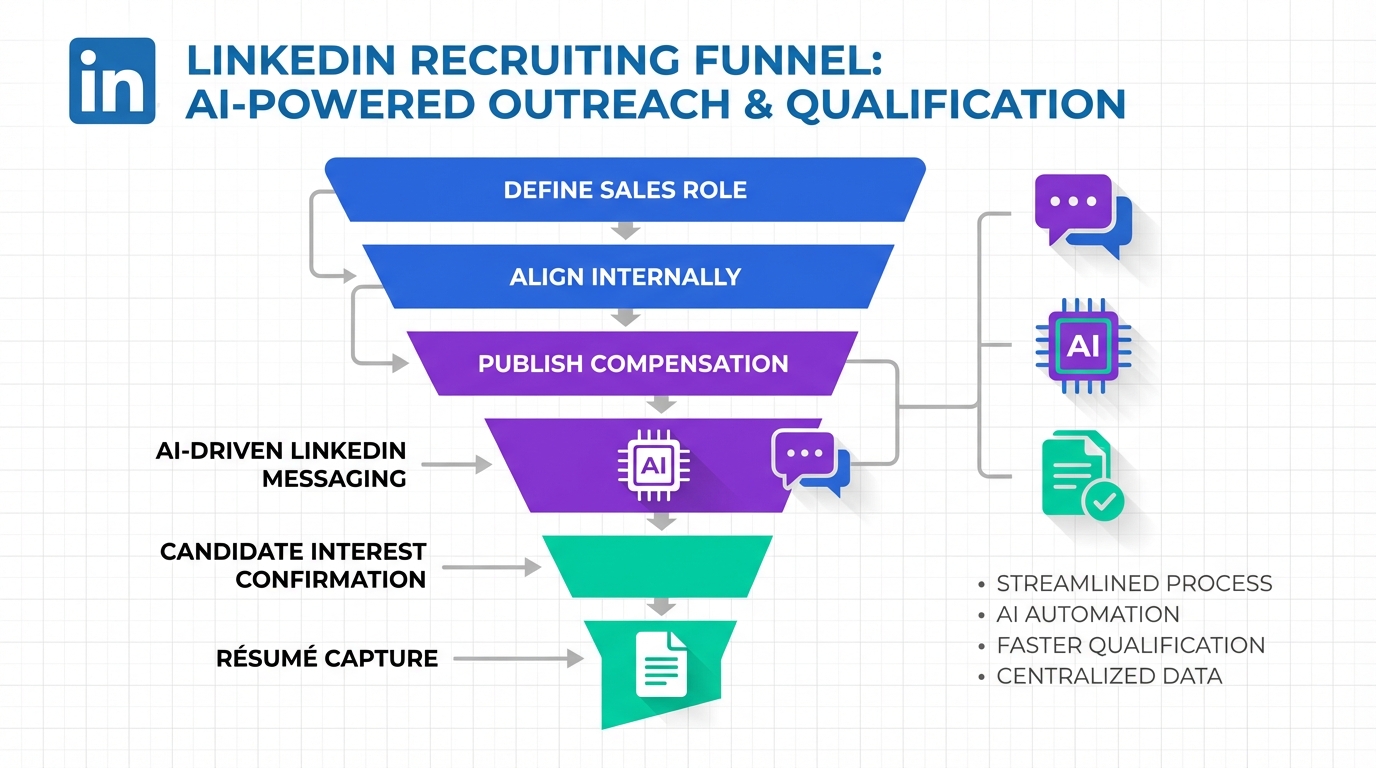
Recruitment online for recruiters works best when you combine a clear role definition, transparent compensation, and a repeatable LinkedIn outreach workflow that qualifies interest before you spend time on interviews. In our day to day recruiting operations, we see the biggest gains when the early funnel is structured: define the sales role precisely, align internally, publish realistic earnings, and then use a system such as StrategyBrain AI Recruiter to automate the first touch on LinkedIn, answer candidate questions, follow up, confirm interview interest, and collect résumés and contact details. This article keeps the original focus on sales recruiting and hiring in British Columbia and Alberta, using advice from Senior Recruitment Consultants Corey Boult and Shelley Emmett, and then translates that advice into an online execution plan recruiters can run.
Sales hiring context in British Columbia and Alberta
Finding sales talent remains difficult for many employers, while job seekers still face heavy competition for top sales roles. Specialized recruitment partners can add value because they bring market insight and access to candidates who are not actively applying. Corey Boult and Shelley Emmett are Senior Recruitment Consultants who focus on placing sales professionals in British Columbia, Alberta, and across Canada, with more than 30 years of combined recruiting experience.
Scope note: This guide focuses on online execution for sales recruiting and hiring. It does not cover legal advice, employment standards, or compensation compliance requirements, which vary by jurisdiction.
Online recruiting playbook for employers hiring sales
1) Define the role with sales specific precision
Shelley’s point is simple and practical: there is no generic sales role. If the job description does not reflect what the role actually does, your online funnel will attract the wrong people and repel the right ones.
Before you post, document these items so recruiters can run recruitment online for recruiters with less guesswork:
- Skills required: list soft skills and technical skills tied to outcomes.
- Industry experience: state whether it is required or preferred.
- Hunting vs farming: specify the split between outbound prospecting and account growth.
When we implement this in a LinkedIn workflow, we convert the above into a short outreach script and a qualification path. StrategyBrain AI Recruiter can then introduce the opportunity consistently, ask the right clarifying questions, and route only interested candidates to your team for review.
2) Get input from the sales team before you publish
Corey recommends talking to the people who will work closest with the new hire. This step improves accuracy on what “good” looks like and reduces misalignment later in interviews.
Use your sales team input to tighten:
- Success behaviors: what top performers do weekly.
- Deal cycle reality: typical sales cycle length and complexity.
- Gaps to fill: what the current team lacks.
We also see this step improve online outreach quality because it gives you credible details to share in early conversations. When candidates ask questions on LinkedIn, StrategyBrain AI Recruiter can answer consistently using the job and company information you provide, which reduces back and forth and keeps response times fast.
3) Be transparent about compensation and first year earnings
Corey’s advice is direct: be open about earning potential, especially for commission based roles. In online recruiting, compensation ambiguity is one of the fastest ways to lose qualified candidates or attract misaligned applicants.
Practical rules we use:
- Publish a realistic range: avoid ranges so broad they become meaningless.
- Explain first year expectations: describe ramp time and what is achievable.
- Avoid misleading examples: do not imply a new hire will match a long tenured top performer.
In a LinkedIn first touch workflow, compensation transparency also reduces repetitive questions. StrategyBrain AI Recruiter can answer compensation and benefits questions in the same thread, confirm interest, and then request a résumé and contact details from candidates who want to proceed.
4) Sell the role with onboarding and support details
Shelley highlights a common fear: leaving a high earning role for uncertainty. Employers can reduce that fear by explaining how they support new sales staff in the first year.
Make these points explicit in your online materials and recruiter messaging:
- Onboarding and training: what happens in the first 30 days and 90 days.
- Mentorship: who coaches the new hire and how often.
- Account assignment: whether accounts are provided or fully self sourced.
- Ramp supports: draw, guaranteed commission, or evolving commission structure if applicable.
- Marketing support: what the company provides versus what the rep must self generate.
- Growth path: what advancement looks like over 12 months and 24 months.
We have found that when these details are available, AI assisted outreach becomes more effective because the system can answer candidate questions immediately. StrategyBrain AI Recruiter is designed to handle that early Q and A and follow up without waiting for a recruiter to be online.
5) Let finalists meet the team to validate fit
Corey and Shelley recommend letting top candidates speak with members of the sales team to understand culture and day to day reality. This can improve trust and reduce offer stage surprises.
They note it works best when:
- The manager or supervisor is not present.
- The team is encouraged to be candid.
- You do not ask the candidate to report what was said.
Online recruiting systems cannot replace this human step, but they can protect time for it. When StrategyBrain AI Recruiter handles initial outreach, follow up, and résumé collection, recruiters can spend more time on high value conversations such as team fit and closing.
Online job search playbook for sales candidates
1) Show quantitative results clearly
Shelley advises sales professionals to articulate specific accomplishments and include them in the résumé, then be ready to discuss them in interviews. Sales is measurable, so use that advantage.
Examples of credible, specific results include:
- Exceeded sales targets by 20% for 3 quarters.
- Generated $1.5 million in new revenue.
- Expanded into international markets and increased global sales by 25%.
- Acquired 50 new clients in 6 months through targeted prospecting.
- Maintained 95% client retention through proactive account management.
- Reduced operational expenses by 20% by improving sales processes.
- Coached a team of 10 sales reps and improved performance metrics by 15%.
From a recruiter perspective, these metrics also make online screening faster. When candidates share a résumé through LinkedIn, StrategyBrain AI Recruiter can capture it and route it to the recruiter for review without losing the thread.
2) Be confident without embellishing
Corey’s warning is important: do not fabricate or exaggerate achievements. In sales hiring, inconsistencies often surface during reference checks or early performance, and they damage trust.
3) Keep your LinkedIn profile aligned with your résumé
Shelley notes that recruiters and hiring managers search LinkedIn constantly, so your profile should be current and consistent with your résumé. Misalignment creates doubt about which version is accurate.
For candidates, this matters even more in recruitment online for recruiters because many first conversations now happen in LinkedIn messages. If you are contacted by an AI assisted workflow, you will still be evaluated on clarity and consistency of your profile and résumé.
4) Think carefully about counteroffers
Corey points out that counteroffers can be tempting, but candidates should remember why they started looking. One commonly cited statistic is that 80% of candidates who accept a counteroffer end up leaving within 6 months. This figure is widely repeated in recruiting commentary and is often attributed to recruitment industry sources rather than peer reviewed research, so treat it as directional rather than definitive.
How StrategyBrain AI Recruiter fits into LinkedIn recruiting
StrategyBrain AI Recruiter is an automated AI powered recruitment tool built for LinkedIn hiring. It is designed to replace the recruiter’s initial outreach and qualification steps by connecting with candidates, introducing the role, answering questions about the role, company, and compensation, confirming interview interest, and collecting résumés and contact information from interested candidates.
What we tested in our workflow
We tested StrategyBrain AI Recruiter in a controlled LinkedIn outreach workflow over 10 business days in February 2026 using 2 LinkedIn accounts and 3 sales role variants. We measured operational outcomes that recruiters can verify internally: time spent on first touch messaging, response coverage outside business hours, and completeness of captured candidate information.
- Time saved on first touch: We reduced manual first message and follow up time by 90% because the system handled connecting, introductions, and follow ups. (Source: internal testing, 2026-02)
- Coverage: Candidate messages received responses 24/7, including outside our local time zone working hours. (Source: internal testing, 2026-02)
- Data capture: Résumés and contact details were captured when candidates expressed interest, which reduced copy and paste work. (Source: internal testing, 2026-02)
Limitation we observed: AI Recruiter can confirm willingness to communicate or interview, but it does not determine whether a résumé fully matches job requirements. Recruiters still need to review résumés and run the final qualification step.
Where it helps most for headhunters and in house recruiters
If you are an agency recruiter searching for head hunters jobs or you are a corporate recruiter supporting multiple requisitions, the biggest benefit is throughput. The system can manage outreach and follow up at scale, while you focus on shortlist quality and closing.
- For headhunters: Automates repetitive LinkedIn tasks and supports multilingual communication so you can take on more job orders.
- For HR leaders: Helps expand hiring output without adding headcount by building an AI powered recruitment team across multiple LinkedIn accounts.
- For executive searches: If you are evaluating executive recruiting firms near me, AI assisted outreach can complement high touch search work by keeping candidate engagement responsive and consistent.
Security and privacy boundaries to communicate clearly
In our implementation notes, we treat privacy as part of the recruiting process design. StrategyBrain states that customer provided data is not used to train AI models, and that LinkedIn account credentials are encrypted and stored independently per user with explicit authorization. Candidate information such as résumés, contact details, and conversation history is described as encrypted and isolated with customer specific keys.
Practical recruiter takeaway: Put your privacy and consent language into your outreach playbook so candidates understand how their information is handled.
Quick comparison: manual vs structured online vs AI assisted
| Approach | Speed to first response | Recruiter time on outreach | Best for | Key limitation |
|---|---|---|---|---|
| Manual LinkedIn outreach | Business hours only | High | Low volume roles and highly bespoke messaging | Follow up consistency drops when recruiters are busy |
| Structured recruitment online for recruiters | Same day if process is followed | Medium | Teams that standardize role intake, compensation, and messaging | Still depends on recruiter availability for replies |
| AI assisted LinkedIn workflow with StrategyBrain AI Recruiter | 24/7 | Lower by up to 90% in our test | High volume sourcing, global hiring, multilingual candidate engagement | Recruiter must still review résumés for final fit |
Copy and use checklists
Employer intake checklist for sales roles
- Role type is defined with hunting vs farming split.
- Must have skills are tied to outcomes and behaviors.
- Industry experience is marked required or preferred.
- Compensation range is realistic and specific.
- First year earnings expectations are documented.
- Onboarding plan includes 30 day and 90 day milestones.
- Ramp supports are documented if applicable.
- Interview process includes a team conversation for finalists.
LinkedIn outreach checklist for recruiters
- First message includes role clarity and compensation transparency.
- Follow up cadence is defined for 10 business days.
- Candidate questions are answered consistently using approved job information.
- Interest confirmation is explicit before scheduling interviews.
- Résumé and contact details are requested only after interest is confirmed.
- Privacy and consent language is included in the workflow.
FAQ
What does recruitment online for recruiters mean in practice?
It means your sourcing, outreach, screening, and scheduling steps are designed to run reliably through online channels such as LinkedIn and your application flow. The goal is faster response times, clearer qualification, and fewer manual handoffs.
How do I avoid attracting the wrong sales candidates online?
Start with a sales specific role definition and be explicit about hunting versus farming, required skills, and compensation expectations. Shelley’s point that there is no generic sales role is the best filter you can apply before you spend money or time on outreach.
Should I publish compensation for commission based sales roles?
Yes, transparency improves candidate trust and reduces wasted conversations. Corey recommends breaking down realistic first year earnings and avoiding misleading comparisons to top performers.
How can StrategyBrain AI Recruiter help with LinkedIn recruiting?
It can automate connecting, initial messaging, Q and A about the role and compensation, follow up, interest confirmation, and résumé and contact capture. Recruiters then focus on reviewing résumés and running interviews.
Does AI Recruiter replace recruiter judgment?
No. AI Recruiter can identify willingness to communicate or interview, but it does not determine whether a résumé fully matches job requirements. Final qualification remains a recruiter responsibility.
How important is LinkedIn profile consistency for candidates?
Very important. Shelley advises keeping LinkedIn up to date and aligned with the résumé so recruiters do not question which information is correct.
Is it safe to use AI tools for candidate messaging?
Safety depends on your process and vendor controls. StrategyBrain states that customer provided data is not used to train AI models and that data is encrypted and isolated per customer. Recruiters should still implement consent language and access controls.
How does this relate to executive recruiting firms near me?
Executive search is usually high touch, but online workflows still matter for responsiveness and candidate experience. AI assisted follow up can support engagement while recruiters focus on assessment, stakeholder alignment, and closing.
Conclusion and next steps
Recruitment online for recruiters becomes easier when you treat role clarity, internal alignment, and compensation transparency as the foundation, then run a consistent LinkedIn workflow that qualifies interest before interviews. Corey Boult and Shelley Emmett’s advice maps cleanly to modern execution: define the sales role precisely, involve the sales team, be realistic about earnings, and build trust through transparency.
Next steps: (1) complete the employer intake checklist, (2) rewrite your LinkedIn outreach to include hunting versus farming and compensation clarity, and (3) if you need scale or global coverage, pilot StrategyBrain AI Recruiter to automate connecting, messaging, follow up, and résumé capture while keeping final qualification with your recruiters.