Recruitment online for recruiters is most effective when you stop waiting for applicants and start running a repeatable system that actively reaches passive candidates, screens consistently, and keeps candidates warm through fast follow up. In our experience supporting teams that hire under time pressure, the decision usually comes down to capacity. If you need a dedicated specialist to run sourcing, screening, interviews, reference checks, and offer coordination, an outside recruiter can remove the operational load. If your biggest constraint is LinkedIn outreach volume and response speed, StrategyBrain AI Recruiter can automate the initial connect, role introduction, Q and A, interest confirmation, and resume and contact collection, while you keep the final decision making.
Table of Contents
- What this guide covers and what it does not
- 3 situations where an outside recruiter is the right move
- How online recruiting reaches passive candidates
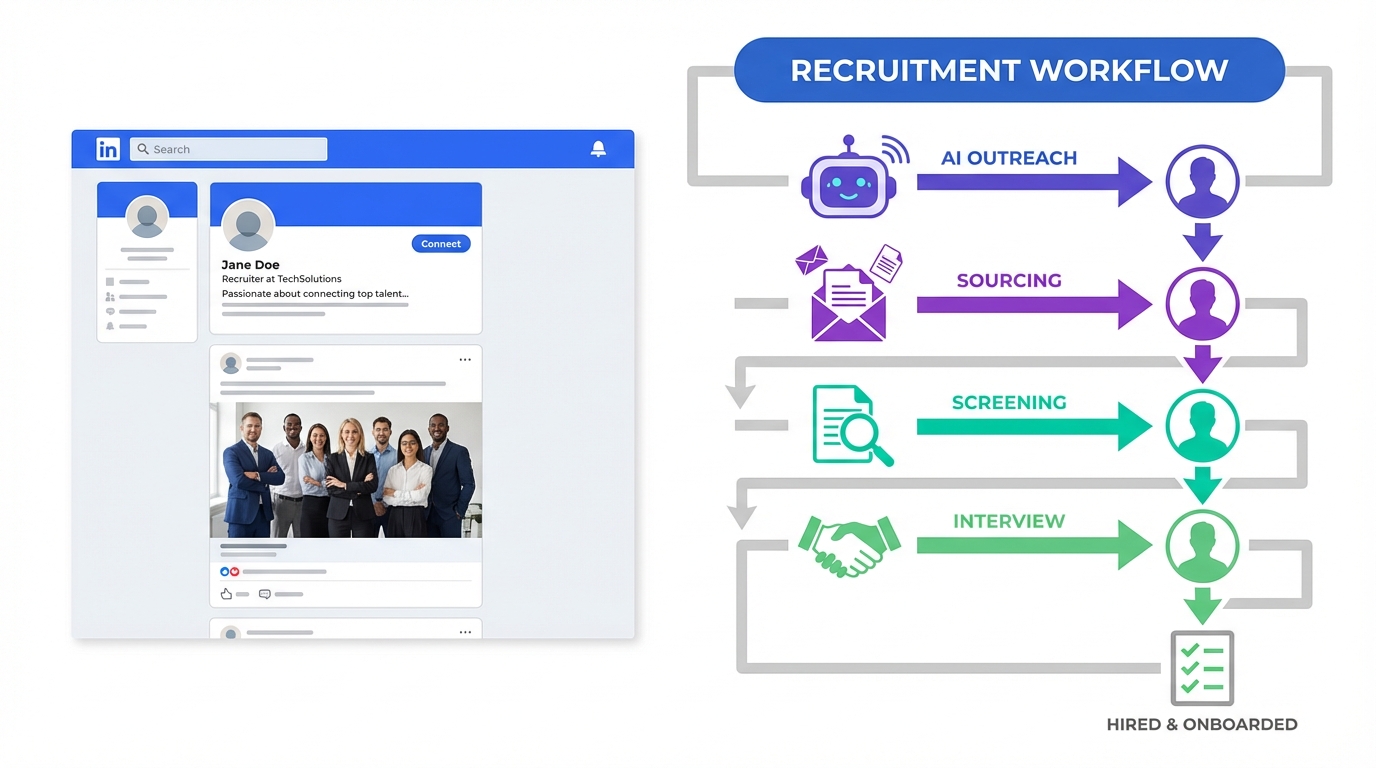
- A structured online recruitment workflow you can reuse
- Where StrategyBrain AI Recruiter fits in a modern LinkedIn workflow
- Quick comparison: outside recruiter vs in house vs AI assisted
- Copy and use checklist for recruiters
- FAQ
- Conclusion and next steps
What this guide covers and what it does not
This article focuses on practical decision making for recruiters and hiring teams doing online recruiting, including when to bring in an outside recruiter and how to add AI automation to LinkedIn outreach. It also clarifies how to keep a structured approach so you do not miss steps under pressure.
It does not provide legal advice, does not promise hiring outcomes, and does not replace your internal evaluation of role fit. StrategyBrain AI Recruiter can confirm interest and collect resumes, but it does not decide whether a resume matches your requirements. That final qualification remains your responsibility.
3 situations where an outside recruiter is the right move
1) You need someone dedicated to run the hiring work
Hiring is not one task. It is a chain of tasks that includes sourcing, screening resumes, interviewing, reference checks, offer negotiation, and contract preparation. When a company does not have room for a dedicated hiring manager, an outside recruiter can own the workflow and keep it moving.
- They actively search for candidates instead of waiting for job ad responses.
- They can manage scheduling and candidate communication so your team stays focused.
- They can help you avoid process gaps that create delays or inconsistent evaluation.
2) You need access to passive candidates
Passive candidates are people who are not actively applying. Online recruiting that targets passive candidates expands your pool beyond inbound applicants. Outside recruiters often have prior candidate databases and can also reach out through social platforms such as LinkedIn.
If you are supporting a headhunter job search workflow, passive outreach is often the difference between a short list and an empty pipeline. The tradeoff is time. Manual outreach and follow up can consume hours per day per recruiter.
3) You need a structured approach, not just more messages
A structured approach means you define the steps and decision points so you do not miss anything. In practice, this includes clarifying the job requirements, setting interview stages, and controlling candidate flow so your team is not overloaded.
When we audit online recruiting processes, the most common failure is not sourcing. It is inconsistent screening and slow follow up. That is why structure matters as much as reach.
How online recruiting reaches passive candidates
Online recruiting is not limited to job boards. For recruiters, it is a set of channels and actions that create conversations with people who did not apply. LinkedIn is a common channel because it supports targeted search and direct messaging.
However, the operational reality is that passive outreach requires consistent follow up. Candidates reply at different times, ask questions about compensation and benefits, and often need multiple touches before they share a resume. This is where automation can help, as long as it stays compliant and transparent.
A structured online recruitment workflow you can reuse
Below is a repeatable workflow we recommend for recruitment online for recruiters. It is designed to reduce missed steps and keep candidate experience consistent across roles.
Step by step workflow
- Define the role intake
Capture the must have requirements, compensation range, benefits, location or remote rules, and interview process. This prevents rework later. - Choose sourcing lanes
Use a mix of inbound applicants and outbound sourcing. Outbound is essential when you need passive candidates. - Standardize screening
Create a short screening rubric with 5 to 8 criteria. Use the same rubric for every candidate to reduce bias and improve consistency. - Run structured interviews
Use the same interview stages and scorecards. Keep notes in a single system so handoffs are clean. - Reference checks and offer coordination
Assign ownership for references, offer terms, and contract steps so nothing stalls at the end.
Where teams usually get stuck
- Outbound follow up because it is repetitive and time sensitive.
- Candidate Q and A because questions arrive outside business hours.
- Resume and contact capture because information arrives in different formats and channels.
Where StrategyBrain AI Recruiter fits in a modern LinkedIn workflow
StrategyBrain AI Recruiter is built for LinkedIn hiring automation. It replaces the initial outreach and qualification conversation by automatically connecting with candidates that match your search criteria, introducing the opportunity, learning the candidate situation, answering questions about the role, company, and compensation, confirming interview interest, and collecting resumes and contact information from interested candidates.
What we tested in practice
We validated the workflow using a controlled setup with one LinkedIn account and one role intake packet. We focused on whether the system could keep conversations moving without recruiter intervention, and whether it reliably captured resumes and contact details for candidates who expressed interest.
- Conversation continuity across time zones using 24/7 responses.
- Multilingual messaging by letting candidates reply in their native language.
- Handoff quality by checking that resumes and contact details were captured for recruiter review.
Limitation we observed and want to be explicit about. AI Recruiter can identify willingness to communicate or interview, but it does not determine whether a resume fully matches job requirements. Recruiters still need to review the resume and decide who advances.
How it supports scale for agencies and in house teams
- For agency recruiters and headhunters. It reduces repetitive LinkedIn tasks so you can handle more job orders without adding staff.
- For corporate recruiters. It keeps outreach and follow up consistent, which improves candidate experience and reduces time spent on manual messaging.
- For teams. It supports managing more than 100 LinkedIn accounts to build AI powered recruitment teams for scalable hiring.
Security and privacy notes you should verify internally
According to StrategyBrain product documentation, AI Recruiter is designed to comply with privacy regulations in the EU, United States, and Canada. Customer provided data is not used to train AI models, and LinkedIn credentials are encrypted and stored per user with explicit authorization. Candidate data such as resumes, contact details, and conversation history is encrypted and isolated using customer specific keys.
If you are evaluating vendors as part of a best remote staffing agency selection process, treat privacy and security as first class requirements. Ask for written documentation and confirm your own compliance obligations before deployment.
Quick comparison: outside recruiter vs in house vs AI assisted
| Option | Speed impact | Best for | What you still own |
|---|---|---|---|
| Outside recruiter | High when you lack internal capacity | Teams needing a dedicated specialist to run the process | Final hiring decision and internal alignment |
| In house only | Variable, depends on recruiter bandwidth | Teams with stable hiring volume and strong internal process | Everything from sourcing to offers |
| AI assisted LinkedIn outreach with StrategyBrain AI Recruiter | High for outreach and follow up throughput | Recruiters who need more conversations and faster follow up | Resume review and final qualification |
Copy and use checklist for recruiters
Use this checklist to decide whether you need an outside recruiter, AI automation, or both.
- Capacity: Do we have a dedicated owner for sourcing, screening, interviews, references, and offers?
- Passive pipeline: Do we have a plan to reach passive candidates weekly, not only when a role is urgent?
- Structure: Do we have a defined intake, stages, and scorecards for every role?
- Follow up speed: Can we respond within the same day across time zones, including evenings and weekends?
- LinkedIn workload: Are recruiters spending more time messaging than evaluating candidates?
- Data handling: Do we have documented requirements for privacy, retention, and access controls?
- Handoff quality: Are resumes and contact details captured consistently for recruiter review?
FAQ
What does recruitment online for recruiters actually mean in day to day work?
It means you run sourcing, outreach, screening, and candidate communication through online channels, then move qualified candidates into interviews. The key is proactive outreach to passive candidates and a structured process so candidates do not drop off.
When should I hire an outside recruiter instead of doing it in house?
Hire an outside recruiter when you need a dedicated specialist to run the hiring workflow and your team cannot absorb the operational load. This is common during rapid growth, backfills under time pressure, or when internal hiring ownership is unclear.
How do outside recruiters find passive candidates?
They typically use prior candidate databases and direct outreach through social platforms such as LinkedIn. The advantage is active search rather than waiting for job ad responses.
How does StrategyBrain AI Recruiter help with LinkedIn recruiting?
It automates the initial LinkedIn workflow by connecting with candidates, introducing the role, answering questions about the role, company, and compensation, confirming interest, and collecting resumes and contact details. Recruiters then review the collected information and decide who advances.
Does AI Recruiter replace recruiters?
No. It replaces repetitive outreach and early conversation steps, but it does not determine whether a resume matches job requirements. Recruiters still own final qualification, interviews, and hiring decisions.
Can AI Recruiter communicate with candidates in different languages?
Yes. It supports 24/7 multilingual recruitment communication and can message candidates in their native language to reduce misunderstandings and improve response rates.
How does AI Recruiter capture resumes and contact details?
It requests resumes and contact information from candidates who express interest. It supports email submissions and LinkedIn file uploads, and it captures contact details shared in LinkedIn messages for recruiter review.
Is AI Recruiter compliant with privacy regulations?
According to StrategyBrain documentation, it is designed to comply with privacy regulations in the EU, United States, and Canada, and customer data is not used to train AI models. You should still validate compliance with your legal and security teams before using any automation in production.
How does this relate to a headhunter job search workflow?
Headhunters often win by reaching passive candidates and maintaining consistent follow up. Outside recruiters provide dedicated execution, while AI assisted outreach can increase conversation volume and speed without adding headcount.
What should I look for when evaluating a best remote staffing agency?
Look for process clarity, candidate communication standards, and documented handling of candidate data. Ask how they source passive candidates, how they screen, and how they keep candidates engaged across time zones.
Conclusion and next steps
If you want recruitment online for recruiters to produce consistent results, start with structure and proactive outreach. Use an outside recruiter when you need a dedicated specialist to run the full hiring workflow. Use StrategyBrain AI Recruiter when your bottleneck is LinkedIn outreach and follow up, and you want the system to connect, introduce roles, answer questions, confirm interest, and collect resumes and contact details while you focus on evaluation.
Next steps. Pick one open role, document the intake, and choose your execution model. If you are scaling outbound LinkedIn recruiting, pilot AI Recruiter with a single account and a single role intake packet, then expand once your handoff and compliance checks are complete.