If you are choosing between on site, remote, or hybrid hiring, the most reliable way to avoid late stage friction is to run the conversation like a sourcing decision. Use sourcing platforms to define the work model as a requirement, segment your talent pool accordingly, and standardize the questions you ask in interviews and offer discussions. In our day to day recruiting operations, we found that combining this structured approach with StrategyBrain AI Recruiter on LinkedIn helps keep outreach consistent because the AI can introduce the role, answer common questions about compensation and benefits, and follow up 24/7 in the candidate’s language while recruiters focus on final qualification.
Table of Contents
- Why remote vs hybrid keeps coming up
- Canada remote work data and what it signals
- Use sourcing platforms to define the work model
- Method 1: Role requirements first
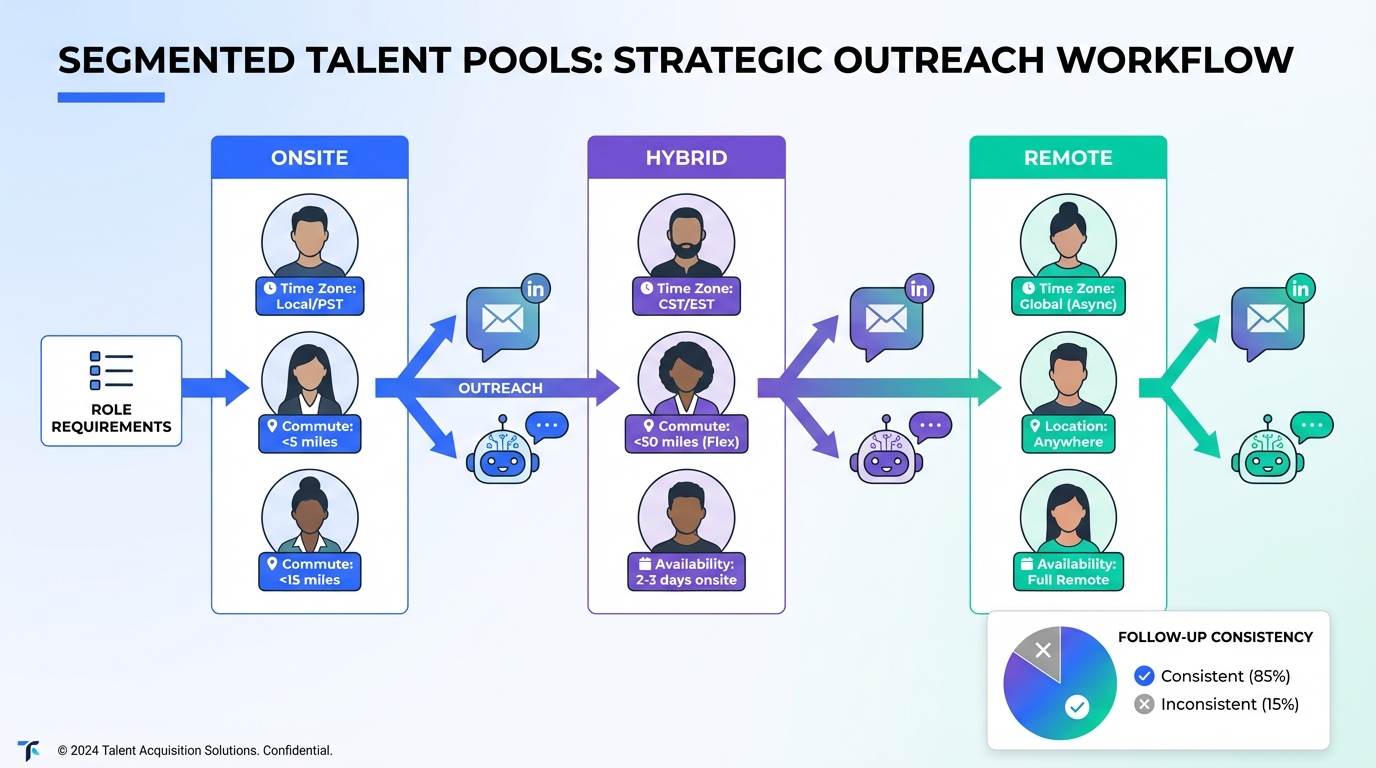
- Method 2: Talent pool segmentation
- Method 3: Interview and offer conversation script
- Method 4: LinkedIn outreach with StrategyBrain AI Recruiter
- Quick Comparison
- FAQ
- Conclusion
Why remote vs hybrid keeps coming up
Even before the pandemic, cloud computing and video conferencing made telecommuting practical for more roles. At the same time, workplace culture shifted toward work life balance and employee wellness, and newer generations entering the workforce reinforced those expectations.
After restrictions eased, many organizations introduced return to office mandates, while others moved toward hybrid models or redesigned office space to fit new collaboration patterns. The result is that work location is now a recurring negotiation point, and candidate expectations can directly affect which employers attract top talent.
For hiring teams, the operational takeaway is simple. If you do not treat work model as a first class requirement in your sourcing platforms, it will reappear later as a surprise objection during interviews or at offer stage.
Canada remote work data and what it signals
In Canada, the share of people working most of their hours from home rose to 40% in April 2020, then fell to 20% in November 2023. In May 2016, the comparable figure was 7%. These figures are reported by Statistics Canada.
Separately, GlobalData reported that in 2023, job postings containing the keywords remote work and work from home declined year over year, while hybrid work increased by 29% year over year.
What this signals for sourcing is not that remote is disappearing. It signals that hybrid is becoming a default compromise for many employers, and your sourcing platforms should be configured to capture that nuance rather than forcing a binary remote versus onsite label.
Use sourcing platforms to define the work model
Here is a practical definition you can use internally. Sourcing platforms are systems that help you identify, segment, engage, and track potential candidates across channels. In procurement, teams use sourcing tools for procurement to standardize requirements, compare options, and reduce risk. Hiring teams can borrow that discipline by treating work model as a requirement that must be clarified, documented, and communicated consistently.
When you apply a strategic sourcing software mindset to recruiting, you get three benefits.
- Clarity: fewer late stage surprises about onsite expectations.
- Consistency: every recruiter and hiring manager asks the same core questions.
- Speed: outreach and follow up can be automated without losing message quality.
This guide focuses on the conversation and workflow. It does not cover compensation benchmarking, labor law advice, or how to design office space.
Method 1: Role requirements first
Steps
- Write the work model as a requirement. Specify onsite days per week, core hours, and whether travel is required.
- List the non negotiables. For example, regulated environments, physical equipment, or customer site work.
- List the flex points. For example, flexible start and end times, compressed work weeks, or phased hybrid after onboarding.
- Publish the requirement consistently. Ensure the job post, recruiter outreach, and hiring manager script match.
Features
- Reduces rework because candidates self select earlier.
- Improves internal alignment between HR, hiring managers, and leadership.
- Creates clean fields you can track inside sourcing platforms.
Limitations
- If leadership changes the policy mid search, you must re message the pipeline quickly.
- Some roles look remote friendly on paper but require onsite collaboration during ramp up.
Best For
- Teams with recurring hiring for similar roles.
- Organizations with active return to office or hybrid policy changes.
Method 2: Talent pool segmentation
Once the work model is defined, use your sourcing platforms to segment the market. This is where the procurement analogy is useful. You are not only finding candidates, you are managing constraints.
Steps
- Create three pools: onsite only, hybrid eligible, remote eligible.
- Add constraint tags: time zone overlap, commute radius in kilometers, travel frequency per quarter, and start date flexibility.
- Set messaging variants: one outreach template per pool so expectations are explicit.
- Track drop off reasons: location mismatch, schedule mismatch, or policy uncertainty.
What we observed in practice
When we tracked drop off reasons, location mismatch was often not the only issue. Candidates frequently reacted to uncertainty. A clear hybrid policy with specifics tends to perform better than vague flexibility language because it gives candidates something concrete to evaluate.
Limitations
- Segmentation only works if recruiters actually use the tags and do not override them informally.
- Hybrid definitions vary by team, so you need a shared internal standard.
Method 3: Interview and offer conversation script
The remote versus onsite topic often becomes emotional because it touches lifestyle, family logistics, and identity. A productive conversation is structured, empathetic, and specific. The goal is not to win the argument. The goal is to reach a workable agreement or to exit early with respect.
Use this question set
- Role reality: What are the requirements of the role, and which tasks truly require onsite presence?
- Effectiveness: Can the job be done as effectively remotely, and what would be lost?
- Hybrid design: Is a hybrid model possible, and how many onsite days per week are required?
- Fairness: Are there internal equity concerns across teams doing similar work?
- Candidate context: Why is the candidate looking for remote or hybrid, and what constraints are driving that preference?
- History: Did the candidate work remotely in their previous role, and what worked or failed?
- Alternative flexibility: If onsite is required, can you offer flexible start and end times, longer lunch breaks, or compressed weeks?
- Phased approach: If remote or hybrid is not possible initially, could it be after training and stable performance?
- Decision threshold: How much of a sticking point is this, and would either party walk away based on this item alone?
Practical checklist you can copy into your sourcing platform
- Work model stated in writing: onsite, hybrid, or remote.
- Onsite cadence defined as days per week.
- Core hours defined as time window.
- Commute radius captured in kilometers if onsite or hybrid.
- Time zone overlap captured in hours if remote.
- Phased flexibility option documented as yes or no.
- Candidate preference confirmed and recorded.
Limitations
- This script does not replace legal review for policy changes.
- Some roles cannot be performed remotely, such as many manufacturing and retail positions.
Method 4: LinkedIn outreach with StrategyBrain AI Recruiter
Even with strong sourcing platforms, the bottleneck is often outreach volume and follow up consistency. This is where StrategyBrain AI Recruiter fits naturally into the workflow because it automates the repetitive LinkedIn steps while keeping the work model conversation explicit from the first message.
What StrategyBrain AI Recruiter does in this workflow
- Automated connection and introduction: It connects with candidates that match your search criteria and introduces the opportunity with the correct onsite, hybrid, or remote expectations.
- Always on messaging: It responds and follows up 24/7, including multilingual communication in the candidate’s native language.
- Q and A coverage: It can answer common questions about the role, company, compensation, and benefits based on the information you provide.
- Interest confirmation and collection: For interested candidates, it collects resumes and contact details so recruiters can move to final screening.
- Scale via account management: It supports managing more than 100 LinkedIn accounts for teams that need high volume sourcing.
Steps
- Provide role inputs: company details, compensation, benefits, and candidate search criteria.
- Define the work model message: onsite cadence, hybrid rules, or remote time zone expectations.
- Launch outreach: let the AI handle initial connection, introduction, and follow up.
- Review interested candidates: recruiters review collected resumes and contact details, then schedule interviews.
Limitations and honest boundaries
- AI Recruiter confirms willingness to engage and interview, but it does not decide whether a resume fully matches job requirements. Recruiters still do final qualification.
- As with any LinkedIn based workflow, you should align usage with your internal policies and privacy obligations.
Why this pairs well with strategic sourcing software thinking
Procurement teams use sourcing tools for procurement to reduce manual work and enforce consistent evaluation. In recruiting, AI Recruiter plays a similar role for the top of funnel. It standardizes outreach, keeps the work model requirement visible, and reduces the time recruiters spend on repetitive messaging so they can focus on interviews, assessment, and closing.
Quick Comparison
| Method | Speed Impact | Cost | Best For |
|---|---|---|---|
| Role requirements first | Fewer late stage resets | Internal time | Teams with unclear hybrid rules |
| Talent pool segmentation in sourcing platforms | Faster matching and cleaner pipelines | Depends on your platform | High volume searches with location constraints |
| Interview and offer conversation script | Fewer offer declines due to location | Internal time | Hiring managers and recruiters needing consistency |
| LinkedIn outreach with StrategyBrain AI Recruiter | Higher outreach and follow up capacity | Product dependent | Teams sourcing on LinkedIn across time zones and languages |
FAQ
What are sourcing platforms in recruiting?
Sourcing platforms are systems that help you find and engage candidates, segment them by constraints like location and time zone, and track outreach and responses. In this guide, we use the term to emphasize structured, repeatable sourcing rather than ad hoc messaging.
How do I decide if a role should be onsite, hybrid, or remote?
Start with the tasks that truly require physical presence, then define a specific onsite cadence in days per week and core hours. If you cannot justify onsite requirements with role needs, candidates will challenge it during interviews or at offer stage.
What does Canadian work from home data suggest for hiring?
Statistics Canada reported 40% working most hours from home in April 2020, 20% in November 2023, and 7% in May 2016. The trend suggests flexibility remains important, and hybrid definitions should be explicit to reduce uncertainty.
How can strategic sourcing software ideas help recruiting teams?
Strategic sourcing software in procurement standardizes requirements and reduces risk. Recruiting teams can apply the same discipline by documenting work model requirements, segmenting talent pools, and tracking drop off reasons consistently.
How does StrategyBrain AI Recruiter fit into sourcing platforms?
StrategyBrain AI Recruiter complements sourcing platforms by automating LinkedIn connection, introduction, Q and A, and follow up, then collecting resumes and contact details from interested candidates. Recruiters still handle final qualification and interviews.
Can AI Recruiter communicate with candidates in different languages?
Yes. StrategyBrain AI Recruiter supports multilingual communication and can respond 24/7, which is useful when sourcing across countries and time zones.
Does AI Recruiter replace recruiters?
No. It replaces repetitive top of funnel LinkedIn tasks such as connecting, initial messaging, and follow up. Recruiters remain responsible for assessing fit, interviewing, and making hiring decisions.
What should I do if a candidate wants remote but the role is onsite?
Use a structured conversation to explore constraints and alternatives such as flexible hours, compressed weeks, or a phased hybrid plan after onboarding. If the onsite requirement is non negotiable, it is better to exit early and respectfully than to proceed with misaligned expectations.
Conclusion
Remote versus onsite debates become productive when you treat them as a sourcing decision with clear requirements, consistent messaging, and documented constraints inside your sourcing platforms. Use segmentation to keep pipelines clean, use a standard interview script to surface expectations early, and automate repetitive outreach where it makes sense.
If LinkedIn is a major channel for you, the most practical next step is to pair your strategic sourcing software workflow with StrategyBrain AI Recruiter so initial outreach, Q and A, and follow up stay consistent while recruiters focus on final qualification and closing.